 No Ground
A star can die only once. The light from that death does not have to arrive only once.
On September 19, 2026, the Hubble Space Telescope finished its 200,000th loop around Earth. The picture from that day is not a souvenir. It is a watch. In the constellation Eridanus, a pile of galaxies called MACS J0417 is bending light from objects far behind it. One of those objects is a supernova — a star that exploded — named Athena. NASA and ESA say Webb found Athena in 2025, and that the same explosion is predicted to show up again between now and early March 2027.
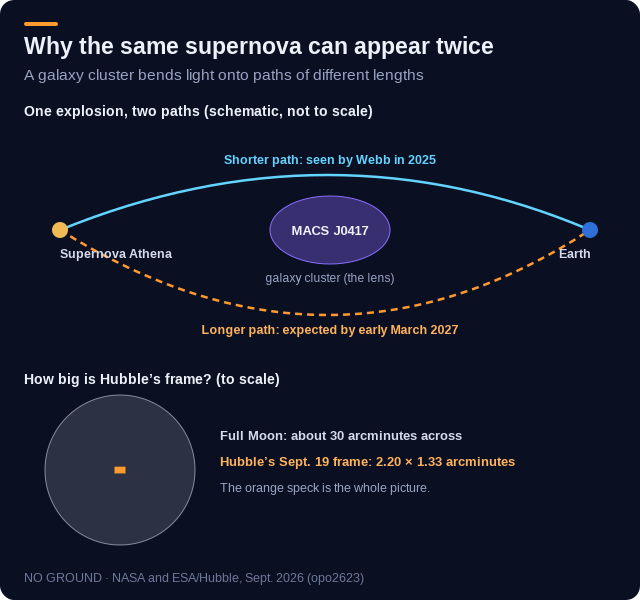
The star is not exploding a second time. One blast is taking more than one road, and the roads are not the same length.
How a galaxy cluster becomes a lens
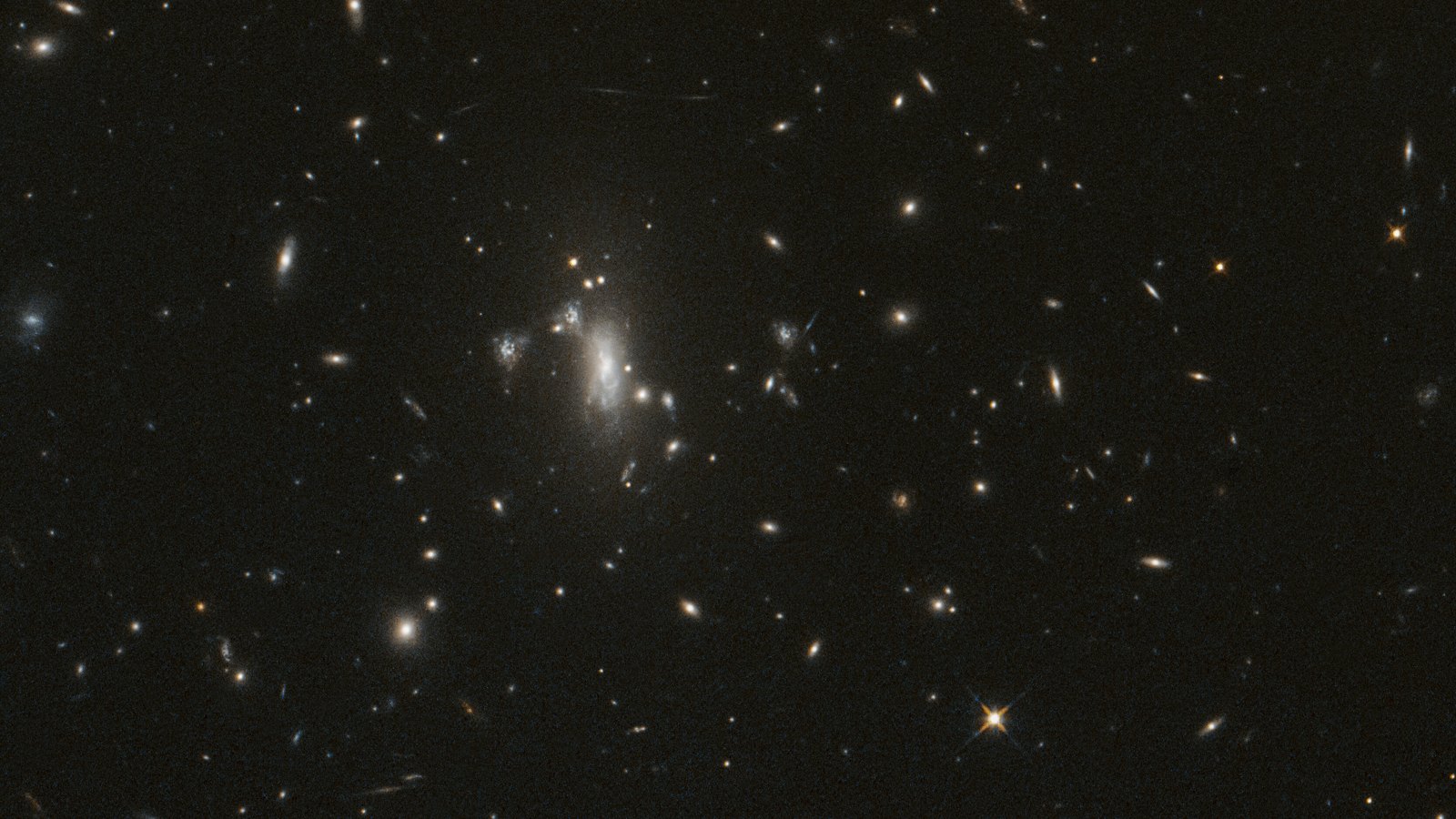
MACS J0417 sits left of center in Hubble’s frame. It is a massive galaxy cluster, which means a huge amount of matter gathered in one patch of sky. That matter bends the paths light can take, the way a heavy dip in a road bends the line a traveler has to follow. Astronomers call the effect a gravitational lens. The cluster does two jobs at once. It magnifies light from things that would otherwise be too faint, and it can split that light so the same event appears more than once, separated by months or even years, depending on which path the light took.
Think of a city with two highways around a mountain. A flare goes off on the far side. Drivers on the short road see it first. Drivers on the long road see the same flare later. Nobody set off a second flare. The mountain decided the schedule. Here the “mountain” is a galaxy cluster, and the flare is the death of a star so far away that its light is still threading different routes around MACS J0417.
Why the delay matters
That delay is the point of the watch. NASA says measuring when Athena’s images arrive can help researchers map the mass of the cluster — how much stuff is there, and how it is arranged — because the mass is what bends the roads. The same timing also feeds one of the questions Hubble was built to chase: how fast the universe is expanding. Astronomers call that rate the Hubble constant. The September releases do not publish a new number for it. They say the reappearances can refine the measurement.
See where MACS J0417 sits in your skyFar too faint for the eye, but the live map shows the spot in Eridanus.What the picture shows
The photograph itself is a real telescope observation, not an illustration. ESA’s record for image opo2623 lists two filters on Hubble’s Wide Field Camera 3: an optical filter centered at 814 nanometers, and an infrared filter centered at 1.05 micrometers. Those are specific colors of light, combined into the picture you see. Bright galaxies crowd the middle. Farther out, the field is full of smaller galaxies, including faint streaks stretched into arcs. ESA’s own description of the frame says those elongated arcs are distorted by gravitational lensing. North in this picture is 38.7 degrees left of vertical. The patch of sky is small: 2.20 by 1.33 arcminutes. The full Moon spans about half a degree, roughly 30 arcminutes, so this frame is a sliver next to the Moon’s face.
The official coordinates put the center at right ascension 4 hours 17 minutes 34.26 seconds, declination −11 degrees 54 arcminutes 42.07 arcseconds, in Eridanus, the river constellation. Hubble took the exposure on the orbit milestone day, September 19. NASA’s write-up went up on September 23. ESA posted the image page on September 30. The prediction window in both accounts is the same: Athena should reappear sometime between those announcements and early March 2027. This article does not claim the bright spiked star in the corner is Athena. The releases describe the picture as part of repeated observations meant to catch the supernova when the next image of that single explosion arrives. The cluster is the landmark. The blast is what they are waiting to see again.
200,000 orbits
The orbit number is its own kind of scale. Hubble has been working for 36 years. NASA says that in that time it has traveled more than 5 billion miles around Earth and made more than 1.7 million observations. ESA states the same mileage as more than 8 billion kilometres. Both agencies say demand has not faded. Astronomers ask for about seven times as much Hubble time as the schedule can give each year. NASA also notes what Hubble still does that its partners do not: it studies ultraviolet and visible light, which complements the James Webb Space Telescope and the Roman Space Telescope. The telescope is still observing around the clock.
Hubble will not orbit forever. NASA has asked companies how they could boost, service or safely bring the telescope down, as we reported in NASA Is Asking Companies How to Save Hubble. Lenses, meanwhile, are becoming a survey tool: ESA’s Euclid counted 15,000 of them in its first big data release, covered in Euclid Just Mapped 900 Million Galaxies.
Waiting for March
None of that turns the September 19 frame into a finished result. A gravitational-lens supernova is a slow experiment. The first sighting tells you an explosion happened and that a cluster is in the way. The later sightings tell you how the light was delayed. Until Athena shows up on another path, the map of the cluster’s mass, and whatever that map says about cosmic expansion, stays a prediction with a deadline. Early March 2027 is that deadline, as NASA and ESA stated it in late September. Hubble’s job between now and then is the unglamorous one: go back to the same speck of Eridanus and look again.
The credit line on the picture names the people who made this particular view usable: NASA, ESA, and the Space Telescope Science Institute, with M. Pascale of UCLA, and image processing by J. DePasquale at STScI. It is released under Creative Commons Attribution 4.0. What it shows is a cluster acting as a lens, on the day a 36-year-old telescope completed orbit number 200,000, while a dead star’s light was still in transit.
No Ground. Stay curious.