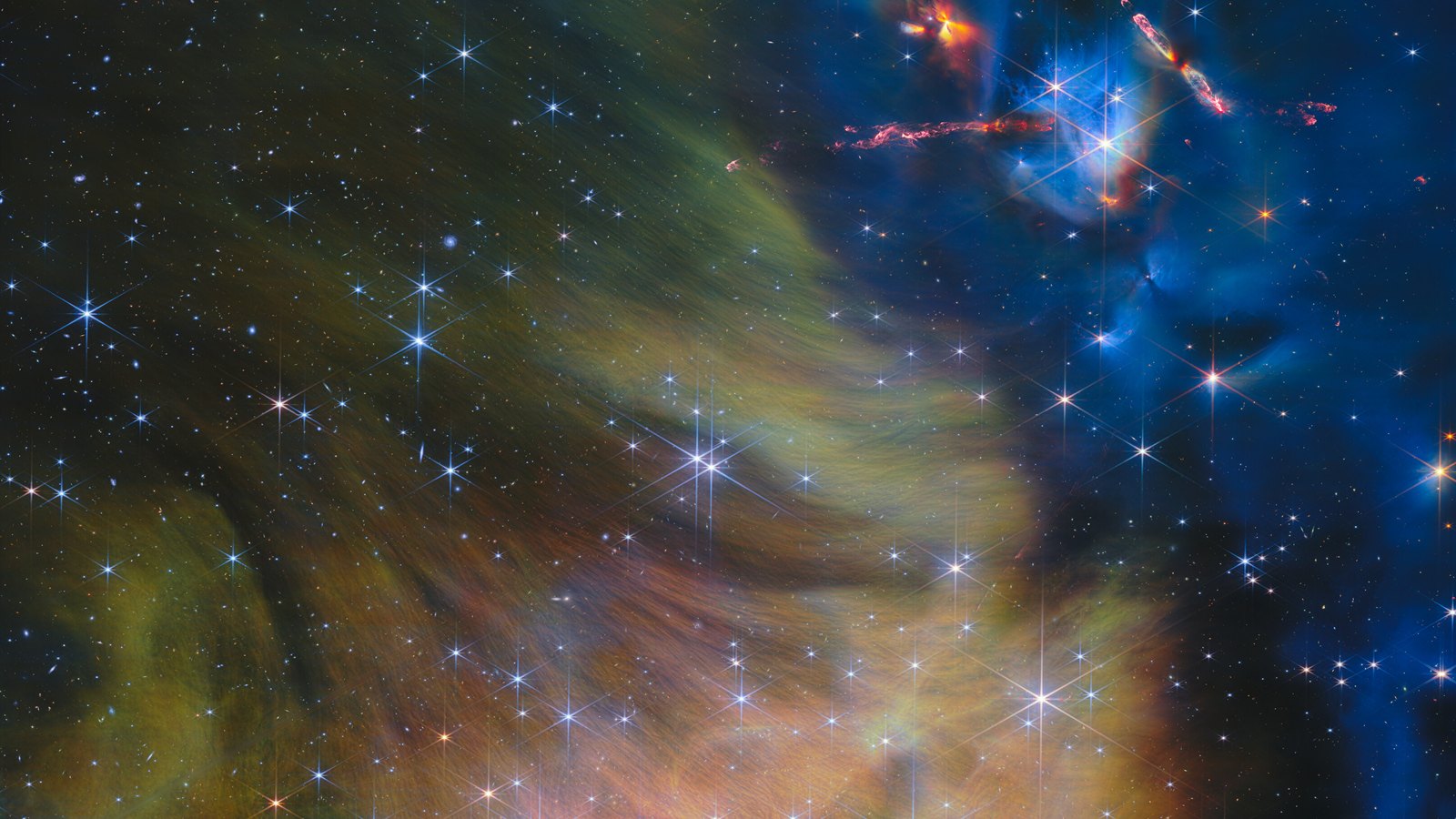
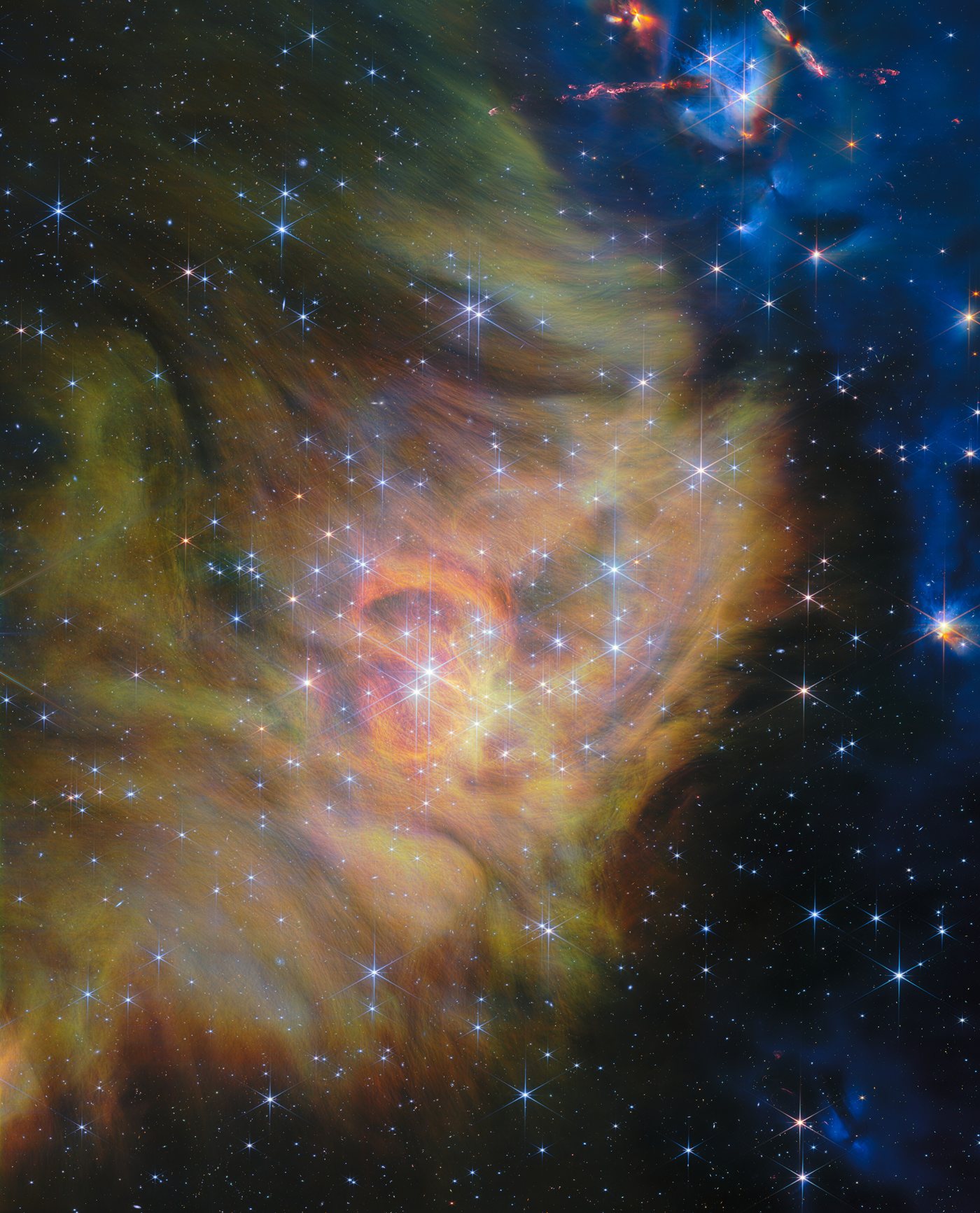
The NASA/ESA/CSA James Webb Space Telescope has released one of its largest public images: a near-infrared panorama of IC 348, a star-forming region about 1,000 light-years away in Perseus. Inside those clouds, astronomers have confirmed brown dwarfs with mass estimates of only about two Jupiters. ESA and NASA published the panorama on 15 September 2026. The measurements were already in a peer-reviewed paper.
Too small to be a star
In a region like IC 348, cold molecular hydrogen collapses under its own gravity. The results cover a huge range. The most massive stars can burn out in a few million years and end in supernovae. The smallest true stars — about 8 percent of the Sun’s mass — live far longer. Below that line is a stranger population: brown dwarfs. They form the way stars do, by cloud collapse, but their cores never get hot enough to fuse ordinary hydrogen into helium. Many briefly fuse deuterium, heavy hydrogen, early in their lives.
The open question is how far down that process goes. How small is the smallest brown dwarf?
What the spectra actually found
Kevin Luhman of Penn State and Catarina Alves de Oliveira of ESA had already used Webb on the cluster’s center in 2022 and found brown dwarfs down to about three to four Jupiter masses. A deeper survey — NIRCam images in 2024, then NIRSpec spectra in 2025, under Webb program 4866 — went further.
Their paper in The Astrophysical Journal Letters (10 June 2025) reports 39 candidates, spectra for 15, and nine new substellar members of IC 348. The faintest have mass estimates of about two Jupiter masses — roughly 0.19 percent of the Sun. ESA and NASA call them the least massive brown dwarfs known. Those figures are model estimates, not a direct weigh-in, but they constrain the bottom of the initial mass function, the spread of masses star formation produces. Both agencies say the objects challenge models of how stars form.
Two of the new members, one near two Jupiter masses and one near ten, show large excess emission from disks of gas and dust. That is raw material for planets, around free-floating objects that are themselves only planet-scale in mass. ESA’s release puts it plainly: a disk around a brown dwarf “the mass of a planet itself.”
A molecule the models missed
The spectra hold a second surprise. Eight of the nine new brown dwarfs, plus one previously known member newly observed with NIRSpec, show absorption from an unidentified aliphatic hydrocarbon — a molecule built only from hydrogen and carbon. Atmospheric models had not predicted it. Across the 11 IC 348 brown dwarfs with the detection, the feature is stronger at fainter magnitudes, which means the cooler objects. Luhman and Alves de Oliveira propose a new spectral class, “H,” defined by the 3.4-micrometer fundamental band of that hydrocarbon.
What you are looking at
The panorama combines NIRCam filters at 1.62, 1.82, 3.6, and 4.44 micrometers. The field is about 16.1 by 19.9 arcminutes. In the upper right, protostars are still buried and throwing jets. The long horizontal feature is Herbig-Haro 797: two protostars with nearly parallel outflows. Beside it, the propeller-shaped source is HH 211, with narrow jets and broader flows. Those glowing patches form where a newborn star’s jet slams into surrounding gas and dust.
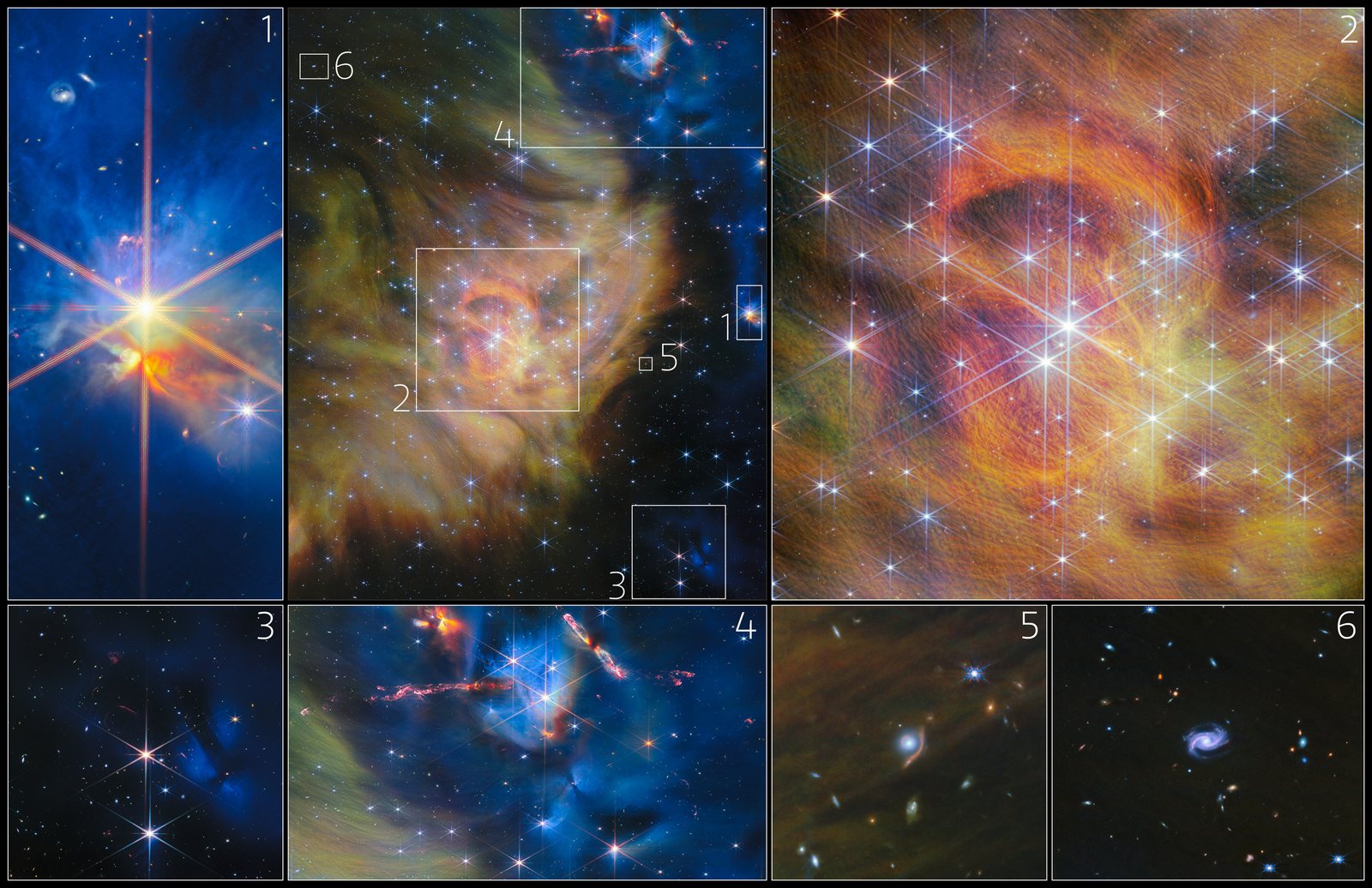
The panorama shows the nursery. The spectra say star formation here did not stop at a tidy limit — it reached free-floating objects closer, on a mass chart, to Jupiter than to the Sun.
No Ground. Stay curious.