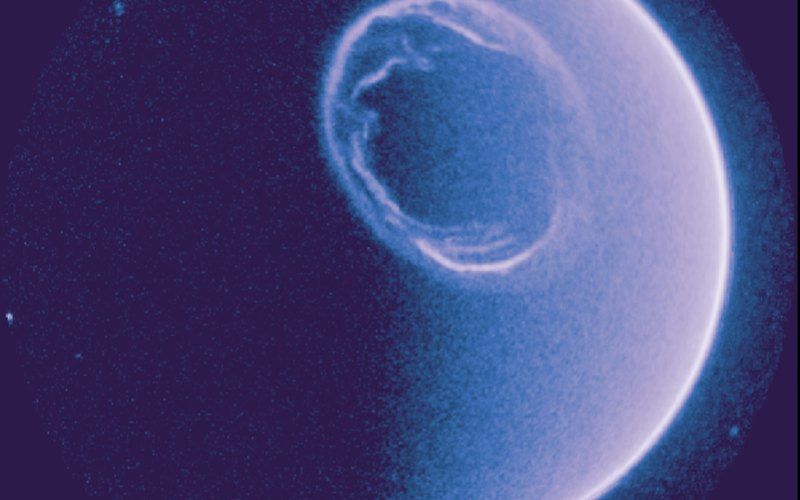
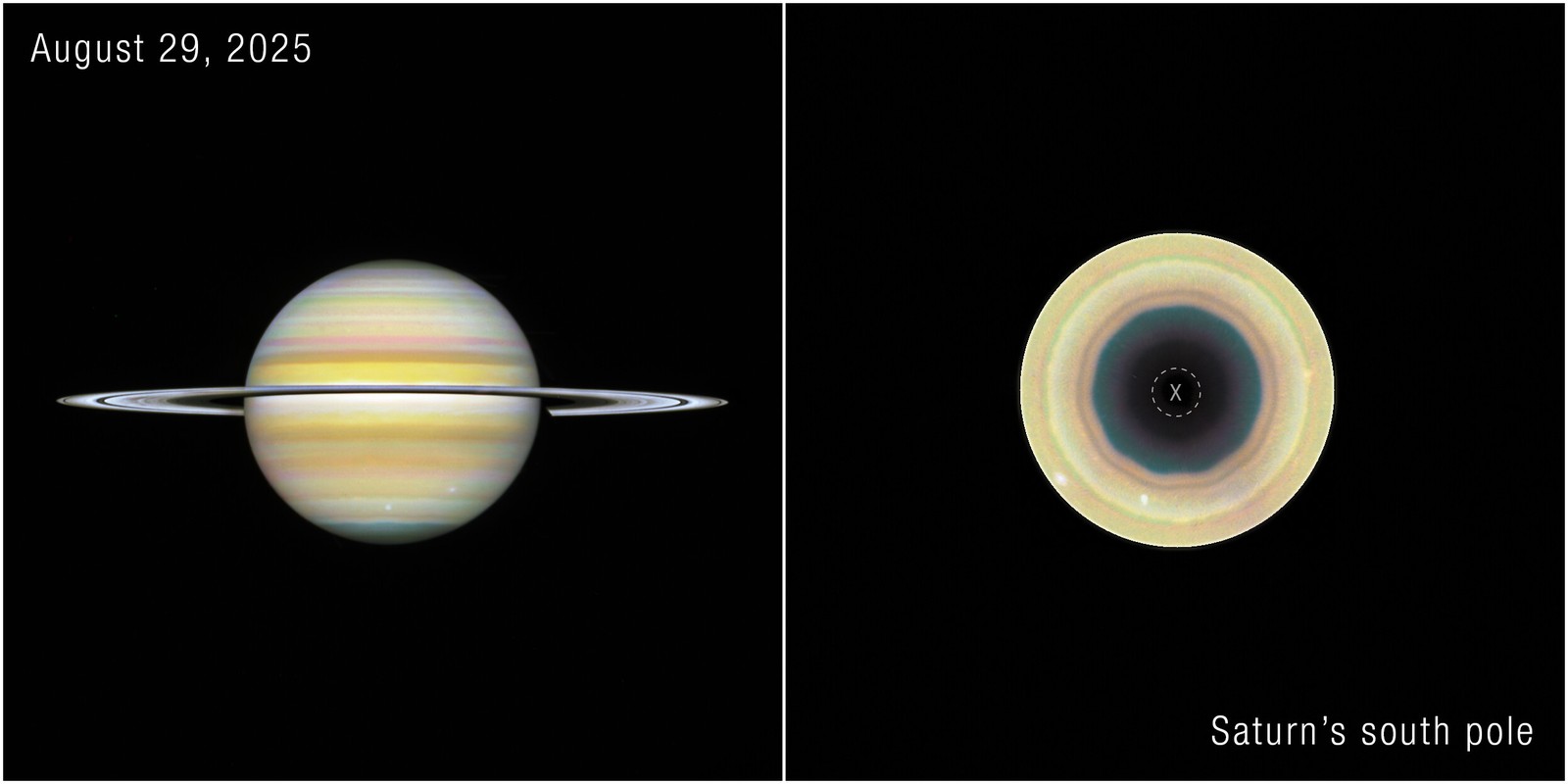
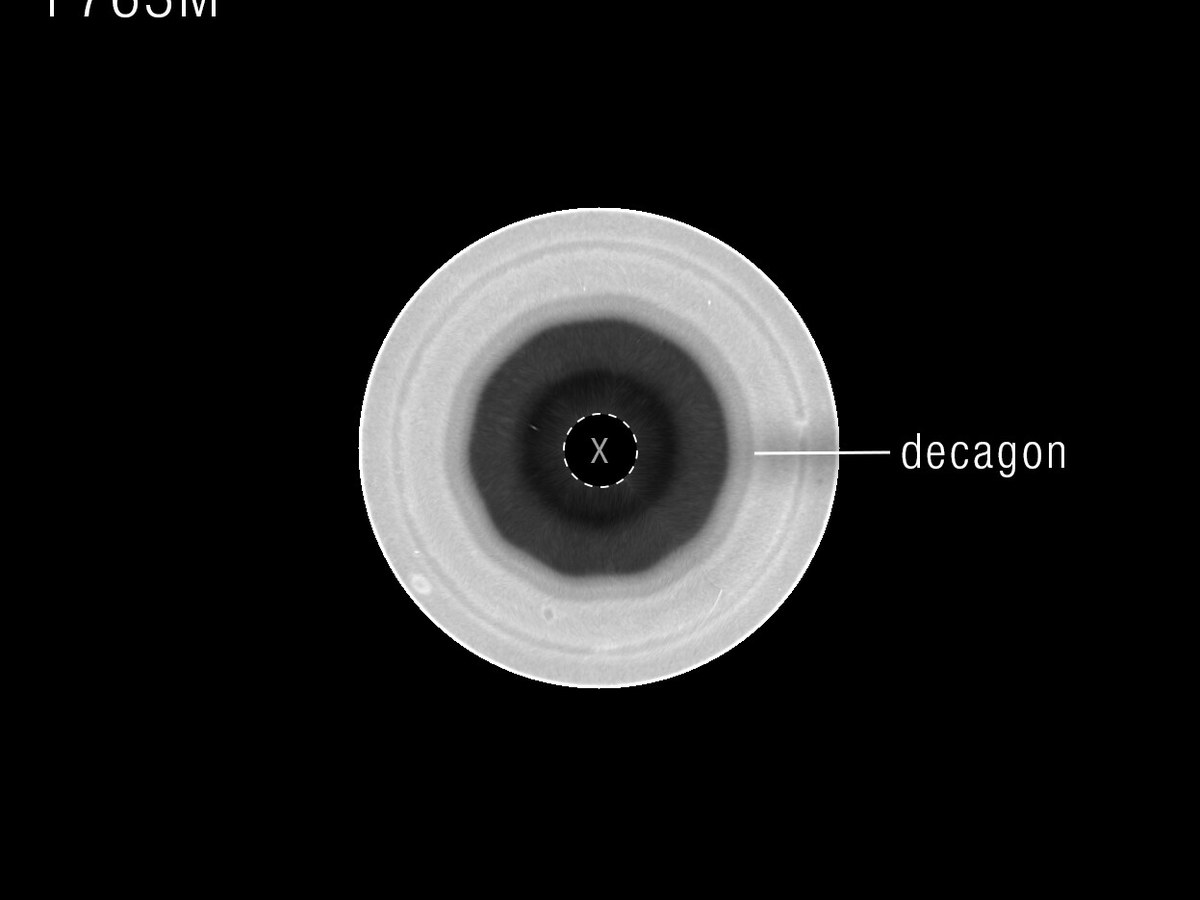
Saturn’s north pole has worn a famous hexagon for more than forty years — a six-sided jet that Voyager, Cassini, and Hubble have all watched sit there like a permanent geometric scar. Now Hubble has confirmed something new at the opposite end of the planet: a giant, evolving 10-sided atmospheric wave wrapped around the south pole.
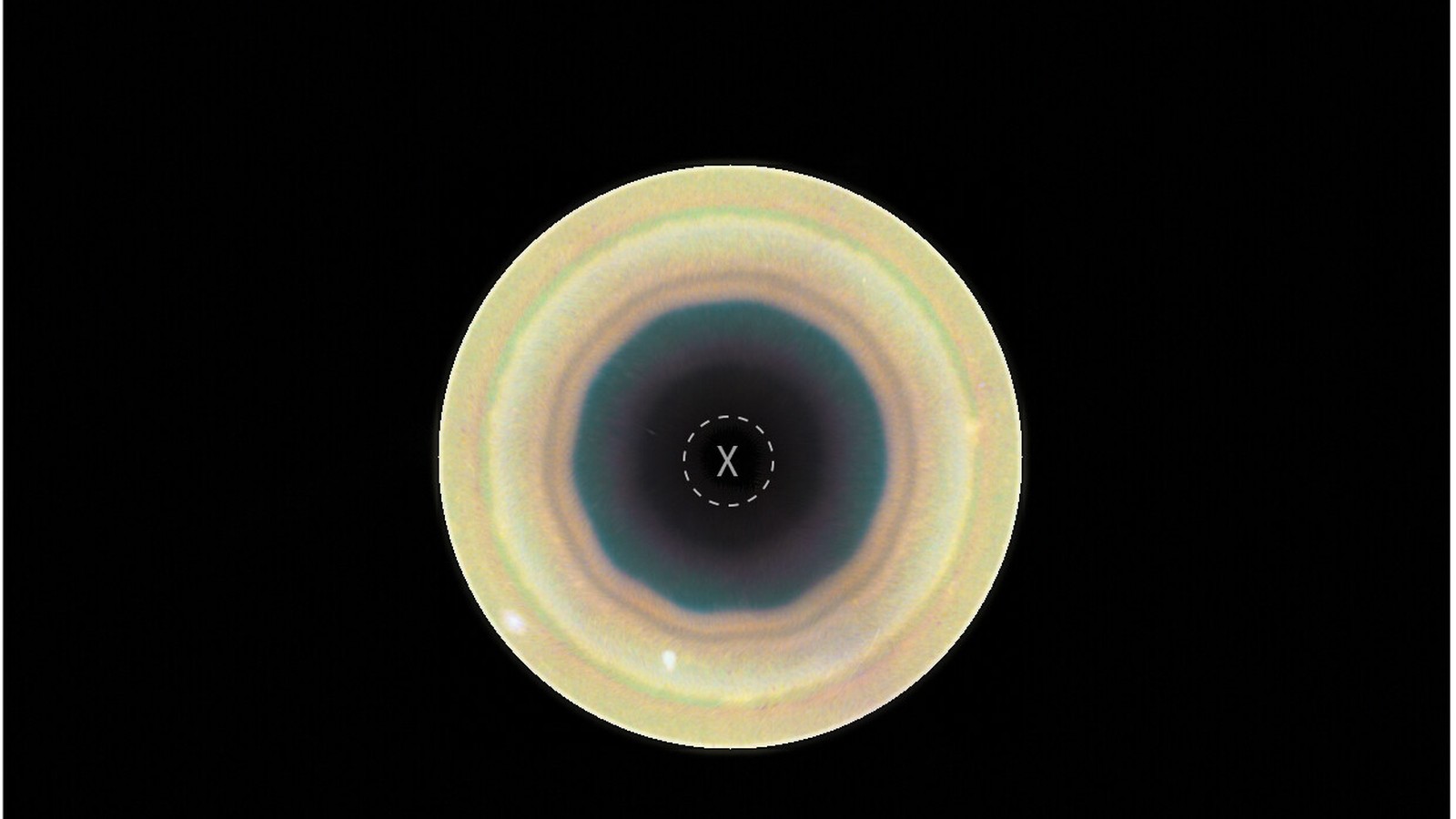
ESA and NASA announced the finding on 2 September 2026, based on Hubble’s Outer Planet Atmospheres Legacy (OPAL) programme and a paper in Science Advances. It is the first time a large, regular-sided jet pattern has been observed in Saturn’s southern hemisphere.
Not a twin of the hexagon — yet
“We’ve never seen anything quite like this in Saturn’s southern hemisphere,” said Amy Simon, OPAL principal investigator at NASA’s Goddard Space Flight Center and a co-author of the study. “The northern hexagon has been there every time we’ve looked for more than 40 years. This feature is different — it appears to be strengthening, giving us the rare opportunity to watch a giant atmospheric pattern develop.”
Lead author Agustín Sánchez-Lavega of the University of the Basque Country and colleagues had been hunting a southern counterpart since 1990. Cassini, which orbited Saturn from 2004 to 2017, showed no long-lived southern twin. Hubble’s OPAL images now push the new feature’s presence back to at least 2023, with the shape growing clearer in 2024 and 2025.
The northern hexagon is old and stubborn. The southern decagon looks young — and still changing.
Spotted first from the ground
Saturn’s seasons slowly tipped the south pole back into Earth’s line of sight. In 2024, Sánchez-Lavega and amateur astronomers Trevor Barry and Jean-Paul Oger noticed a subtle undulating band in ground-based images collected through the Planetary Virtual Observatory Laboratory. More 2025 ground imagery made the ten-sided outline harder to ignore — then Hubble’s sharper, space-based frames locked it in.
The wave sits inside one of Saturn’s powerful eastward jets and shows up at multiple wavelengths, which means it is not a thin cloud graffiti. Different filters probe different altitudes, so the decagon’s apparent position shifts slightly — a sign it is a vertically extended structure.
How fast — and how big
The Science Advances analysis places the wave near planetographic latitudes about 58°S to 63°S. Relative to Saturn’s System III rotation, the decagon drifts eastward at only about 2.5 meters per second — crawling compared with the jet near 60.5°S, which peaks near 116 meters per second. The vertices also wobble in longitude on a roughly 32-day cycle, with amplitudes of about 4.6° to 8.4°. The mean zonal wavelength is roughly 16,800 kilometers.
Models suggest a large-scale meandering wave trapped by the jet — possibly born from a periodic disturbance in the jet peak, or nudged by a dark anticyclonic vortex just to the north. Those ideas are still being tested. The team plans more Hubble work, and help from the NASA/ESA/CSA James Webb Space Telescope, to learn whether the decagon settles into a hexagon-like fixture or keeps evolving.
“The most intriguing part to me is that this seems to have just formed recently,” Simon said. “The question is, why did it suddenly form now when we haven’t seen one before?”
Why OPAL keeps paying off
OPAL has photographed the outer planets every year for more than a decade. Mike Wong of the University of California, Berkeley, a study co-author, put the lesson plainly: many OPAL discoveries are not one lucky snapshot — they are years of patient frames stacked until a slow change finally becomes obvious.
Saturn just handed them another one. A ten-sided wave is drawing itself around the south pole while we watch. The hexagon up north still refuses to leave. Down south, something new is still deciding what it wants to be.
No Ground. Stay curious.