Somewhere in Scorpius, the constellation of the Scorpion, the sky holds a shape that looks less like a cloud and more like a print. Bright pads. A sweep of red gas. Astronomers call it the Cat’s Paw Nebula. Its catalog name is NGC 6334.
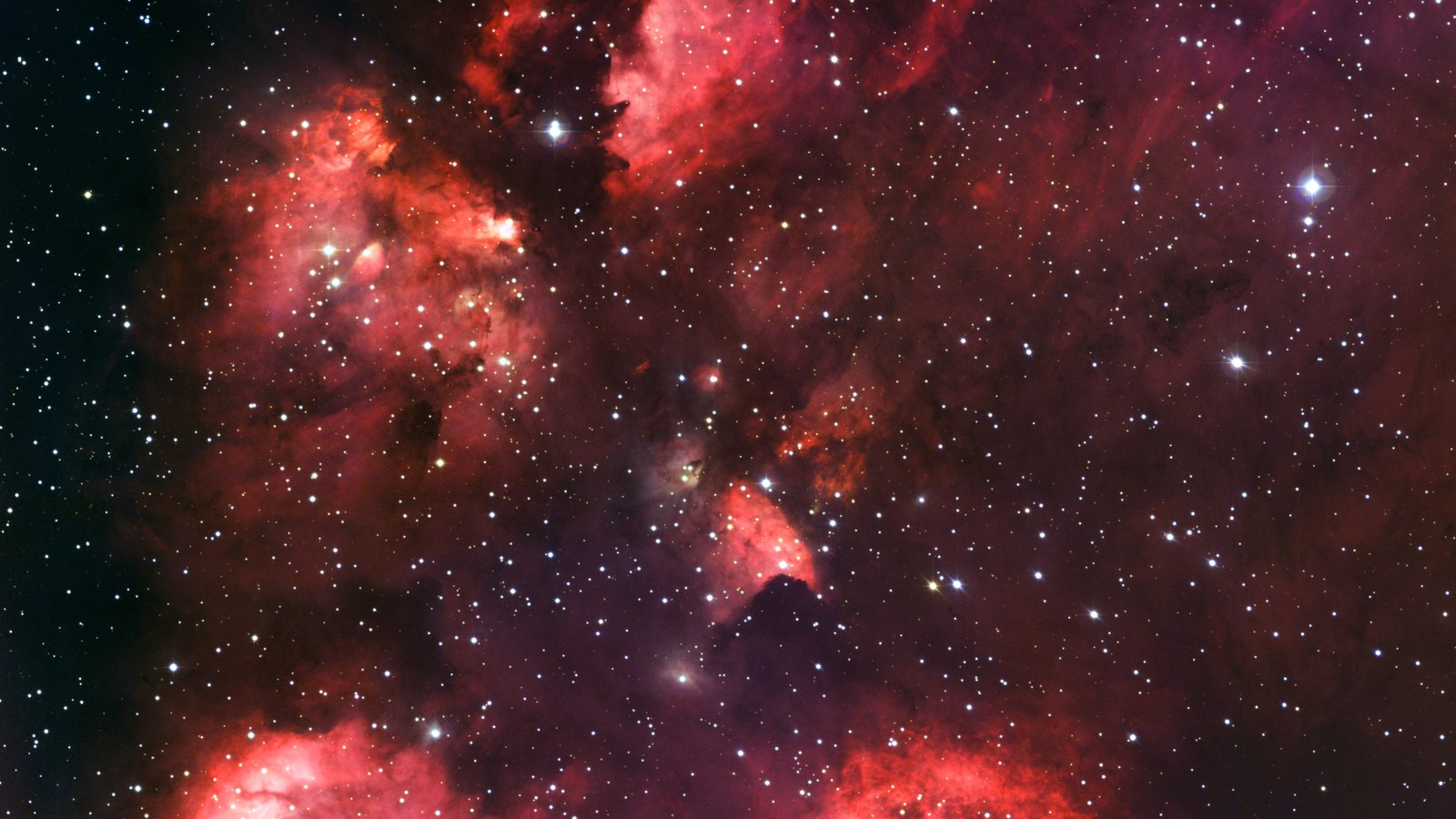
It is not a trick of a phone photo. It is a real region of gas and dust, one of the busiest places in our galaxy for building massive stars. The wide portrait most people know was made from light collected at ESO’s La Silla Observatory in Chile and released on January 20, 2010.
British astronomer John Herschel first recorded NGC 6334 in 1837, while he was in South Africa. He was using one of the largest telescopes in the world at the time. Even so, ESO notes that he seems to have caught only the brightest part of the cloud — the piece toward the lower left of that modern image. The rest of the paw was waiting on darker skies, better cameras, and a filter that could pick out one kind of light.
On the sky, the cloud covers an area slightly larger than the full Moon. That does not mean it is nearby. ESO’s 2010 release placed it about 5,500 light-years from Earth, in the direction of the Milky Way’s heart, and described the whole gas cloud as about 50 light-years across. A light-year is the distance light travels in one year. Fifty of them is a neighborhood of stars, not a single sun.
Distance is one number that still moves. When NASA, ESA, and the Canadian Space Agency released a James Webb Space Telescope view of one “toe” of the same nebula on July 10, 2025, they described the Cat’s Paw as approximately 4,000 light-years away. Both figures come from major observatories. They are estimates of a dusty, complicated region, not a single surveyed mile marker. What does not change is the kind of place it is: a star-forming cloud inside our own galaxy, close enough, in cosmic terms, that telescopes can watch the mess of birth in detail.
The red is hydrogen. Hot young stars flood the cloud with harsh light. Hydrogen gas answers by glowing, and a special filter on the telescope was built to let that glow through. Blue and green light from the nebula are scattered and absorbed more easily by material between it and Earth, so the red is what arrives. The 2010 picture is not a painting and not an infrared scan. It is an optical observation: images through blue, green, and red filters, plus that hydrogen filter, combined from the Wide Field Imager on the 2.2-metre MPG/ESO telescope at La Silla.
Inside the glow, the nursery is crowded. ESO describes NGC 6334 as one of the most active nurseries of massive stars in our galaxy. The cloud hides brilliant blue stars formed in the last few million years, each nearly ten times the mass of the Sun. Many more are still buried so deep in dust that ordinary visible light cannot study them well. Altogether, the Cat’s Paw could hold several tens of thousands of stars. The region has been studied for years precisely because so much of the action is hidden.
One shape in the picture refuses a tidy label. In the lower right of the ESO image there is a red, intricate bubble. ESO says it is most likely one of two things: a star throwing off a large amount of matter at high speed as it nears the end of its life, or the remnant of a star that has already exploded. The photograph shows the scar. It does not, by itself, decide which history wrote it.
Dust is why the paw looks both obvious and secretive. The nebula lies near the heart of the Milky Way and is heavily obscured by clouds in between. Visible light draws the outline. Infrared light walks through it.
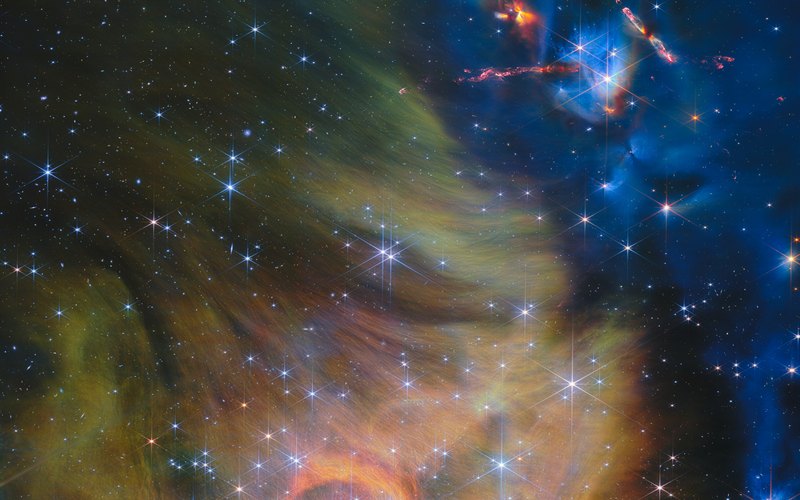
That is what Webb did for its third year of science operations. On July 10, 2025, astronomers pointed Webb’s Near-Infrared Camera, NIRCam, at a single toe of the paw. Inside it they found smaller structures NASA compared to “toe beans” — pockets where young stars are shaping the gas and dust around them. The official caption is blunt about the ending. Massive young stars are carving the gas and dust. Their light makes a bright nebulous glow. Eventually this turbulent region will quench star formation.
The scene is temporary. NASA describes these stars as disruptive, bright, and living relatively short lives. They clear cavities. In Webb’s near-infrared view their starlight is shown as a blue glow. They also push, heat, and thin the material later stars would need. In that patch, local star formation will stop because the stars already there are too rough on the nursery. Astronomers still do not fully understand every step from a large molecular cloud to a massive star. A place like this is where those missing steps can be watched.
Webb’s team gave one structure a nickname: the “Opera House,” a circular, tiered form in the toe near the top of the frame. The cloudy blue glow there is most likely driven from below, either by bright yellowish stars or by a source still hidden behind dense, dark brown dust. Just under the orange-brown tiers sits a bright yellow star with the cross-shaped diffraction spikes bright stars make in telescope images. It has carved out its immediate surroundings. It has not been able to push the gas and dust very far, so the material remains as a compact shell.
Patches that look empty are not empty. Beside the Opera House, a tuning-fork shape shows fewer stars because dense filaments of dust in the foreground block the stars behind them. Those same filaments are where stars are still forming. Small red clumps scattered in the brown dust mark massive star formation that is underway but still obscured. Near the bottom of one toe, tiny clumps of dust have survived the radiation, which suggests they are dense enough to become protostars — stars that have not finished assembling. A red-orange oval at the top right of Webb’s frame lets so few background stars show through that NASA reads it as a dense zone just beginning the process. A bow shock there is the sign of an energetic ejection of gas and dust from a bright source that is still partly wrapped in material.
None of this is a permanent monument. ESO’s wide red paw and Webb’s close infrared look are two chapters of the same short story: a cloud lights up, massive stars switch on, and the cloud is spent. The cat’s paw is what that work looks like from a few thousand light-years away, while it is still going.
No Ground.