 No Ground
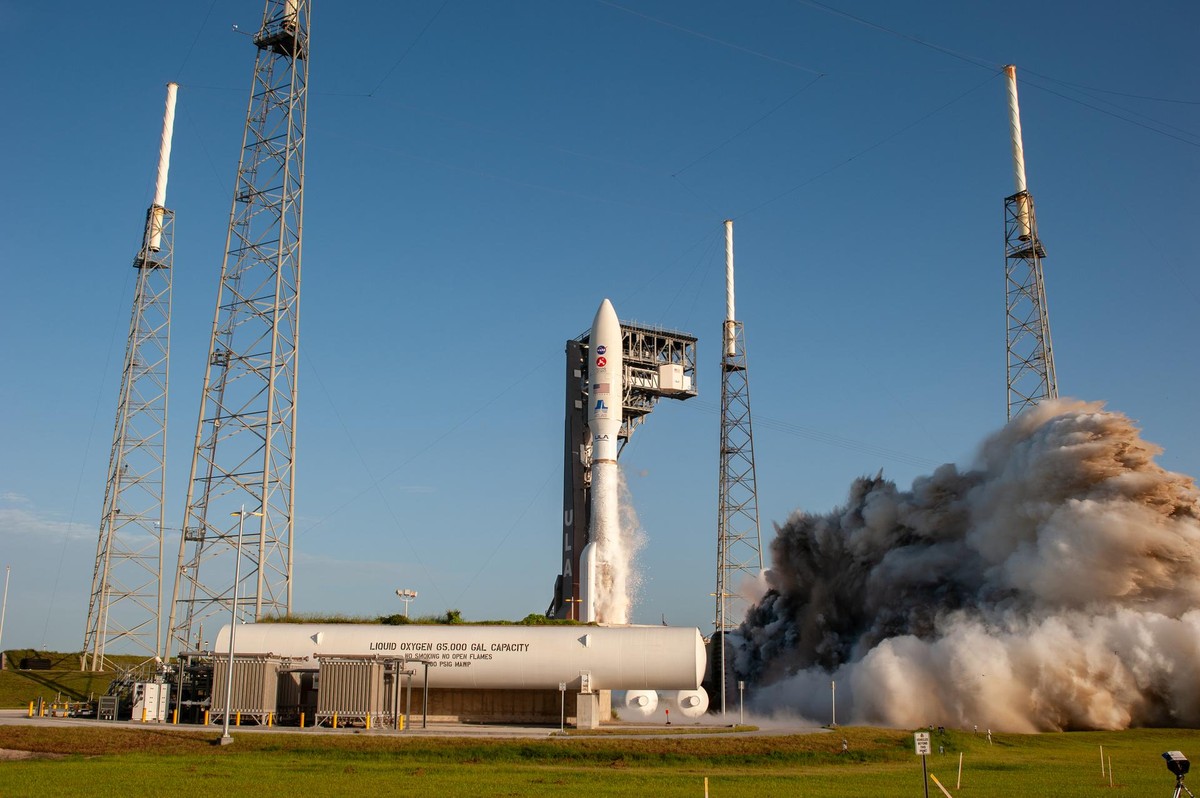
The short answer: about seven months. NASA’s Perseverance rover left Florida on July 30, 2020, and touched down on Mars on Feb. 18, 2021, after a 203-day cruise. Most robotic missions take somewhere between seven and ten months.
The longer answer is more interesting, because the trip to Mars is not a straight line, it can only start on certain dates, and it has a lot less to do with how fast your rocket is than you might think.
How far away is Mars?
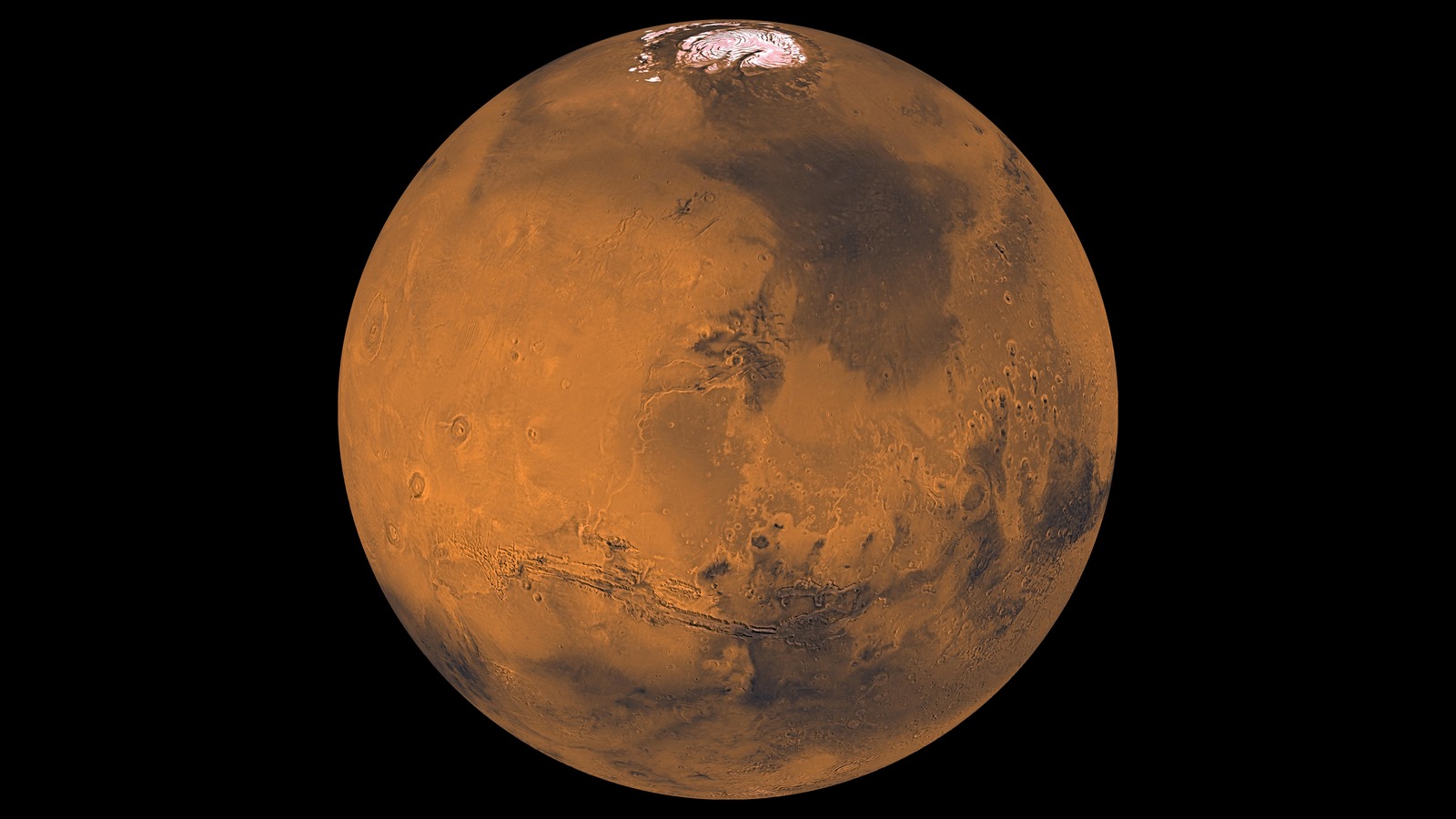
It depends on the day. Earth and Mars both circle the Sun, but at different distances and speeds. Earth sits about 93 million miles from the Sun and finishes a lap in one year. Mars averages about 142 million miles out and needs 687 Earth days for one lap. So the gap between the two planets is always changing.
When Earth passes Mars on the inside track, they can be fairly close. The closest pass in recorded history came in August 2003, at about 34.8 million miles. When the two are on opposite sides of the Sun, they can be roughly 250 million miles apart. On average, the gap is about 140 million miles.
Even a radio signal, moving at the speed of light, needs anywhere from 3 to 22 minutes to cross that gap, NASA says. A spacecraft is a little slower than that.
Why you can’t fly straight there
Here is the part that surprises most people. Perseverance did not travel 35 million or 140 million miles. NASA says it covered about 293 million miles, more than twice the average distance between the planets.
That is because a spacecraft leaving Earth is already moving with Earth around the Sun, at about 67,000 mph. It cannot just point at Mars and go. Instead, its rocket adds a little extra speed in the direction Earth is already traveling. That stretches the spacecraft’s path around the Sun from a circle into an ellipse, an oval that swings out until it touches the orbit of Mars.
The cheapest version of that path, the one that uses the least fuel, is called a Hohmann transfer, after the German engineer Walter Hohmann, who described it in 1925. The spacecraft fires its engine near Earth, coasts for months with its engine off, and meets Mars on the far side of the Sun from where it started.
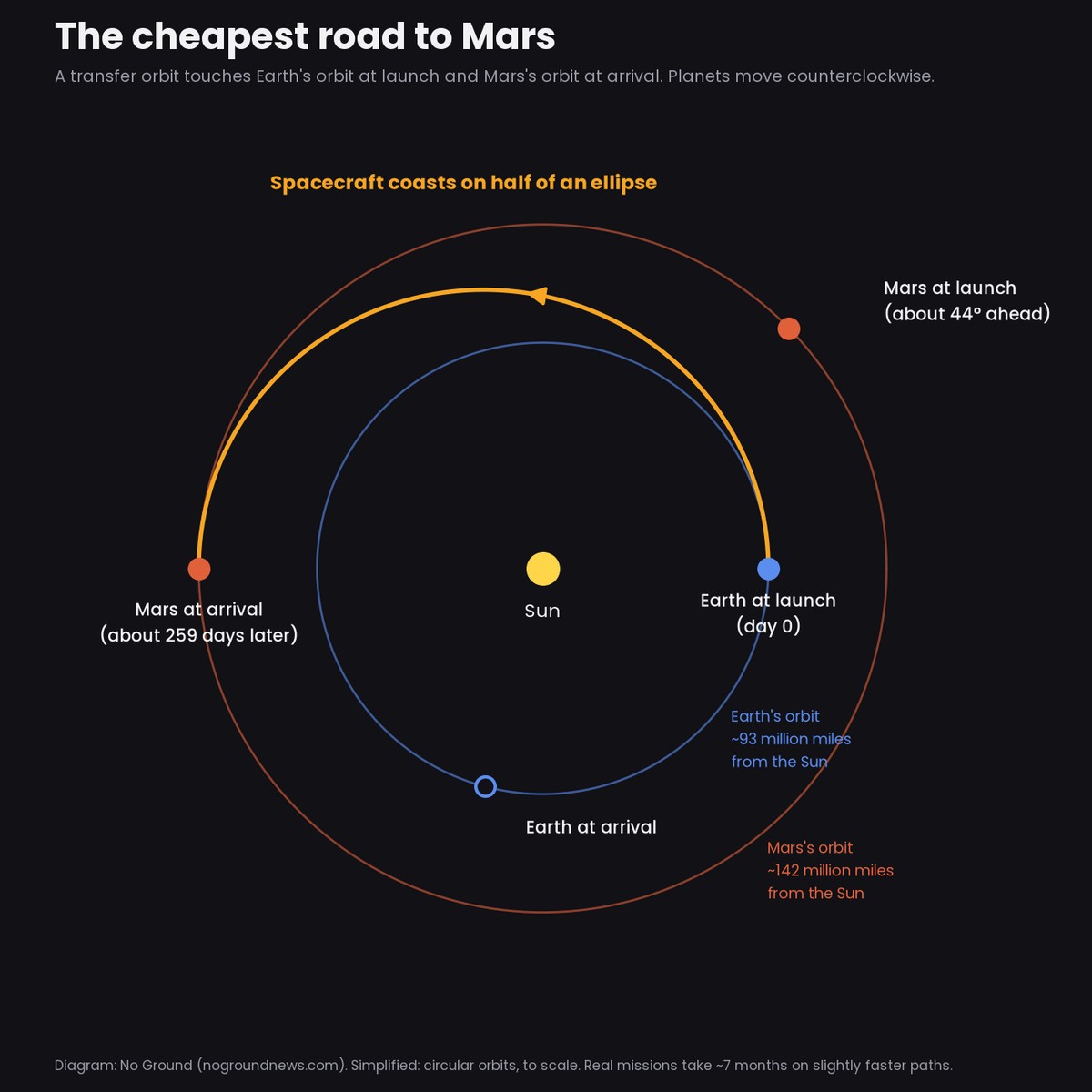
Do the math with simple circular orbits and that coasting half-ellipse takes about 259 days, or roughly eight and a half months. Real missions usually launch with a bit more speed than the bare minimum, which shortens the trip to around seven months. That is the trade-off behind every Mars schedule: more fuel buys a shorter trip, less fuel means a longer one.
The 26-month window
There is a catch. Because the spacecraft needs months to get there, you have to aim at where Mars will be, not where it is. NASA compares it to a quarterback throwing a pass to a receiver who is still running.
Explore your sky tonightLive sky map for where you are: planets, the ISS and bright stars above your horizon.For the cheapest path, Mars needs to be about 44 degrees ahead of Earth in its orbit on launch day. Earth moves faster than Mars, so it laps Mars and reaches that same arrangement only once every 26 months or so. That is why Mars missions come in waves. In July 2020, the United Arab Emirates, China and NASA all launched Mars missions within about two weeks of each other, because that is when the door was open.
Miss the window, and you usually wait about two more years. That is also why NASA’s twin ESCAPADE orbiters, which launched on Nov. 13, 2025, outside the usual window, are scheduled to reach Mars only in September 2027, after a longer, roundabout route.
The fastest and slowest trips
Some of the quickest trips have been flybys, which do not need to slow down at the end. NASA’s Mariner 7 launched March 27, 1969, and passed Mars on Aug. 5, 1969, just 131 days later.
Missions that stay take longer. NASA’s Mars Reconnaissance Orbiter needed about seven and a half months; MAVEN took about ten. Perseverance took 203 days, then hit the top of the Martian atmosphere at about 12,100 mph and had about seven minutes to get down to the ground. At that moment, a radio signal took about 11 minutes and 22 seconds to reach Earth, so by the time engineers heard the landing had started, the rover was already on the surface, one way or another. That is why landers have to land themselves.
Slowing down at Mars is half the challenge. Missions that stop, rather than fly past, need to shed thousands of miles per hour, either with an engine burn into orbit or with a heat shield, parachute and rockets. Japan’s MMX spacecraft, which launched toward Mars’s moon Phobos, will have to brake the same way when it arrives.
And for people?
A crew would face the same physics, plus one more problem: getting home. After a seven-to-nine-month trip out, the planets are no longer lined up for the cheapest ride back. One NASA Goddard calculation for the classic Hohmann path works out to about 459 days of waiting at Mars before the return window opens.
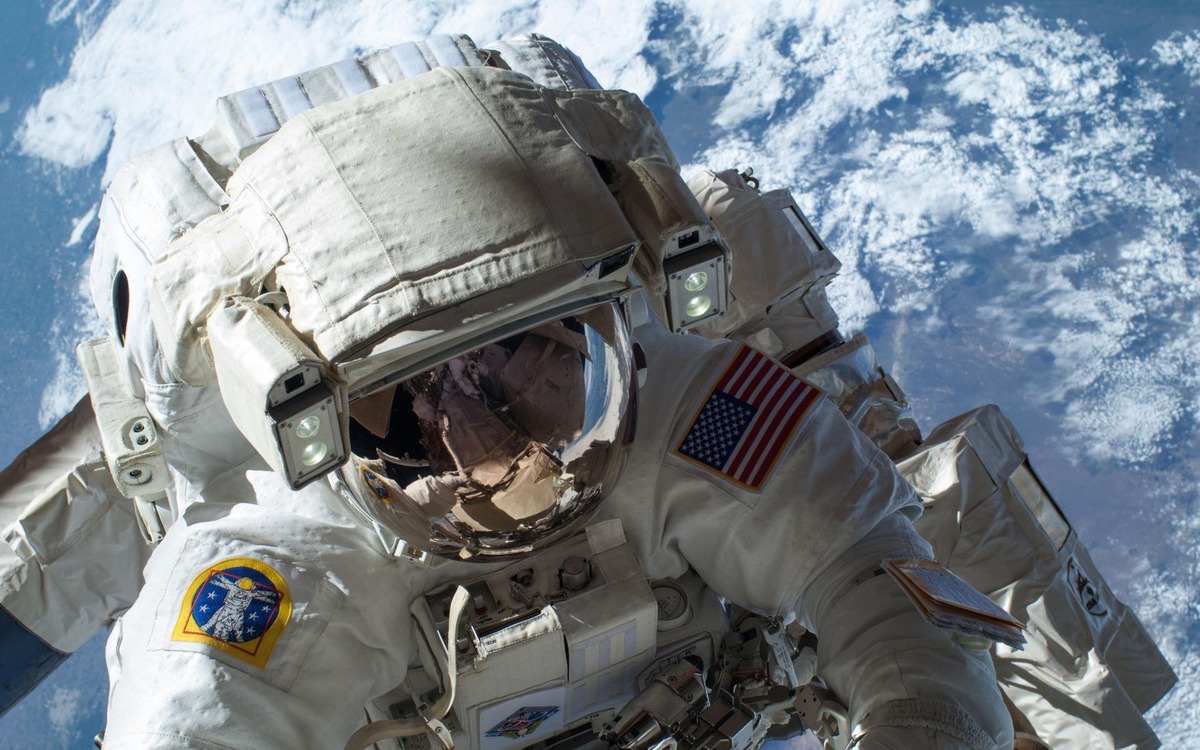
Add it up, roughly eight and a half months out, about 15 months on Mars and eight and a half months back, and the whole trip comes to about two and a half to three years. That is why NASA tests how people cope with long isolation. One crew spent 378 days inside a simulated Mars habitat in Houston to learn what that might feel like.
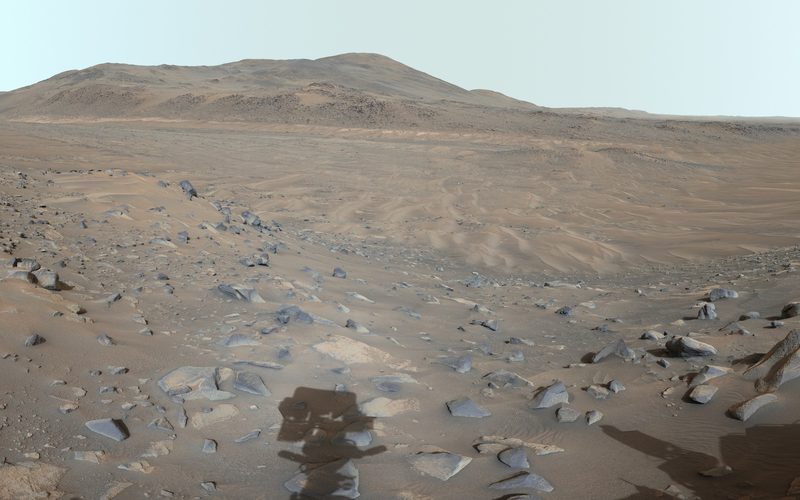
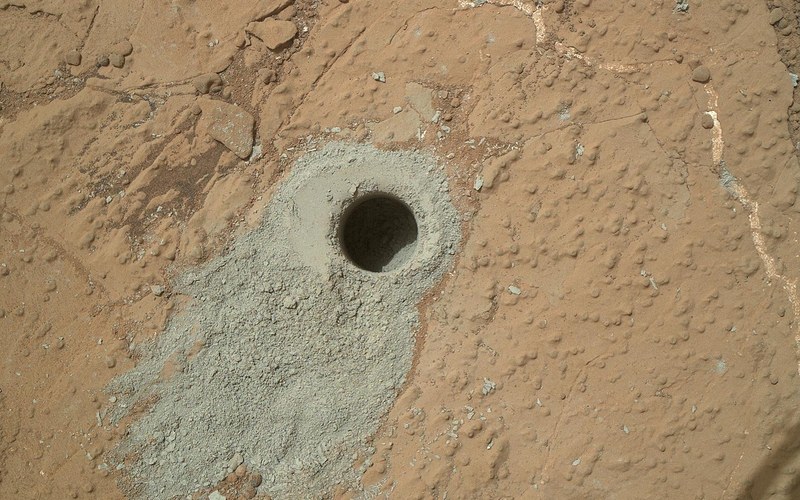
In the meantime, robots keep making the trip for us. The rover that took 203 days to get there has since been finding rocks on Mars that glow like rubies under its laser.
Bottom line: Getting to Mars takes about seven months on a typical mission, sometimes as little as four for a flyby or as long as ten. The real limits are the planets’ positions, a launch window that opens about every 26 months, and how much fuel you are willing to burn.
No Ground. Stay curious.