Organic chemistry is not the same thing as life. That distinction matters on Mars, where every carbon discovery arrives already wrapped in hope and fear of a headline that goes too far.
What Curiosity found in a rock called Cumberland is still the largest organic molecules identified on the planet to date. They are real. Their origin is not settled. And that gap is the story.
The molecules are alkanes: decane (C10), undecane (C11), and dodecane (C12). NASA announced the result in March 2025, with a paper led by Caroline Freissinet of CNRS / LATMOS in the Proceedings of the National Academy of Sciences. The team used Curiosity’s Sample Analysis at Mars instrument — SAM, a chemistry lab the size of a microwave oven riding inside the rover.
SAM heated powder from the Cumberland mudstone and measured what came off. In a specially designed run, the instrument released those three long-chain alkanes at the tens of picomoles level. Dodecane, with twelve carbons, is the heaviest organic molecule identified at Mars’s surface in that study.
Fragments, not fossils
The alkanes themselves are not the full story. Laboratory tests support a stronger claim: they are likely fragments of longer molecules that were preserved in the mudstone as carboxylic acids — the chemical family that includes fatty acids.
On Earth, fatty acids help build cell membranes. Living things make them. Non-living chemistry can make them too, including reactions in hydrothermal systems where water meets rock and minerals. NASA’s own write-up is careful on this point. Freissinet’s paper is, too: the origin remains uncertain. Abiotic or biological. Both are still on the table.
That is why this is not a life detection. It is a complexity detection. Earlier SAM results had already shown smaller Martian organics in Gale Crater rocks, with structures up to about six carbons. Crossing into the C10–C12 range matters because it shows prebiotic chemistry on Mars could get further along than those earlier finds suggested — further toward the kinds of molecules an origin of life would need, whether or not life ever started.
A hole drilled for a lake that dried
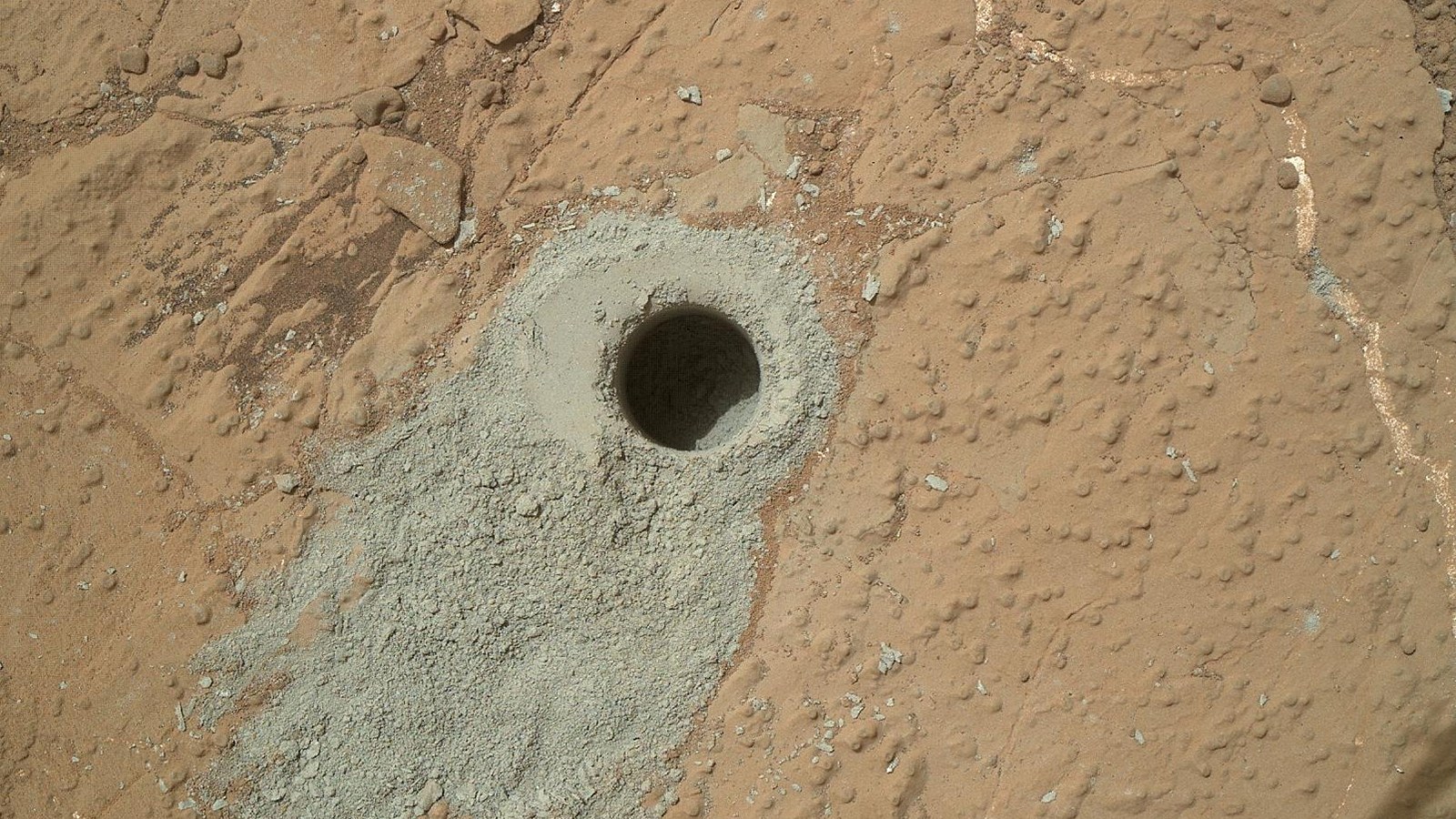
Curiosity drilled Cumberland in May 2013, on sol 279, in Yellowknife Bay — an ancient lakebed in Gale Crater. The team diverted the rover there before the long climb toward Mount Sharp because the place looked like a once-wet basin. That detour paid off for years.
Cumberland’s mudstone is rich in clay minerals that form in water. It carries sulfur that can help protect organic molecules. It holds nitrates. Earlier work on the same sample, also involving Freissinet, had already delivered the first conclusive identification of indigenous Martian organics. The rock has been asked the same question many times, with different SAM methods.
This particular answer arrived as a side effect. The team was hunting for amino acids — the building blocks of proteins — and did not find them. What they did find, after a two-step heating procedure designed to drive off oxygen from perchlorate salts before looking for organics, were the long alkanes.
Working backward, they argued the alkanes came from fatty acids with 11, 12, and 13 carbons. When they mixed undecanoic acid into a Mars-like clay and ran a SAM-style experiment on Earth, heating released decane, as predicted. Published work by others lined up for the longer chains.
Why the length matters
The presumed parent fatty acids have straight backbones of 11 to 13 carbons. According to NASA’s summary of the study, non-biological processes typically make shorter fatty acids, with fewer than 12 carbons — so the pattern is intriguing, though not decisive. The paper does not claim biology. It also notes a limit: SAM may not be optimized to see even longer chains that could still be hiding in the rock.
There is a second practical payoff. Radiation and oxidation on Mars were long expected to shred large organics over tens of millions of years. Finding C12 molecules still intact in mudstone several billion years old strengthens the case that Gale Crater — and perhaps other ancient lake sediments — can preserve the kinds of compounds a future sample-return mission would want to study with instruments that never fit on a rover.
“Our study proves that, even today, by analyzing Mars samples we could detect chemical signatures of past life, if it ever existed on Mars,” Freissinet said in NASA’s release. The if is doing essential work in that sentence.
Co-author Daniel Glavin of NASA Goddard put the next step bluntly: there is a limit to what molecule-hunting instruments on Mars can settle. Bringing samples home is how the debate gets sharper tools.
A later chapter, a different claim
In April 2026, NASA described a separate Curiosity result from a rock nicknamed Mary Anning: a more diverse set of organic molecules revealed with a wet-chemistry technique using tetramethylammonium hydroxide, or TMAH. That release is about chemical variety in another sample — not a claim of longer carbon chains than Freissinet’s C12. Keep the two findings distinct. One pushed molecular size. The other pushed diversity of molecules seen.
Yellowknife Bay was wet for a long time. Glavin has said liquid water likely persisted in Gale Crater for millions of years, maybe longer — enough time, in principle, for life-forming chemistry. Enough time, also, for geology to cook carbon without a single cell.
Curiosity did not find life in Cumberland. It found carbon chains long enough to make the next questions harder and more interesting. That is what a good Mars result looks like: not a verdict, a better mystery.
No Ground. Stay curious.