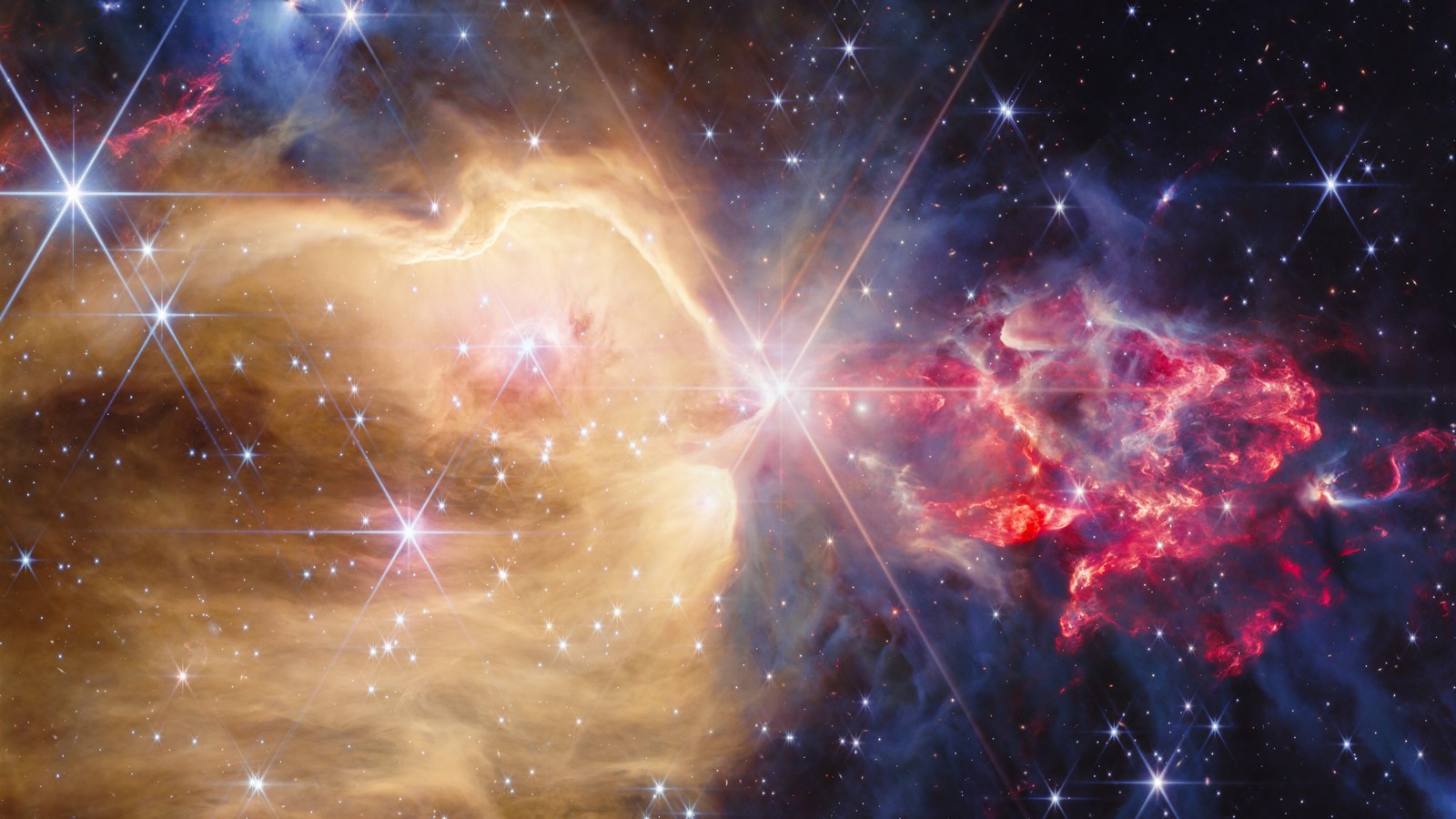
One side of the picture looks molten. The other looks like something is still fighting its way out. In between sits a bright yellow star with Webb’s trademark eight-pointed spikes — the loudest object in a neighborhood that has been making stars for a long time.
NASA and ESA released the new James Webb Space Telescope view of NGC 7129 on October 6, 2026. The cloud sits about 3,300 light-years from Earth in the constellation Cepheus. It is a stellar nursery: cold dust and gas collapsing into stars, then being pushed, heated, and torn by the stars that have already switched on.
What makes the portrait startling is not a single discovery announcement. It is the map of ages. On the left of the central star, hot atomic hydrogen glows gold. On the right, cooler molecular hydrogen — still locked in H2 — turns red where protostar outflows slam into it. The coldest, densest gas, where stars have not formed yet, reads as gray. Same cloud. Different chapters of the same story, side by side.
The star in the middle
The most massive and most mature object in the frame is the luminous central star known as LkHα 234 (pronounced “Lick-H-alpha”). NASA describes it as a pre-main-sequence star about 5 to 8 times the mass of the Sun. Stars like this have mostly finished gathering mass. Gravity is tightening them; their temperatures are rising. In time, LkHα 234 will fuse hydrogen the way the Sun does.
It already leaves a mark. To its left, a golden cavity spans roughly 3.5 light-years — the largest demonstration of this star’s impact in the image. Earlier in its life, outflows carved into the dense molecular cloud. The outflows and the star’s light energize the gas, making it glow. Some of that hydrogen is blown away. A large amount is also compressed, which can set up conditions for even more stars to form.
A few younger pre-main-sequence stars are visible inside the cavity. They drive stellar winds of their own. Where those winds plow into the energetic gas, they leave curved bow shocks and carve smaller hollows. Together, the central star and its neighbors heat the cavity and push against colder, denser molecular gas outside it. Along that sharp ridge, NASA notes a photodissociation region: a boundary where ultraviolet light breaks hydrogen molecules apart into atoms. Over millions of years, that kind of pressure and chemistry helps erode the molecular cloud.
The red side is younger — and messier
Cross to the right of LkHα 234 and the story flips. The clumpy red plume hides objects younger than the stars in the golden cavity: protostars. That stage comes after a molecular cloud compresses and fragments, and before a star settles onto the pre-main-sequence track.
As protostars gain mass, they eject outflows of superheated material. Those jets slam into the dense gray matter wrapped around them, creating shocks that give the region its textured look. The red glow is the light from that interaction — cooler molecular hydrogen, heated and stirred by the blast. From Earth, multiple outflows overlap, so the scene looks chaotic. It is. Birth in this cloud is not orderly.
More of those red outflows appear toward the upper left of the frame, near a blue-colored nebula. At the center of that blue patch sits a protostar with a donut-shaped disk of material. The disk casts a shadow on the surrounding nebula — a silhouette NASA compares to the famous “Bat Shadow” seen earlier by Hubble. Even the quiet-looking blue is a construction site.
Why infrared sees what eyes cannot
Young stars often stay buried in dusty cocoons. Visible light scatters or dies in that dust. Webb’s Near-Infrared Camera (NIRCam) is built to pierce it. Infrared wavelengths slip through the haze, so astronomers can watch the earliest stages of the star life cycle that optical telescopes mostly miss.
NASA’s retired Spitzer Space Telescope had already mapped gas and dust in NGC 7129. Webb’s sharper resolution pulls out finer filaments and, in the same field, many background galaxies that Spitzer could not resolve the same way. The point is not that Spitzer was wrong. It is that every generation of infrared eyes adds structure to the same nursery.
Astronomers will keep mining this dataset for how the stars and protostars in NGC 7129 shape the gas and dust around them — heating it, compressing it, shredding molecules, and eventually starving later generations of the material they need to form.
A cauldron, not a postcard
It is easy to treat a Webb release like wallpaper. This one resists that. Gold means heat and dissociation: mature stars rewriting the chemistry of their neighborhood. Red means shocks: newborns still launching jets while they eat. Gray means the next round has not started yet. The bright central star is not decorating the cloud. It is one of the reasons the cloud looks the way it does.
NGC 7129 is not a frozen sculpture. It is a temporary balance between collapse and feedback — gravity building stars, stars tearing the nursery apart. Webb’s October 6 portrait simply catches the fight mid-swing, 3,300 light-years away, in light our eyes were never meant to see.
No Ground. Stay curious.