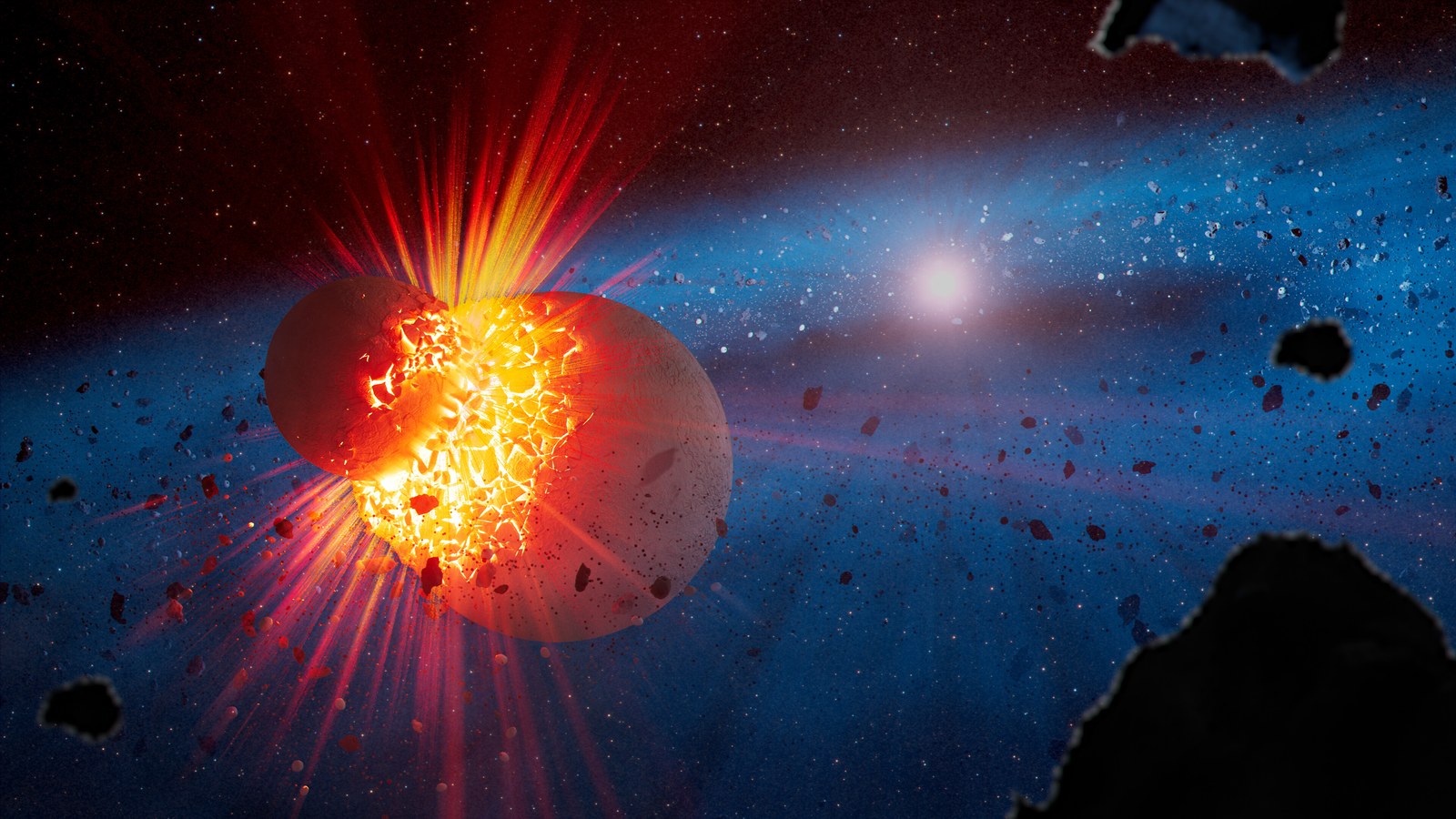
Long before Earth had oceans or a thick air, something the size of Mars slammed into the young planet. Astronomers call that world Theia. The crash vaporized rock and threw debris into space. Some of that material coalesced into the Moon.
That story is about our solar system. On October 1, 2026, NASA and ESA released a study that asks a harder question: can we see the same kind of violence — written in dust — around other stars?
Using the NASA/ESA/CSA James Webb Space Telescope and archival data from NASA’s retired Spitzer Space Telescope, a team led by Kate Su of the Space Science Institute in Boulder, Colorado, examined a rare class of young stellar systems called extreme debris disks. Their mid-infrared spectra carry mineral fingerprints of giant collisions. The findings appear in The Astrophysical Journal.
A star’s neighborhood changes as it ages. First comes a gas-rich protoplanetary disk, where planets can still grow. Later comes a gas-poor debris disk — leftover rock and ice grinding down into dust. Spitzer found that some of those debris systems are extreme: they hold unusually large amounts of warm dust close to the star, in the zone where rocky planets orbit in our own system.
Theory once suggested those extreme phases should be common. Observations say otherwise. Based on the data so far, only about 1% of young stars show observable signatures of this stage — possibly including our Sun during its youth.
Rarity did not stop the team. They assembled a sample of 21 extreme debris disks: five from Spitzer’s archives and 16 from Webb, including 12 newly observed systems and follow-up on four of Spitzer’s targets.
“This is the first time we have gathered enough systems to truly understand this subclass that we call extreme debris disks,” said Su, lead author of the paper. “Before Webb, we had limited information. We knew that they are weird and very different from the typical cold debris disks that we know, like Vega and Fomalhaut. Now that we have more data, we can pin down what these disks represent for planet formation and evolution.”
Across the sample, three traits keep showing up. The dust grains are smaller than those in ordinary protoplanetary or classic debris disks. There is a lot of warm dust. And the infrared brightness flickers irregularly over time. Webb and Spitzer mid-infrared spectra revealed all three.
The minerals tell the rest of the story. The disks split into silica-rich and silica-poor groups. On Earth, volcanic glass like obsidian is one silica-rich example; the silica-poor mineral forsterite shows up as green sand on some Hawaiian beaches. In a debris disk, that chemistry is a clue to how hard the collisions were.
“To just see their mid-infrared emission and beautiful spectral features with Webb, which allowed us to identify their compositions, was the most exciting thing for me,” said Agnes Kospal of Konkoly Observatory in Budapest, Hungary, a coauthor. “We have no other way to study these planetary embryos directly because they are too small.”
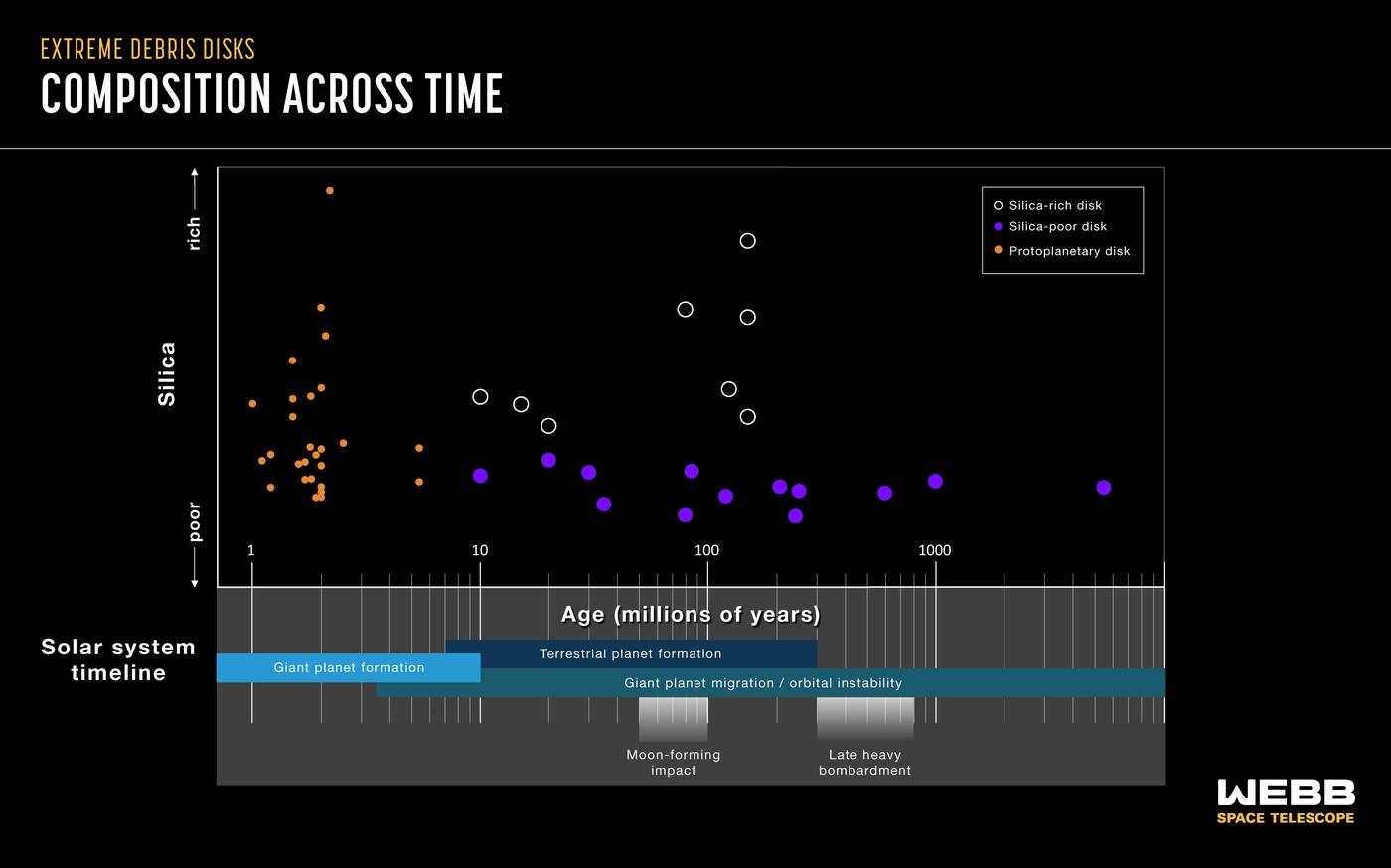
About one-third of the sample is silica-rich. NASA’s accompanying graphic counts eight of those systems. That signature points to high-energy impacts between Mars-sized bodies, where a large share of the rock is vaporized and then recondenses as silica-rich dust — the same broad chemistry tied to giant impacts like the one that may have built our Moon.
The remaining two-thirds — thirteen systems in the graphic — are silica-poor. Those collisions look gentler: smaller scales, often grazing hits between Moon-sized objects. Silica-rich disks appear only around stars younger than about 300 million years. Silica-poor disks show up across a much wider range of ages and often vary more dramatically in brightness. The team argues that rapid orbital and collisional evolution of fresh debris can drive that flicker.
Our own solar system may have lived through more than one extreme-debris phase. Simulations say terrestrial planets like Earth should finish forming within the first few hundred million years. That window matches the ages of the silica-rich disks seen so far — and the estimate that Earth and the Moon formed roughly 100 million years after the Sun, with the Moon likely born from a Mars-sized collision.
Older silica-poor disks, with their irregular infrared brightenings, may flag a later kind of chaos. If those flickers reflect orbital instability, they line up broadly with the Late Heavy Bombardment idea for our solar system: gas giants migrate, smaller bodies get flung onto dangerous paths, and short-lived dust storms light up in the infrared.
“How rocky planets formed and giant planets evolved are part of the broader story of the solar system’s formation. It’s all one story,” said Su. “Our work on extreme debris disks helps us bring together the big picture of what we currently understand.”
There are still gaps. “Of course, there’s many things we still don’t know about these disks,” said Attila Moor of Konkoly Observatory, a coauthor. “We expect no silica-rich systems among older extreme debris disks. We only have three disks in our sample that fit that age criteria, so it’ll be nice to observe more of these systems to confirm our hypothesis.”
Webb cannot photograph Theia. It can read the dust left when worlds the size of Mars and the Moon smash into each other around other suns — and that dust looks a lot like the violence that helped make our own sky.
No Ground. Stay curious.