 No Ground
Even the James Webb Space Telescope can miss a planet sitting right next to its star.
Stars outshine their planets by enormous margins — young giant planets can still be about 100,000 times fainter than their hosts, and typical planets are closer to a million times fainter. Coronagraphs block much of the starlight, but leftover glare can still drown a world that is otherwise in the frame.
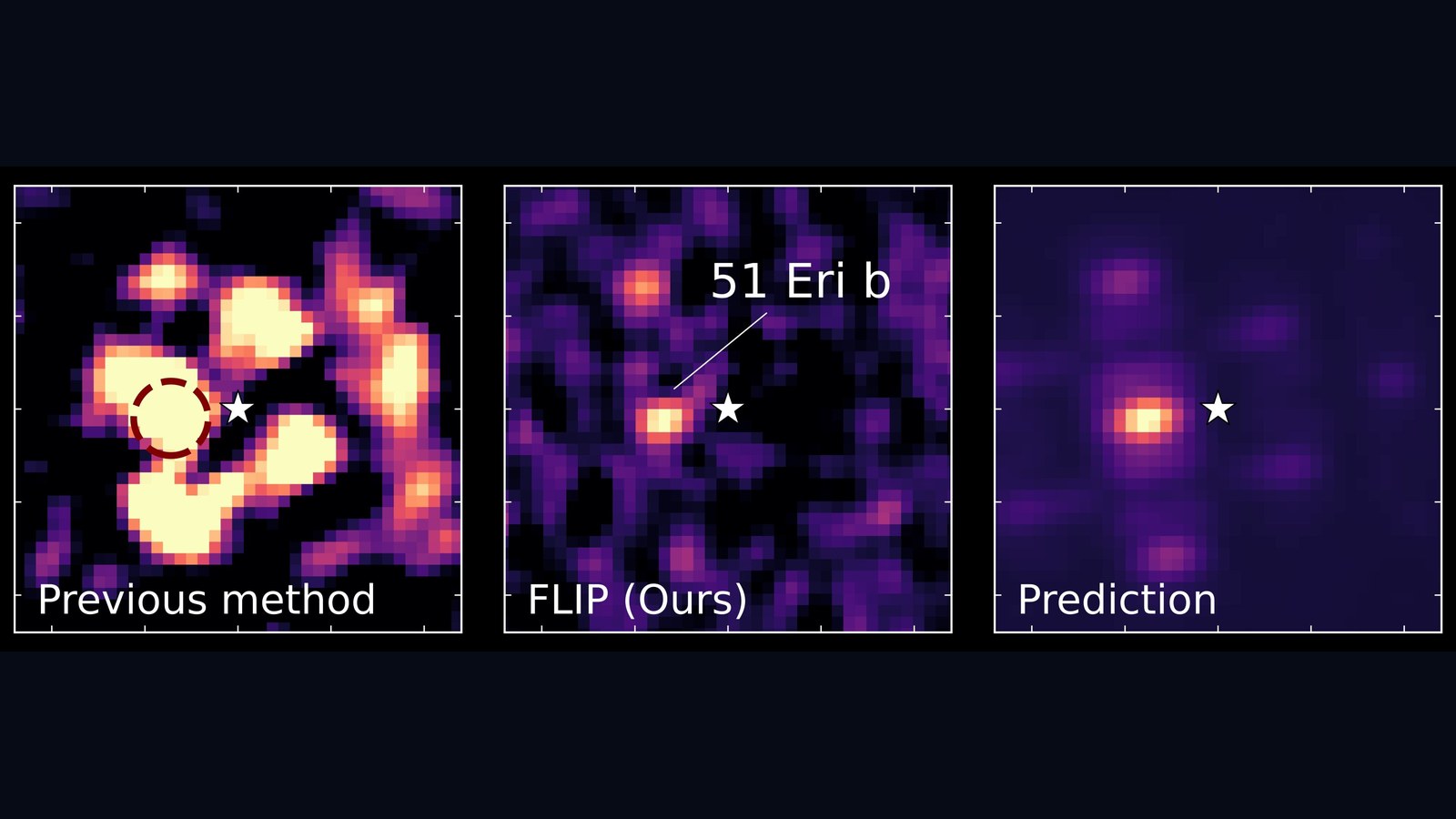
On Nov. 4, 2026, a Northwestern University–led team reported in Nature a new way to model and subtract that glare. When they reprocessed existing JWST Near-InfraRed Camera (NIRCam) images with the method, a known giant exoplanet — 51 Eridani b — appeared at 4.3 microns, a wavelength where earlier analysis had reported a non-detection.
What FLIP does
The tool is called Physics-based Learning for Imaging Planets, or FLIP. Instead of relying only on a reference photo of another star — the standard approach for the past two decades — FLIP builds a physics-based “digital twin” of how starlight travels through the telescope’s mirrors and reaches the detector.
Tiny shifts matter. Northwestern’s Rodrigo Ferrer-Chavez, who led the study, noted that changes on the scale of a few nanometers can reshape the glare pattern. The team fine-tuned millions of model parameters with the same style of optimization tools used to train AI systems. Co-author Jason Wang, an assistant professor of physics and astronomy at Northwestern, stressed the distinction: they used those computational tools, but they did not use AI to identify planets, because the physics of the telescope was already known.
Once the digital twin matched the unwanted starlight, the researchers subtracted that simulated glare from the real image.
The planet that was already there
51 Eridani b was discovered in 2015 with the Gemini Planet Imager on a ground-based telescope. It is a young, Jupiter-like world. What Webb adds is access to wavelengths that are hard or impossible from the ground — including about 4.3 microns, where carbon dioxide in a planet’s atmosphere absorbs infrared light.
That same absorption also makes the planet fainter at the wavelength astronomers most want. In a published JWST analysis that used the standard KLIP glare-subtraction method, 51 Eridani b was not detected in the F430M filter. When Ferrer-Chavez and colleagues ran FLIP on the same kind of observations, the planet emerged with a signal-to-noise ratio of 6.3 — the first image of 51 Eridani b at 4.3 microns, according to the Nature paper.
Find Eridanus in the night sky51 Eridani sits in the constellation Eridanus. Open the live sky map to see whether it is above your horizon tonight.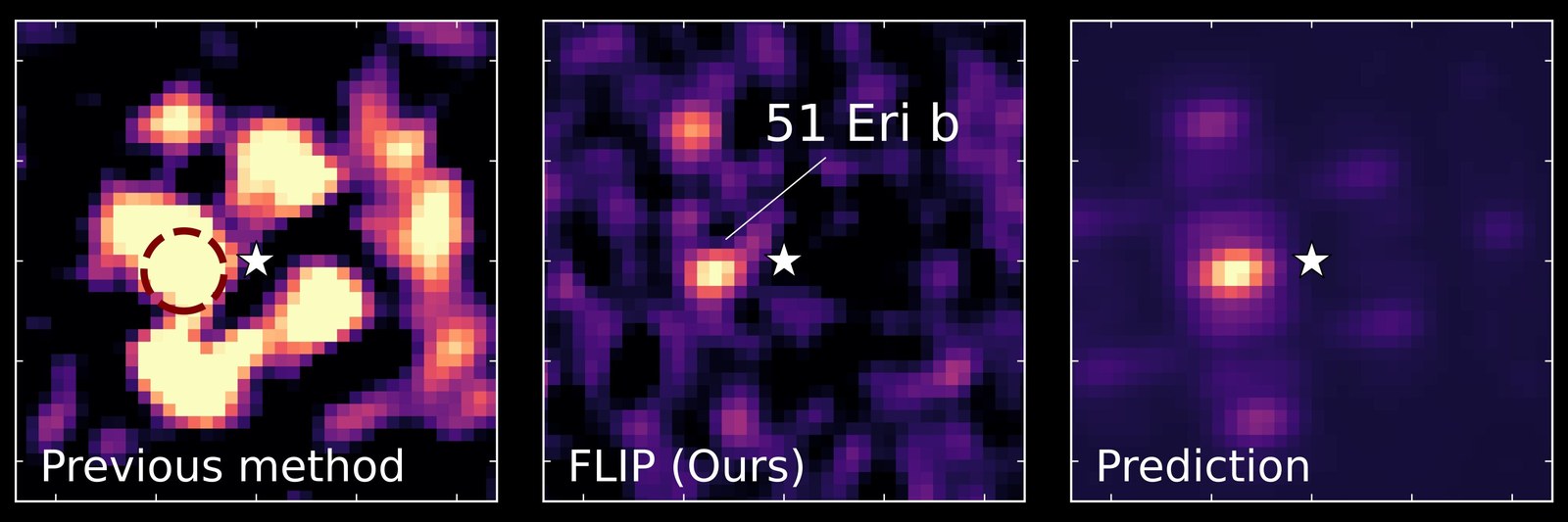
How much better
Across tests on HIP 65426, 51 Eridani, and TYC 5899 — a star with no known planets used to probe discovery potential — FLIP improved sensitivity to faint planets by about 2 to 15 times compared with standard processing. On TYC 5899, where the reference images were taken months earlier, the gain reached roughly 15 times at half an arcsecond from the star.
Wang put the practical point simply: the planet signal was already in the data. It was science left on the table until the right analysis tool arrived.
Why it matters beyond one planet
Detecting features at 4.3 microns can help constrain a planet’s atmosphere and composition. Carbon dioxide is a useful tracer of atmospheric metallicity; follow-up work can use the new detection to refine earlier evidence that 51 Eridani b may be metal-rich relative to its star.
Looking ahead, NASA’s proposed Habitable Worlds Observatory aims to image Earth-like planets around Sun-like stars. That mission may need optical stability at the picometer scale — hundreds of times more stable than Webb. FLIP points to another path: correct tiny imperfections in software instead of requiring a near-perfectly still telescope.
“We know of no planets around other stars that are like those in our own solar system,” Ferrer-Chavez said in Northwestern’s release. “It’s not that they don’t exist. It’s that we cannot see them.”
Bottom line: A physics-based glare model called FLIP recovered giant exoplanet 51 Eridani b in existing JWST images at 4.3 microns — the first detection at that wavelength — and boosted faint-planet sensitivity by up to 15 times without changing the telescope.
No Ground. Stay curious.