 No Ground
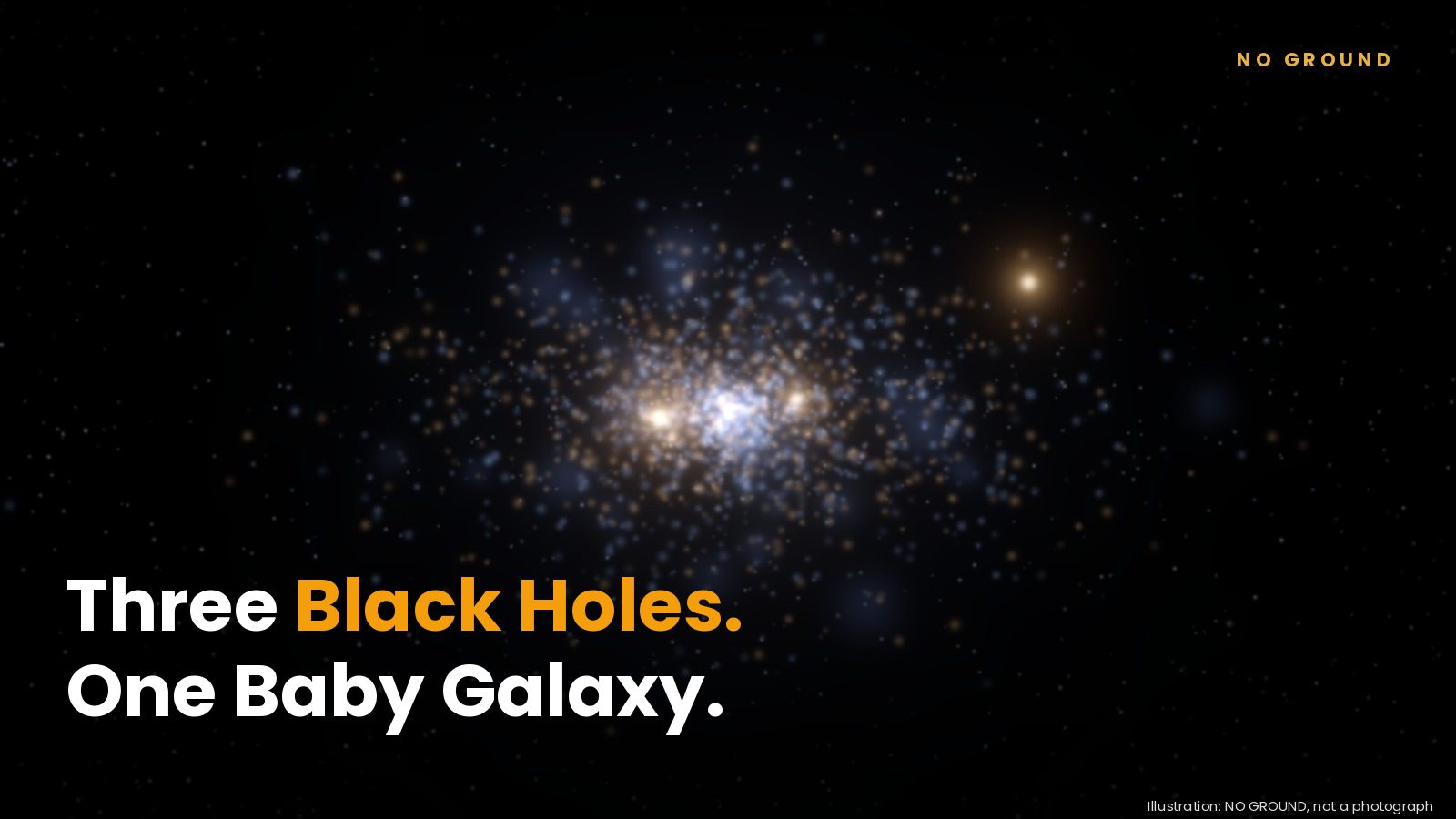
Imagine looking at a galaxy so far away that its light left 12.5 billion years ago, back when the universe was only about 1.2 billion years old. Now imagine that when astronomers looked closer, they found not one black hole at its heart, but three.
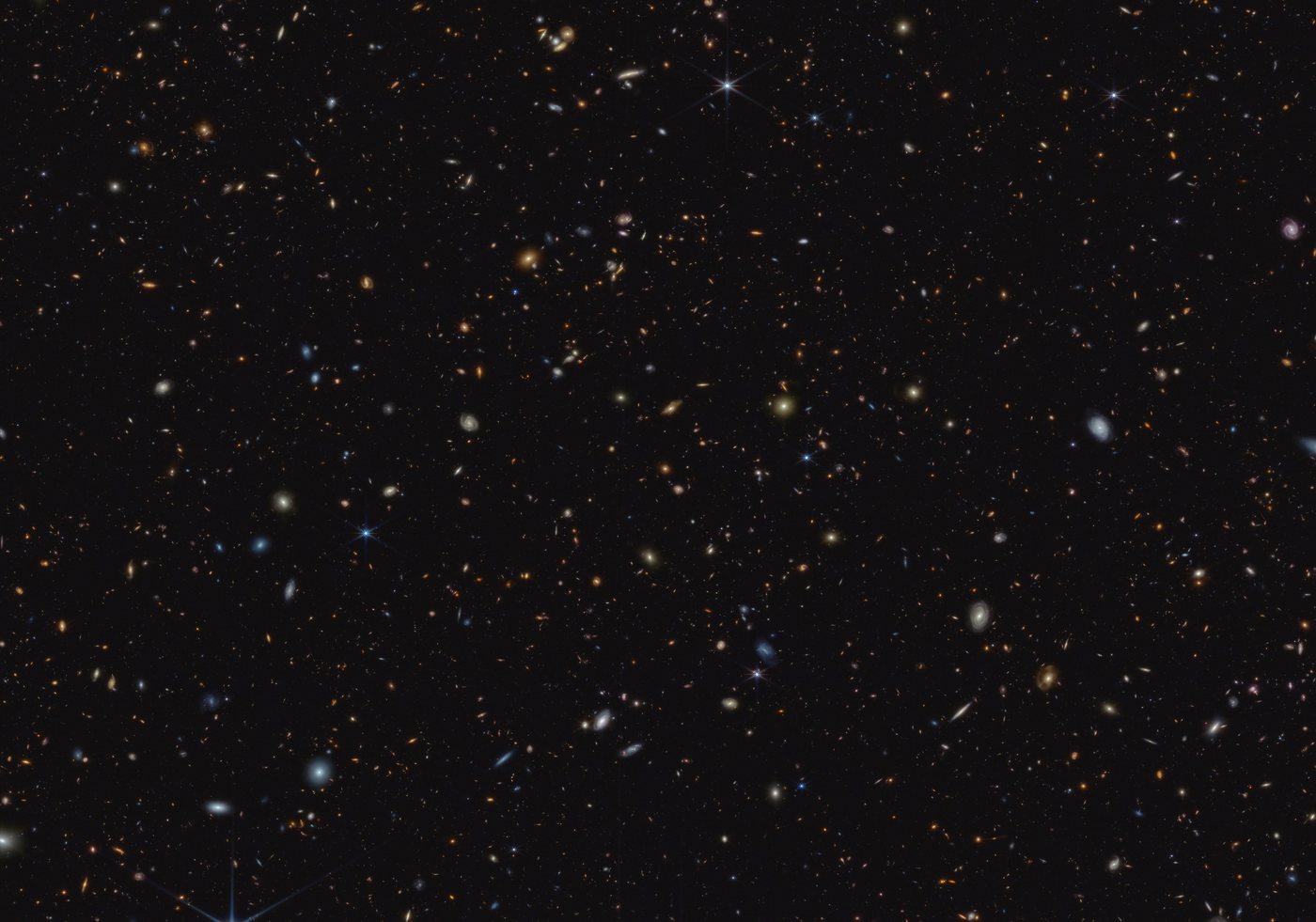
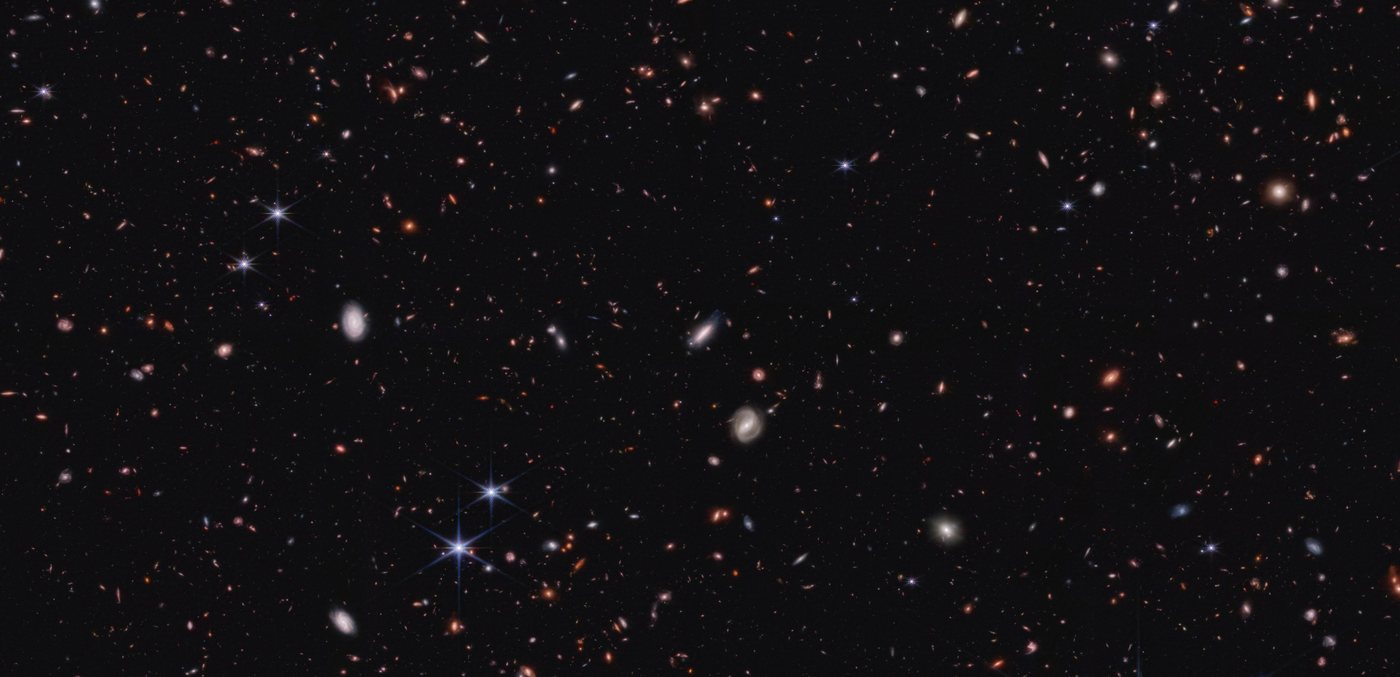
That is what an international team led by the Max Planck Institute for Extraterrestrial Physics reports in the galaxy J0148-4214. They used the James Webb Space Telescope and its NIRSpec instrument, which splits light into a spectrum for every point in a small patch of sky. The result was published in the journal Astronomy & Astrophysics.
All three black holes are active. That means gas is falling toward them, heating up and glowing. The telltale sign was hydrogen gas moving at enormous speeds, in places at thousands of kilometers per second, a pattern that points to material swirling around a massive black hole.
A tight pair, and a loner
Two of the black holes sit near the center of the galaxy, about 620 light-years apart. For comparison, the nearest star to our Sun is about 4 light-years away. The bigger of the two weighs roughly 80 million Suns. Its neighbor is far lighter, at roughly 600,000 Suns.
The third is about 5,500 light-years from the center, out in the galaxy’s outskirts, with a mass of roughly 2 million Suns.
Webb cannot see the two central black holes as separate dots. The team separated them by measuring how their glowing gas shifted position in the data, a technique called spectro-astrometry.
Why one galaxy with three is such a big deal
The whole galaxy holds only about 1.3 billion Suns’ worth of stars. The black holes make up a significant share of that, according to team member Giovanni Mazzolari. That is a lot of weight for a young galaxy to carry.
It also touches one of the biggest puzzles Webb keeps running into. Supermassive black holes seem to have grown very large very early in the universe’s history, and astronomers are still working out how. Co-author Roberto Maiolino of the University of Cambridge says this system suggests that merging may be “an additional, fast route” to that growth.
Explore your sky tonightLive sky map for where you are: planets, the ISS and bright stars above your horizon.Lead author Hannah Übler calls it the first evidence of three active black holes in a single galaxy this far back in cosmic time.
What happens next
The team expects the two central black holes to spiral together and merge, in well under a billion years. The smaller one may also be feeding faster than the usual theoretical speed limit for a black hole, known as the Eddington limit, though the measurement is uncertain.
The loner is a mystery. It may have been thrown outward when two black holes merged earlier, a kick known as a gravitational recoil. The authors consider that more likely than a three-body encounter. It could also be slowly sinking toward the center, where it would eventually join the others.
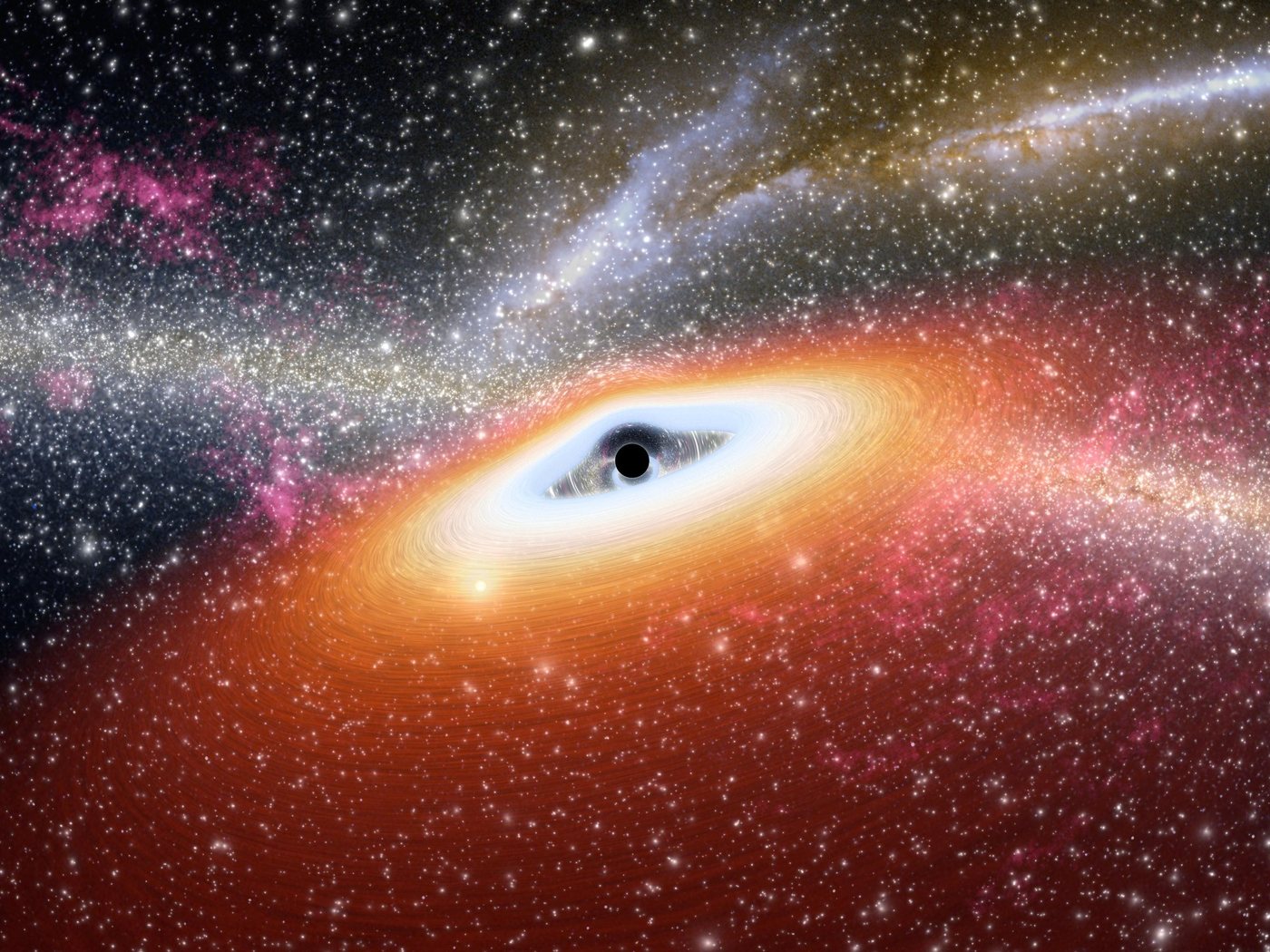
If the mergers happen, the ripples they send through space, called gravitational waves, might one day be detected by future observatories such as the planned LISA mission. The paper’s own estimates of the chances are rough and rest on simplifying assumptions, so treat them as a hope, not a forecast.
The team also thinks other distant galaxies may hide more than one black hole that nobody has noticed yet. We have mostly been looking for one at a time.
Bottom line: One young galaxy, seen 12.5 billion years back, holds three actively feeding black holes. Two may soon merge, and the third is a mystery.
No Ground. Stay curious.