Astronomers say they have picked up a radio signal from a planet outside our solar system — and, for the first time, pinned it on the planet itself, not its host star.
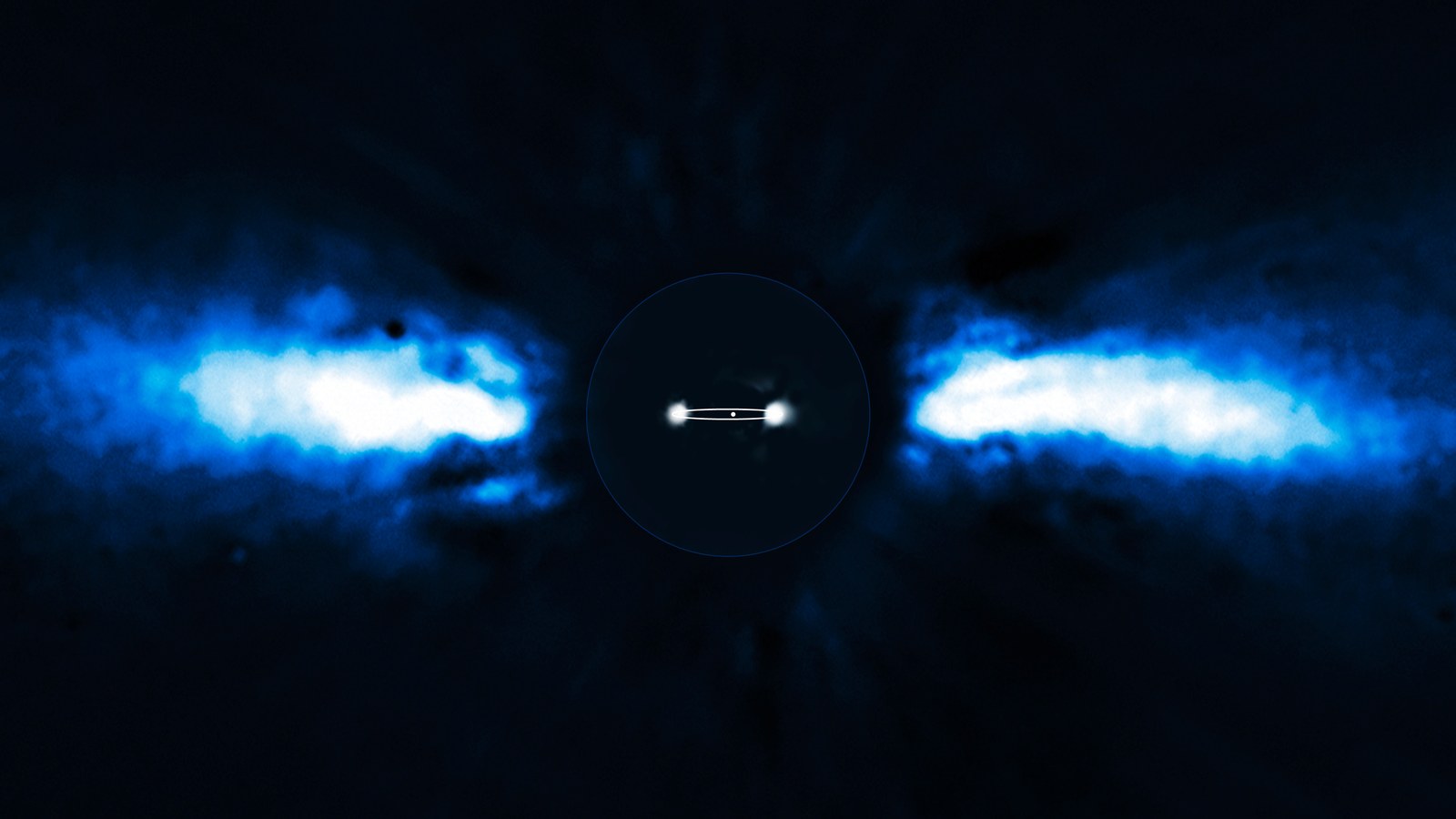
This is not about aliens. In a preprint posted to arXiv on 15 September 2026, Kevin N. Ortiz Ceballos, Edo Berger (Center for Astrophysics | Harvard & Smithsonian), and Yvette Cendes (University of Oregon) report that South Africa’s MeerKAT array detected recurring, highly circularly polarized radio bursts from Beta Pictoris b — a young gas giant about 64 light-years away (Gaia ≈19.6 pc).
The paper is still awaiting peer review. What follows is what the authors report in arXiv:2609.16720 — not a journal verdict yet.
Why this one is different
Planetary magnetic fields shape atmospheres and mediate stellar-wind interactions, but they have never been directly measured beyond the Solar System. One clear signature is auroral radio emission — the same family of glow Jupiter produces — made by the electron cyclotron maser instability. Its highest frequency tracks the magnetic field strength at the source.
Earlier searches often left an awkward ambiguity: planet or magnetically active star? The authors argue this case breaks that deadlock. After tying MeerKAT images to the Gaia frame, they find the radio source coincides with Beta Pictoris b and is inconsistent with the host star at about 4.4σ (and with planet c at about 4.8σ), including assessed systematics.
Not a message. Not the star. Auroral radio from a giant planet — if the localization holds under peer review.
What MeerKAT actually saw
Across four epochs in 2025 and 2026, in L band (~0.8–1.7 GHz) and S band (1.7–3.5 GHz), the team detects rapid, recurring bursts with circular polarization of about 40–70%, plus fainter emission between bursts. They identify the bursts as electron-cyclotron-maser (ECM) radiation. Emission up to 3.5 GHz implies a magnetic field of at least about 1.25 kilogauss at the emission site — the first such direct field-strength measurement claimed for an exoplanet.
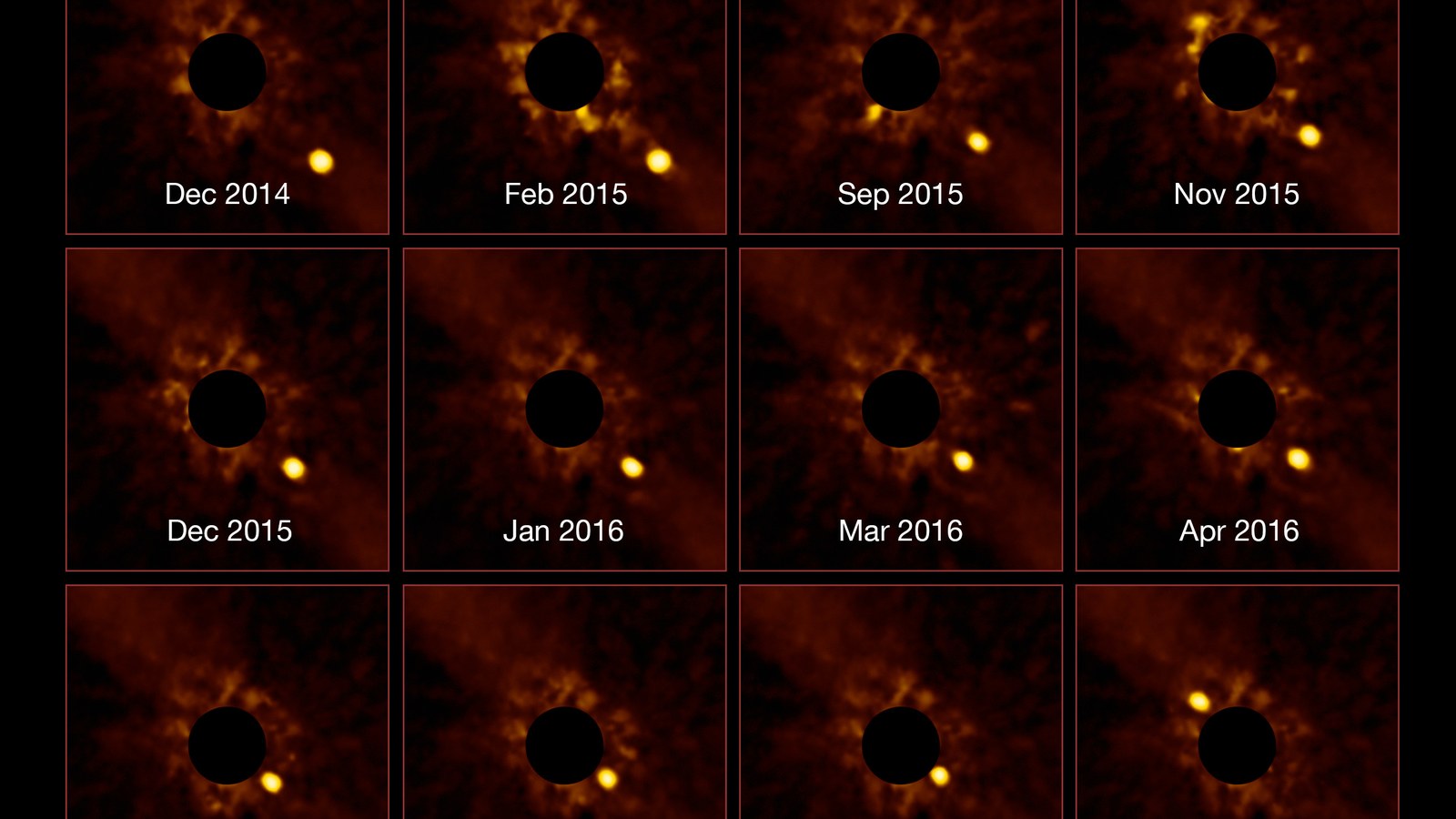
Beta Pictoris b is a natural target: a young (~23 Myr), massive planet (roughly 12 Jupiter masses in the orbital solution they cite), orbiting an A-type star that is magnetically quiet. The planet rotates in about 8–9 hours. The authors favor magnetosphere–ionosphere coupling driven by that fast spin over a stellar-wind or moon-driven scenario for the observed power.
What is confirmed vs preliminary
In the preprint so far: MeerKAT observed the system; the authors present a detailed astrometric case assigning the radio source to planet b; and they interpret the polarized bursts as auroral ECM emission implying B ≳ 1.25 kG.
Still preliminary: journal peer review has not finished, and independent teams have not yet confirmed the localization in print. Secondary ideas in the paper — such as whether weak X-rays once ascribed to the star might partly come from the planet — are flagged by the authors as speculation.
If the result holds, radio monitoring could probe exoplanet magnetic geometry, and other nearby directly imaged giants sit where the same localization method could work as instruments improve. For now: MeerKAT has reported the first auroral radio signal localized to a bona-fide exoplanet — and peer review will test that claim.
No Ground. Stay curious.