 No Ground
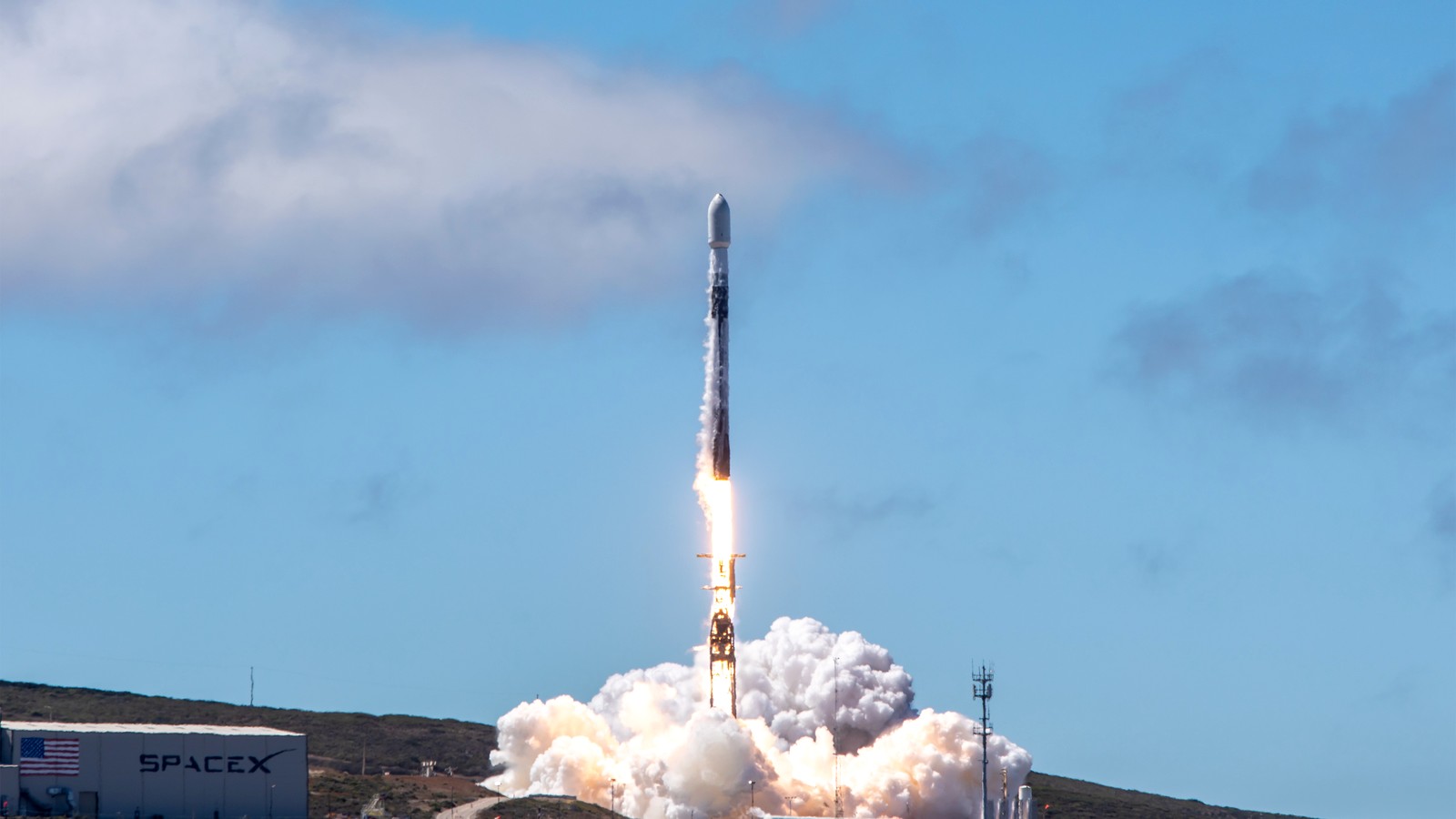
Update — Oct. 1, 2026: SpaceX’s dedicated smallsat rideshare Transporter-18 launched successfully at about 11:32 a.m. PT (2:32 p.m. ET) from Space Launch Complex 4 East at Vandenberg Space Force Base in California. A Falcon 9 lofted roughly 130 payloads toward a sun-synchronous low-Earth orbit — the second Falcon flight of a packed SpaceX day that had already sent NASA’s Crew-13 crew to orbit from Florida that morning.
One pad on the California coast. About 130 spacecraft headed for polar orbit. The booster came home to LZ-4.
Landing, then the long deployment chain
After stage separation, Falcon 9’s first-stage booster returned to Vandenberg and touched down at Landing Zone 4 (LZ-4). Mission coverage identified the booster as B1082 on its 25th flight — a reused vehicle that had previously flown USSF-62, NROL-145, OneWeb Launch 20, and multiple Starlink batches.
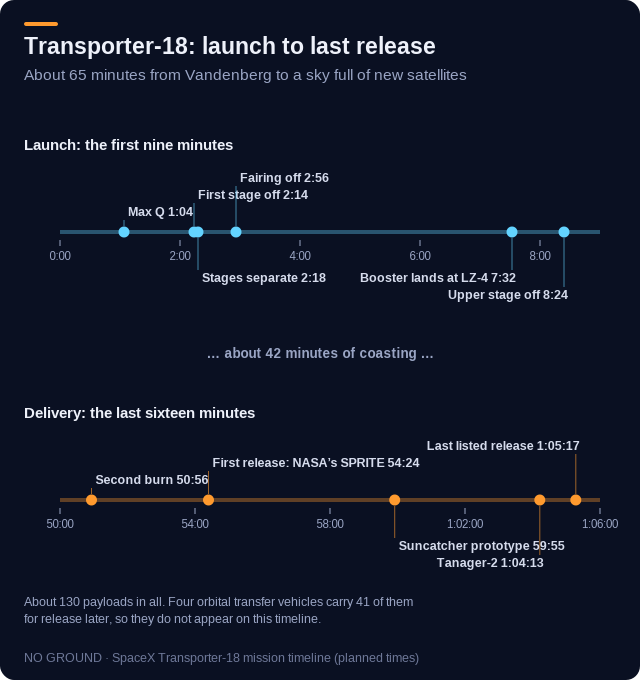
Upstairs, the second stage continued into orbit and began releasing satellites. Deployment work started about 54–55 minutes after liftoff and ran for roughly 11 minutes of sequential separations. SpaceX later confirmed that the rideshare deployment sequence had concluded at about 3:41 p.m. ET.
Official mission materials describe the stack as cubesats, microsats, and hosted payloads, plus two spacecraft with reentry vehicles and four orbital transfer vehicles carrying 41 payloads scheduled for later release. Across the Transporter program, SpaceX says it has now flown more than 1,800 rideshare payloads to orbit.
Explore your sky tonightLive sky map for where you are: planets, the ISS and bright stars above your horizon.Why the long wait before deployment?
The timeline looks strange at first. The booster was back on the ground at LZ-4 seven and a half minutes after liftoff, and the upper stage shut down about a minute later. Then, for roughly 42 minutes, nothing seems to happen. In SpaceX’s timeline, the upper stage fired again at 50 minutes 56 seconds for a burn of only a few seconds, and the first satellite, NASA’s SPRITE CubeSat, left the stack at 54 minutes 24 seconds.
That pause is how rockets reach a particular orbit efficiently. The first burn puts the stage into an initial orbit; it then coasts around Earth to the point where a short second burn can shape the final orbit the customers want. After that, the satellites leave one at a time, spaced out over about 11 minutes, so they drift apart instead of bumping into each other. Google’s Suncatcher prototype was released at 59 minutes 55 seconds and Planet’s Tanager-2 at 1 hour 4 minutes, with the last spacecraft on SpaceX’s list at 1 hour 5 minutes 17 seconds.
What sun-synchronous means
Most Transporter passengers want a sun-synchronous orbit. According to ESA, this is a kind of polar orbit, usually 600 to 800 kilometres up, in which a satellite stays in step with the Sun. It passes over any given place at the same local time every day. ESA’s example is passing over Paris daily at noon. Because the lighting and shadows are the same each time, images taken weeks or years apart can be compared directly. That makes the orbit ideal for tracking forest fires, floods, crops, ice or methane leaks, which is exactly what many of Transporter-18’s Earth-observation satellites do.
Not every customer wants to stay where the rocket drops them. Four of the passengers were orbital transfer vehicles, sometimes called space tugs, carrying 41 smaller payloads between them. A tug can fire its own engine later to move its cargo to a different altitude or orbit, then release it. So SpaceX’s count of about 130 payloads includes 41 that were still riding on their tugs when the Falcon 9’s part of the job was done.
Project Suncatcher and a crowded manifest
Among the highest-profile riders: a prototype for Google’s Project Suncatcher, manifested by Planet Labs. Google describes Suncatcher as a research moonshot to test how its Tensor Processing Units (TPUs) — chips built for machine-learning workloads — handle launch stress, radiation, vacuum cooling, and heat in orbit. Planet also flew Tanager-2, a methane-tracking satellite tied to Carbon Mapper, on the same mission.
The rest of the stack looked like a cross-section of the smallsat economy: Earth-observation birds (including ICEYE SAR spacecraft and Satellogic optical sats), GHGSat methane monitors, Sateliot IoT satellites, NASA’s SPRITE CubeSat, StarCatcher’s Protostar power-beaming demonstrator, Starfish Space’s first Otter servicing vehicle for NASA’s SSPICY effort, and reentry capsules from Varda Space Industries — among many others listed on SpaceX’s deployment timeline.
Why this flight matters
Transporter flights are how a lot of modern space gets to orbit without owning a rocket: shared Falcon 9 rides to sun-synchronous orbits that favor Earth-imaging and climate monitoring. Today’s flight also sat in the middle of an ambitious SpaceX tripleheader — Crew-13 in the morning from the Cape, Transporter-18 from Vandenberg in the afternoon, and a Falcon Heavy National Reconnaissance Office mission later from Florida.
For Google and Planet, Suncatcher is an early on-orbit data point, not a finished constellation. For everyone else on the manifest, it is simpler: another reliable path from California fog to polar daylight. The countdown is over. The satellites are on their way.
Shared rides carry a shared risk, too: when a rocket fails, every passenger is lost at once. In mid-November, United Launch Alliance’s Vulcan failed on the way to orbit with 40 Amazon satellites aboard. Transporter-18 went the other way: a booster on its 25th flight, a clean landing and a full deployment.
No Ground. Stay curious.