Look east after sunset this week and you are not staring at “just another bright star.” That steady golden point is Saturn — and for 2026, it does not get better than this.
On October 4, Earth slid between the Sun and Saturn. Astronomers call that geometry opposition: Saturn sits opposite the Sun in our sky, rises around sunset, stays up for much of the night, and reaches its closest and brightest for the year. NASA’s October 2026 skywatching tips put opposition squarely on the calendar. The rest of this week is the hangover — the easy part, when the geometry is still excellent and anyone with clear skies can take a look.
This is not a distant deep-space mystery. It is a planet in our own solar system, about 70 light-minutes away at closest approach, wearing the rings that still stop people mid-sentence the first time they see them through a backyard telescope.
What “opposition” actually means
Opposition is a word that sounds technical and turns out to be simple. Earth orbits the Sun faster than Saturn. Once a year we catch up, pass “inside” Saturn’s orbit relative to the Sun, and for a moment the three bodies line up: Sun, Earth, Saturn. From the ground, Saturn is then opposite the Sun — hence the name.
That lineup has three practical gifts for skywatchers. First, Saturn is closest to Earth for the year. For the 2026 opposition, that distance was about 8.43 astronomical units — roughly 1.26 billion kilometers, or about 784 million miles. Second, the planet’s disk appears largest through a telescope: about 19.7 arcseconds across. Third, it shines at about magnitude 0.3 — bright enough to outshine ordinary stars in that part of the sky, even if it remains the faintest of the classic bright planets.
Saturn was in front of the constellation Cetus at opposition. You do not need to know Cetus by heart. After dusk, look toward a clear eastern horizon for a steady, non-twinkling golden light climbing upward. As the night turns, it arcs across the southern sky (from mid-northern latitudes) and sets in the west near dawn. Through the middle of the night it is highest — the best time for a sharp telescopic view, when it sits above the thickest, shakiest air near the horizon.
Fully lit — and why that matters
Opposition also means Saturn is fully illuminated as seen from Earth. We are looking almost “Sun-behind-us” toward the planet, so the dayside faces us. There is no crescent Saturn in the evening sky the way there can be for an inner planet. The globe is lit. The rings are lit. What you see in a telescope is the classic postcard orientation: a pale banded world wearing a hard-edged disk of ice.
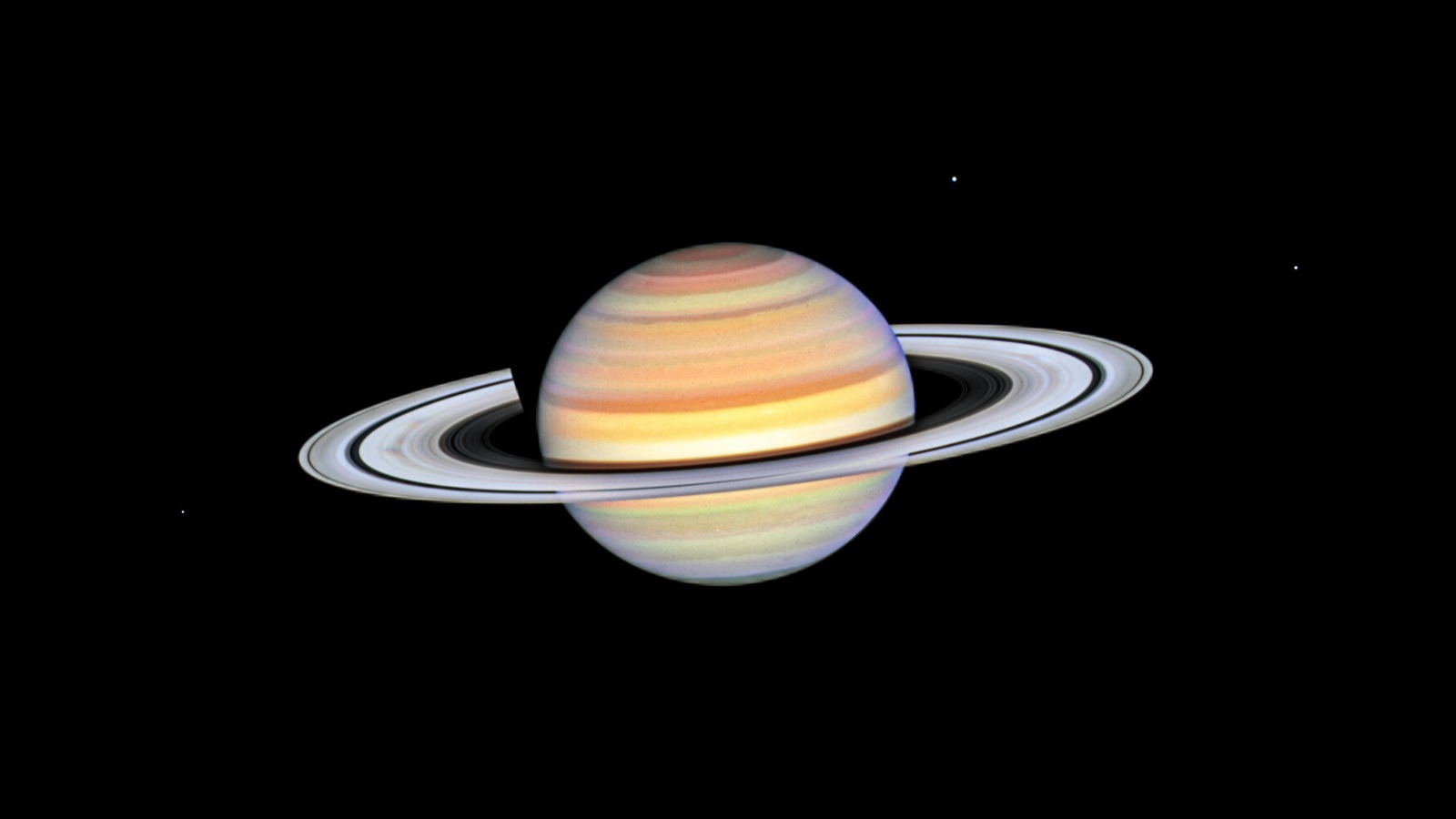
Those rings are not solid. Spacecraft and telescopes have shown thousands of ringlets of ice and rock, from gravel to house-sized chunks, orbiting in a system only about as thick as a skyscraper is tall over a span of hundreds of thousands of kilometers. From Earth this week you will not resolve every gap — but even a small telescope will show the famous silhouette: the bright A and B rings, the dark Cassini Division between them, and the planet’s shadow cutting across the far side of the ring plane when the geometry is right.
The rings are opening again
Saturn’s rings do not always look the same year to year. The planet is tilted about 27 degrees, so as it orbits the Sun over nearly three decades, our view of the ring plane slowly opens and closes. Roughly every 13 to 15 years, Earth passes through the ring plane and the rings appear edge-on — nearly invisible in small telescopes for a few weeks.
We went through that crossing in March 2025. The rings are opening again now. In October 2026 they are tilted about 7.5 degrees south relative to earthly viewers — still shallow compared with the dramatic “wide open” years, but clearly readable. That is part of what makes this week’s portrait feel special: Saturn is at peak brightness and distance for the year, and the rings are coming back into view after their near-vanishing act.
How to see it tonight
You do not need a research observatory. You need darkness, patience, and either sharp eyes or a small optic.
Naked eye: Clear eastern horizon after sunset. Look for a steady golden light — not an airplane, not a hard twinkle. Give your eyes a few minutes off phone screens.
Binoculars: Steadily held or tripod-mounted binoculars often turn Saturn into a soft oval instead of a point. That alone separates a star from a world.
Small telescope: Even a modest beginner scope will show the rings. Find Saturn at low power, then increase magnification. Expect a pale cream disk with subtle banding; Titan may appear as a nearby speck if your chart marks it. Opposition week is forgiving — if dusk is cloudy, try again near midnight or before dawn.
What Hubble sees that your backyard cannot
The photograph on this page — and Hubble portraits from NASA and ESA — show detail no backyard scope will match: seasonal weather, faint ring “spokes,” tiny moons, and color that shifts with filters. Hubble’s Outer Planet Atmospheres Legacy (OPAL) program has watched Saturn year after year for roughly a decade. Cassini’s 13 years in orbit still define many of the mosaics we know by heart; Webb has added infrared views where the icy rings blaze. Your telescope will not copy those frames. It will do something else: put a real world in your eye tonight — the same Saturn those missions studied, hanging over a tree line or a rooftop.
A week, not a minute
Opposition is a moment on the calendar (about 12:00 UTC / 8 a.m. EDT on October 4). The best viewing window is broader. For weeks around opposition, Saturn remains brighter and closer than at any other time in 2026. NASA’s October skywatching note is blunt about the opportunity: opposition makes the ringed planet visible for much of the night — one of the year’s best chances to see it.
So this week is not a countdown you already missed. It is an invitation still open. Walk outside after dusk. Find the golden point in the east. If you have a telescope, point it. If you do not, borrow one, visit a public star party, or just stare — knowing that light left Saturn about an hour and ten minutes ago and finished its trip in your eye.
Closest. Brightest. Fully lit. The rings, opening again. That is Saturn at its best for the year — and it is happening now.
No Ground. Stay curious.