Most planets form with their stars. This one — if it is real — may have formed after its star died.
In a paper published today in Nature Astronomy, a University of Warwick–led team reports what it calls a second-generation planet candidate around the white dwarf HS 0209+0832. The word that matters is candidate. The evidence is strong. It is not a locked, photographed confirmation. It is a cold case that suddenly looks like a world remade from wreckage.
White dwarfs are the collapsed cores left when ordinary stars run out of fuel and shed their outer layers. Astronomers already knew many of them are “polluted”: their atmospheres carry metals that should have sunk long ago, usually from rocky debris raining onto the star. Silicon and iron typically dominate that chemistry — the rock-forming elements of worlds like Earth.
HS 0209+0832 did not look like that.
Hubble first observed the star in 1999. The far-ultraviolet spectrum held roughly a hundred absorption lines nobody could name. Lead author Jamie Williams, a PhD student at Warwick, went back to those archives with updated atomic data. Many of the mystery lines matched niobium. Zinc and copper showed up in unusual strength too. Silicon and iron — the usual rock signature — are depleted. Nature Astronomy and Warwick both highlight that this is the first time niobium has been identified in a white dwarf’s atmosphere, at levels more than a thousand times higher than in the Sun.
Those heavy elements are not random. They are a fingerprint of the slow neutron-capture process — the “s-process” — that builds nuclei heavier than iron inside dying stars during the asymptotic giant branch phase. “This pattern of elements is a telltale sign of the ‘s-process,’” said co-author Nicholas Stone of the University of Wisconsin–Madison in Warwick’s release. “It's a chemical signature no ordinary, ‘first-generation’ planet should carry.”
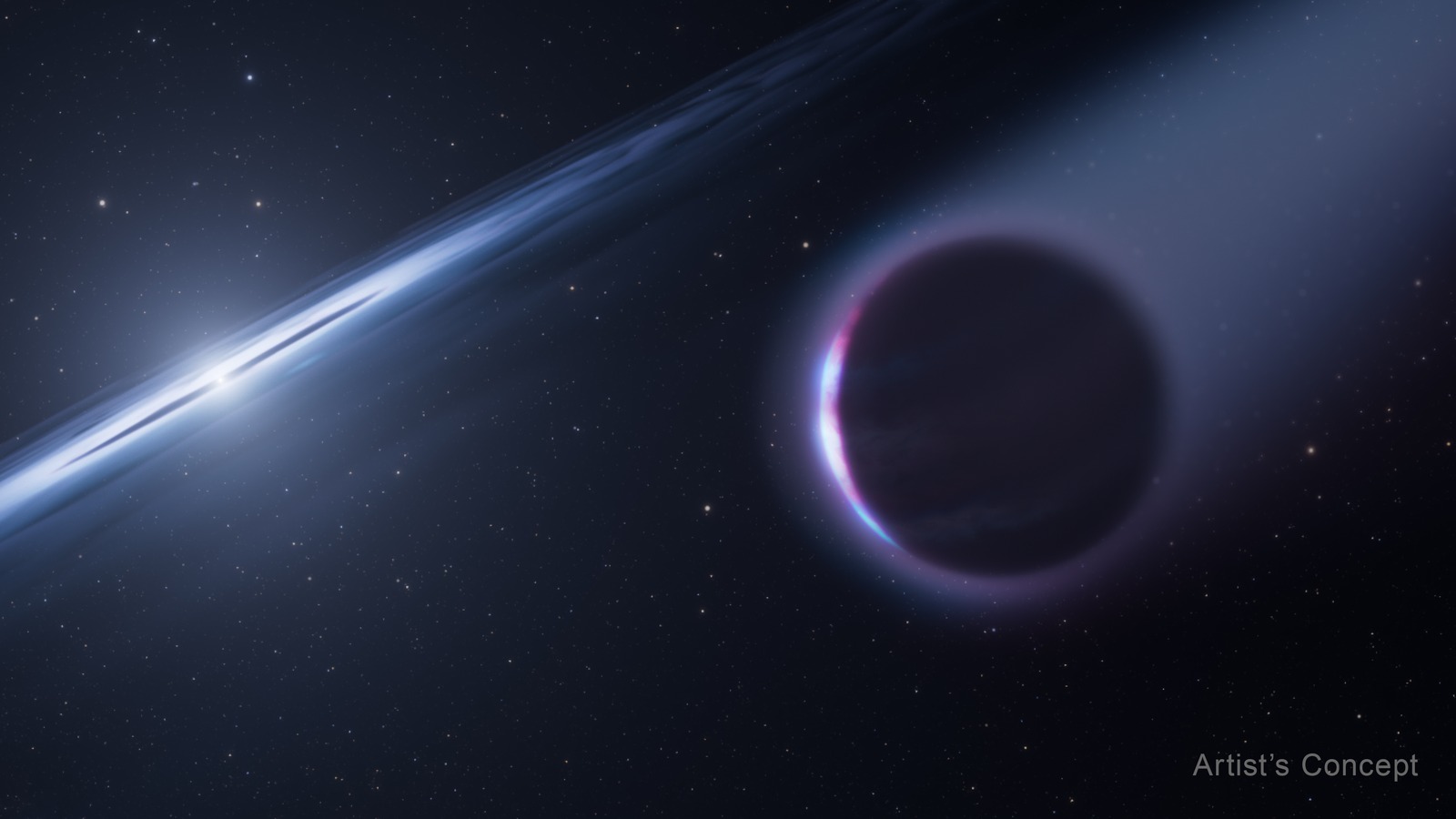
The team’s best explanation: a Jupiter-sized gas giant formed from material the progenitor star cast off as it died. Because the white dwarf is still young and hot — about 35,800 kelvin, with a cooling age of roughly five million years — its radiation is stripping the planet’s outer atmosphere. Some of that gas falls onto the white dwarf, which is how Hubble and NASA’s retired FUSE mission read the chemistry in the star’s light.
NASA’s TESS satellite adds a second line of evidence. Over four months of observations, researchers found a faint brightness cycle repeating every 4.399 ± 0.026 days. That period fits a close-in giant planet at about 0.04 astronomical units — roughly 3.7 million miles (6 million kilometers) from the white dwarf, far inside Mercury’s distance from the Sun. The paper attributes the signal to day–night temperature contrast on a tidally locked world, or possibly a cometary tail of evaporating gas crossing the line of sight.
Williams put the idea in plain language for Warwick’s press office: “It's a bit like finding a planet that has risen from the ashes of the very star it once orbited.” The “phoenix” nickname is journalism, not a formal catalog name. The paper’s own title still says planet candidate.
Forming such a world is hard. A lone star that sheds mass symmetrically does not easily leave a disc. The team argues HS 0209+0832 likely needed a companion that pulled ejected material back into orbit — a short-lived second-generation disc rich in s-process elements, from which a giant planet could condense or grow an atmosphere.
Professor Boris Gänsicke of Warwick, an ERC grantee on the work, said the remarkable part is not a survivor from the system’s birth, but a world built from the star’s own cast-off material. If confirmed, HS 0209+0832 would be the first white dwarf shown to host a second-generation planet — opening a search for the same carbon and heavy-element signature in other dead stars.
What this is not: a discovery of life, a photograph of the planet’s surface, or a closed case. It is archival Hubble spectroscopy, FUSE confirmation of niobium, TESS timing that fits a close-in giant, and a chemical pattern that does not match Solar System rock. That is enough to make the universe look stranger — and to keep the word candidate on the page.
No Ground. Stay curious.
Tags: white dwarf, second-generation planet, phoenix planet, Hubble, TESS, HS 0209+0832, Warwick, Nature Astronomy