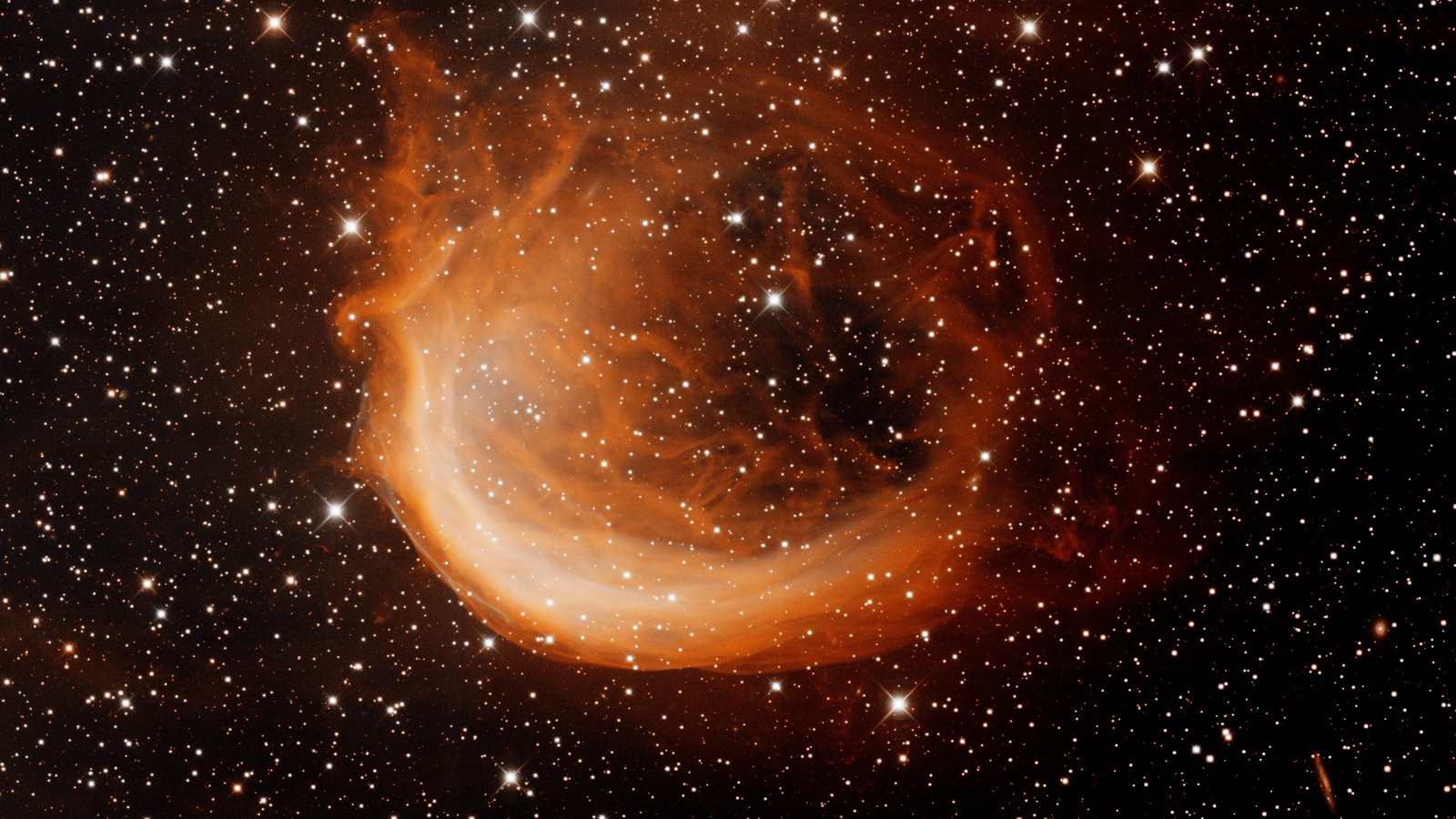
Look long enough at Cassiopeia’s W and you will find a faint crescent that does not belong to any cartoon. Catalogued as Sh2-188 — and nicknamed the Shrimp Nebula — it is a planetary nebula: the outer layers of a Sun-like star, shed late in life and lit by the hot core left behind.
That core is now a white dwarf, racing through the thin gas between the stars. The shrimp shape is not a joke of the imagination. It is a bow shock — the glow of gas piled up where the nebula plows forward, like the wave ahead of a boat.
Not a bubble. A wake.
Most planetary nebulae look roughly round because their shells expand into relatively calm surroundings. Sh2-188 does not get that luxury. Models that match its bright southeastern arc and faint trailing filaments need the central star moving at about 125 kilometers per second relative to the interstellar medium — roughly the speed of a jet airliner, but for a stellar remnant several thousand light-years away.
Ahead of the motion, the shell compresses and brightens into a sharp, filamentary limb. Behind it, faint material stretches downstream. Deep hydrogen-alpha imaging has even shown a thin opposite arc and a long tail — evidence that most of the mass lost earlier may already have been swept that way.
The shrimp is not decoration. It is motion made visible.
What “planetary” actually means
The word is historical, not literal. Through small telescopes, some of these shells looked disk-like, so astronomers borrowed the language of planets. Physically, a planetary nebula is a late chapter for stars with roughly the Sun’s mass: the envelope drifts outward while the exposed core floods it with ultraviolet light until the gas fluoresces.
In Sh2-188’s case, that fluorescence is strongest where the remnant rams into ambient gas. Compress the leading edge and it brightens — which is why the “body” of the shrimp reads so clearly in long exposures, even though the nebula is faint to the naked eye. On the sky it spans roughly half the Moon’s angular diameter, yet you will not stumble on it without a dark sky, filters, or a photograph.
Distance estimates still carry wide uncertainty — often cited near 850 parsecs, on the order of 2,800 light-years — but the geometry of the shock does not wait for a perfect yardstick. Proper motion of the central star points toward the bright limb. Speed and shape tell the same story.
Standing under Cassiopeia
You do not need to see the shrimp with your own eyes for the idea to land. Somewhere under that familiar W, a dying star’s leftover core is still moving — still pushing a glowing front through the thin weather of the galaxy. The light that reaches you tonight left years ago. The motion is still happening.
Tonight the sky holds a shrimp-shaped wake of hydrogen and oxygen. You are under it. The white dwarf is still racing. The bow shock is still bright.
No Ground. Stay curious.