For a few thousandths of a second, something in a faraway galaxy blazed in radio waves. Then it was gone.
By the time that flash reached a radio telescope in South Africa on March 4, 2024, it had been travelling for more than 10 billion years. It started out when the universe was only about 3 billion years old.
The signal is called FRB 20240304B, and it is now the most distant fast radio burst ever traced back to its home galaxy. In a study published Oct. 8 in the journal Science, a team led by Manisha Caleb of the University of Sydney used NASA’s James Webb Space Telescope to find that home. It looked nothing like what they expected.
A flash nobody can explain
Fast radio bursts were first discovered in 2007. They are millisecond-long blasts of radio energy from far beyond our galaxy, and most are seen once and never again.
“What makes fast radio bursts interesting is that we don't know what generates them. We have theories for what objects produce them, but we don't have conclusive proof,” Caleb said in the NASA and ESA release.
Caught in South Africa, invisible from the ground
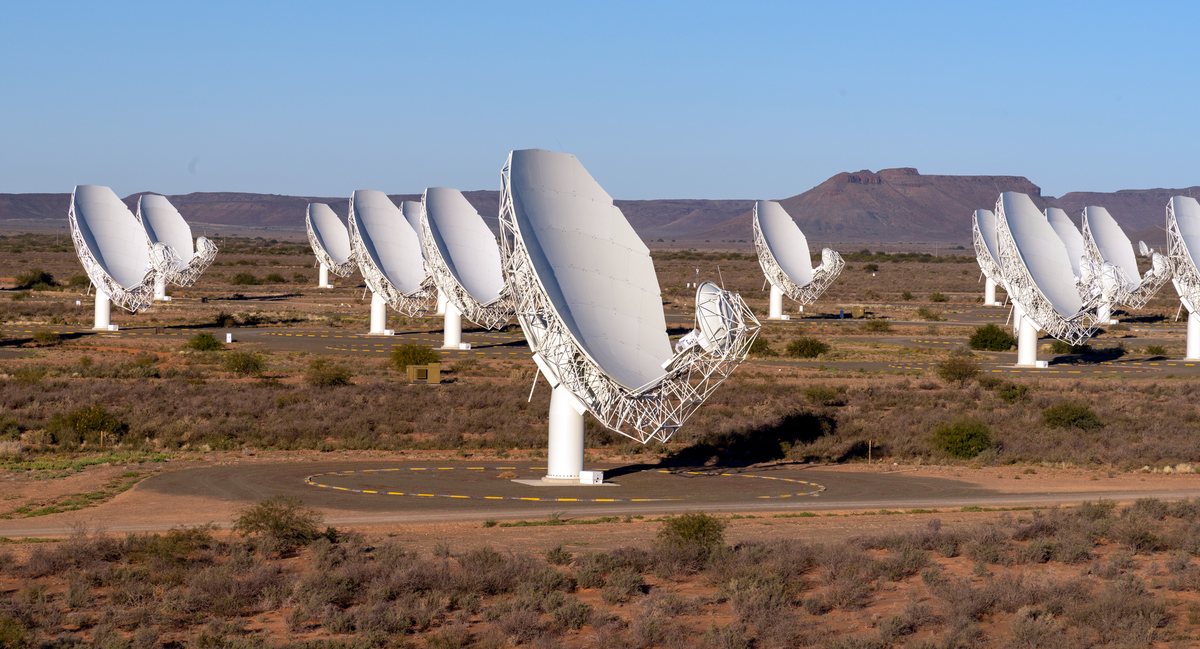
The burst was picked up by MeerTRAP, a system on the MeerKAT radio telescope built to catch fast-changing signals in real time. The first clue to its distance was in the signal itself. Its higher radio frequencies arrived slightly ahead of the lower ones. Astronomers call this dispersion. The more charged gas a signal crosses, the bigger the delay, and this burst showed a lot of it.
The team pinned down exactly where the burst came from, then searched that spot with the W. M. Keck Observatory in Hawaiʻi. They found nothing.
“We pointed it right at the location of the FRB and looked as deeply as we could from Earth, but there was simply nothing to see,” said co-author J. Xavier Prochaska of the University of California, Santa Cruz. “We immediately concluded: If we wanted to find the source, we had to go to space.”
Webb finds a faint smudge
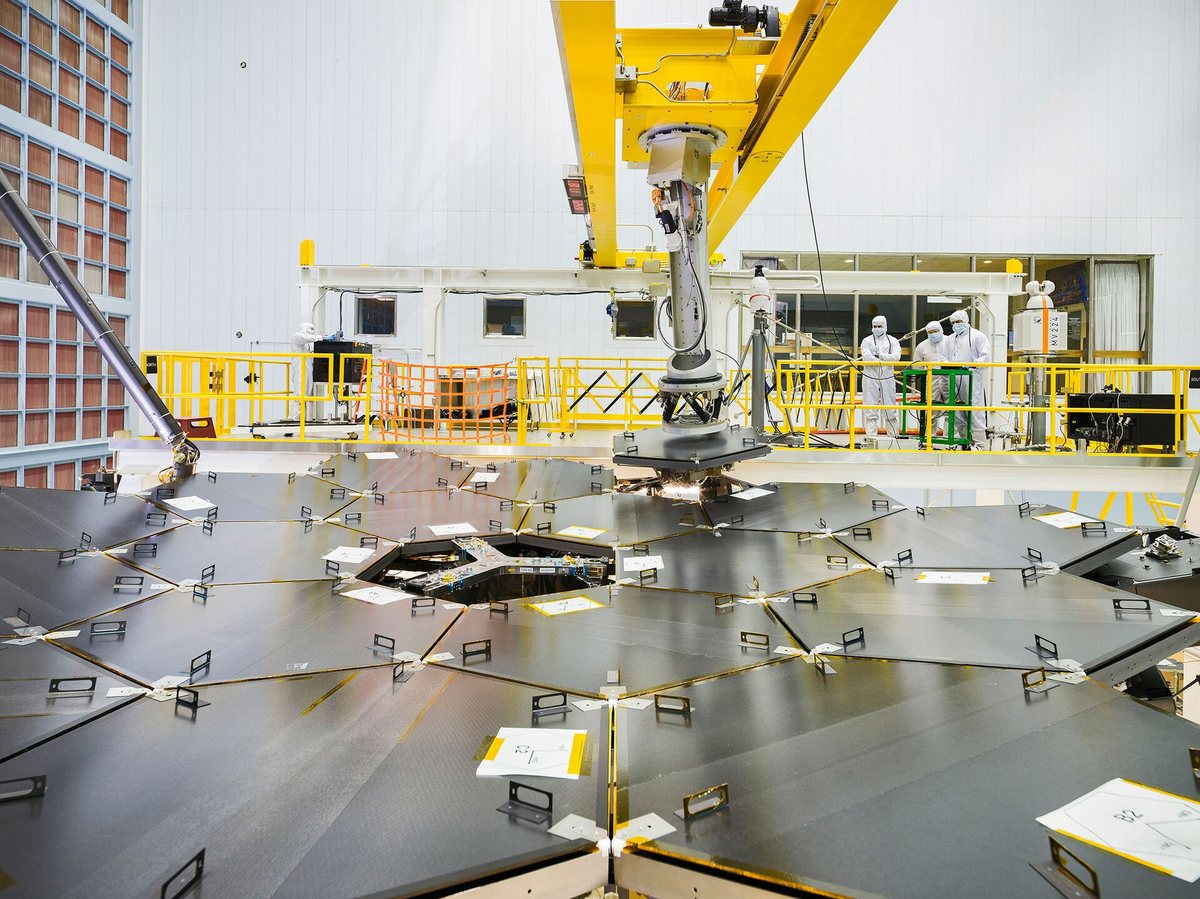
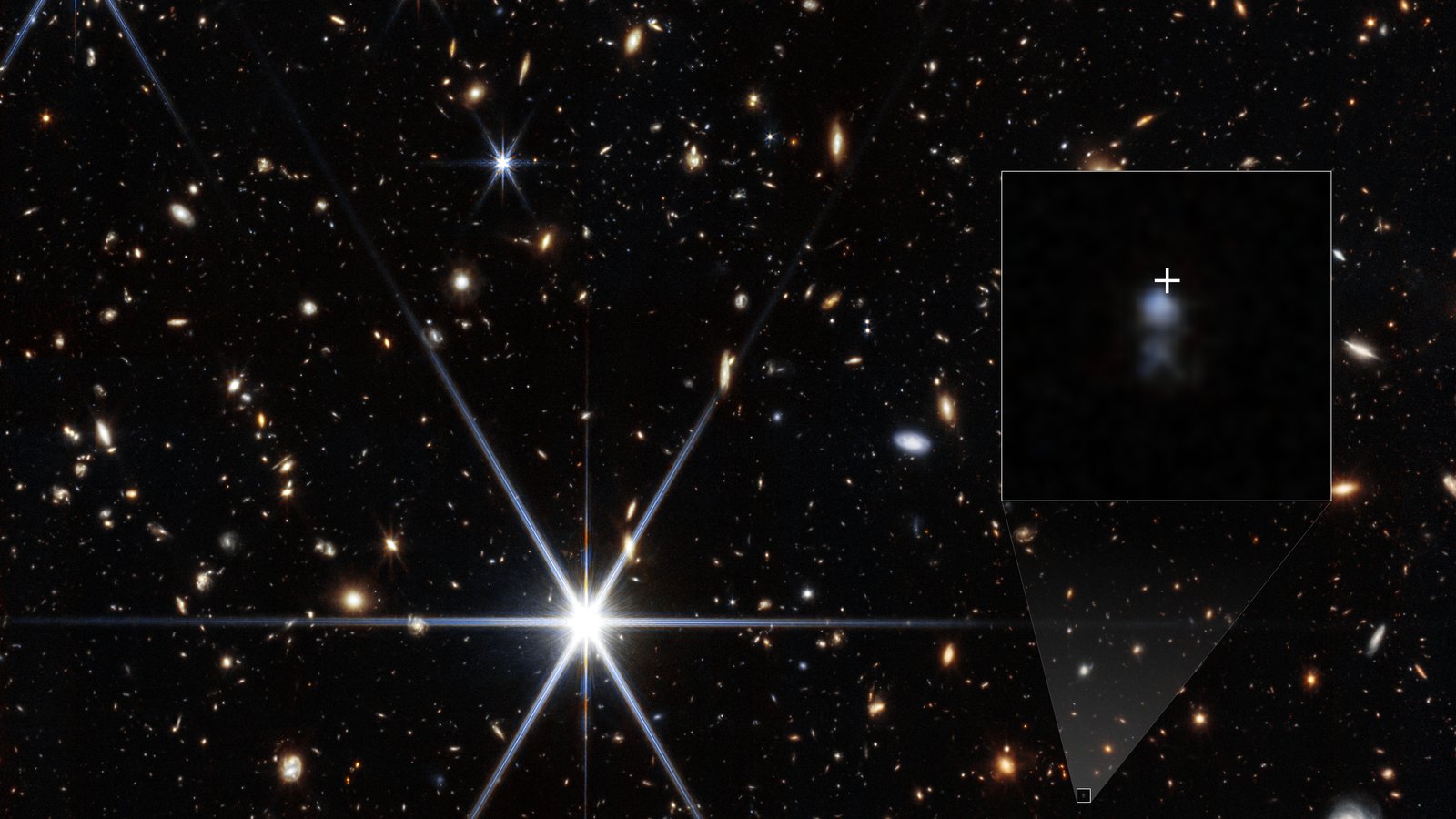
Webb’s infrared camera, NIRCam, found a tiny, faint galaxy right at the burst’s position. It is the one in the box at the top of this page. Webb’s spectrograph, NIRSpec, then split its light into colors.
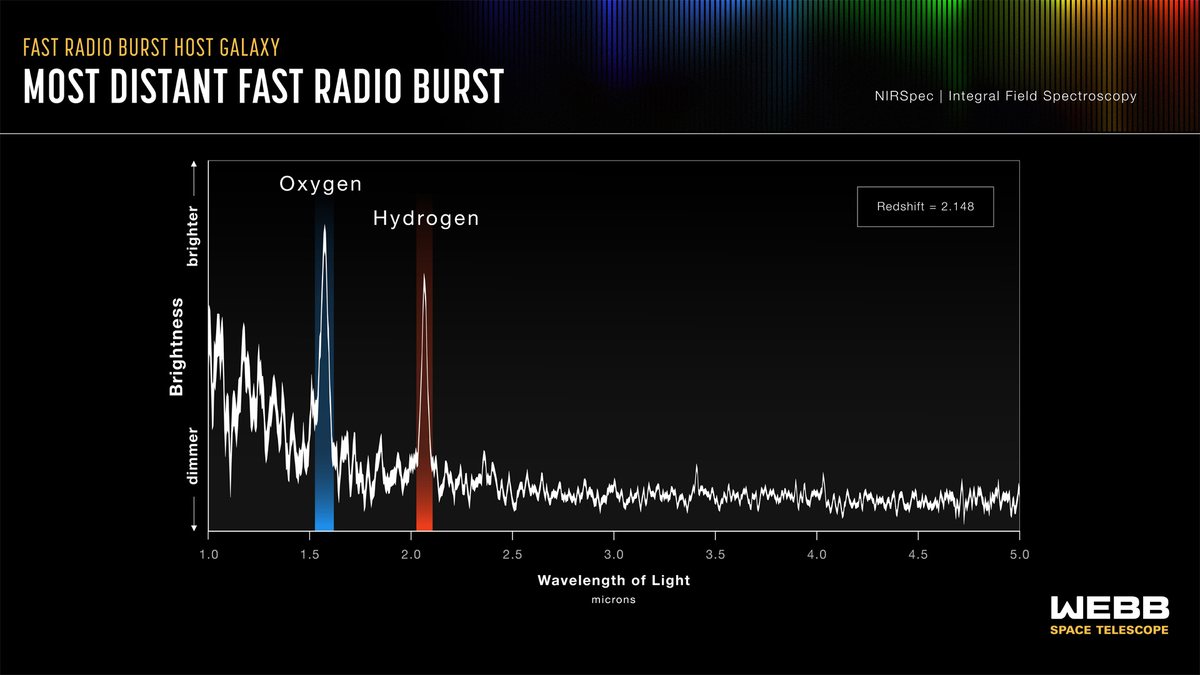
Glowing oxygen and hydrogen stood out, stretched to redder wavelengths by the expanding universe. The amount of stretching, called redshift, came out to 2.148. That puts the burst just 3 billion years after the Big Bang.
A quick note on “how far.” The authors write that the light left this galaxy about 10.6 billion years ago. That is how long the light was travelling, not a distance in light-years. Space kept stretching the whole time, so the galaxy is much farther than 10.6 billion light-years from us today.
The previous record holder was FRB 20220610A, found by Australia’s ASKAP telescope in June 2022. It sat at a redshift of 1.016, and its light took about 8 billion years to reach us. The new burst roughly doubles that redshift.
A tiny galaxy with a big clue
The galaxy was the real surprise. Most galaxies that host fast radio bursts are big, star-forming galaxies. This one has only about 10 million times the mass of the Sun in stars, which is about 1,000 times less massive than the team expected.
“We thought it would be a big, nicely formed galaxy with lots of stars, and instead it was a little dwarf galaxy, although it was actively forming stars,” Caleb said.
“The host sticks out in the whole galaxy sample that we have. And it definitely was not what we were expecting,” said co-author Ben Stappers of the University of Manchester, who leads MeerTRAP.
It lived at the height of “cosmic noon,” the universe’s peak era of star-making, and most of its stars may have formed within just 30 million years. Co-author Laura Driessen of the University of Sydney called it “surprisingly small, metal-poor and undergoing a very active episode of star formation.”
Why a young galaxy matters
There are two main ideas about what makes these bursts. One is that they come from two neutron stars spiraling together and merging. That takes billions of years, so it would mostly happen in older galaxies.
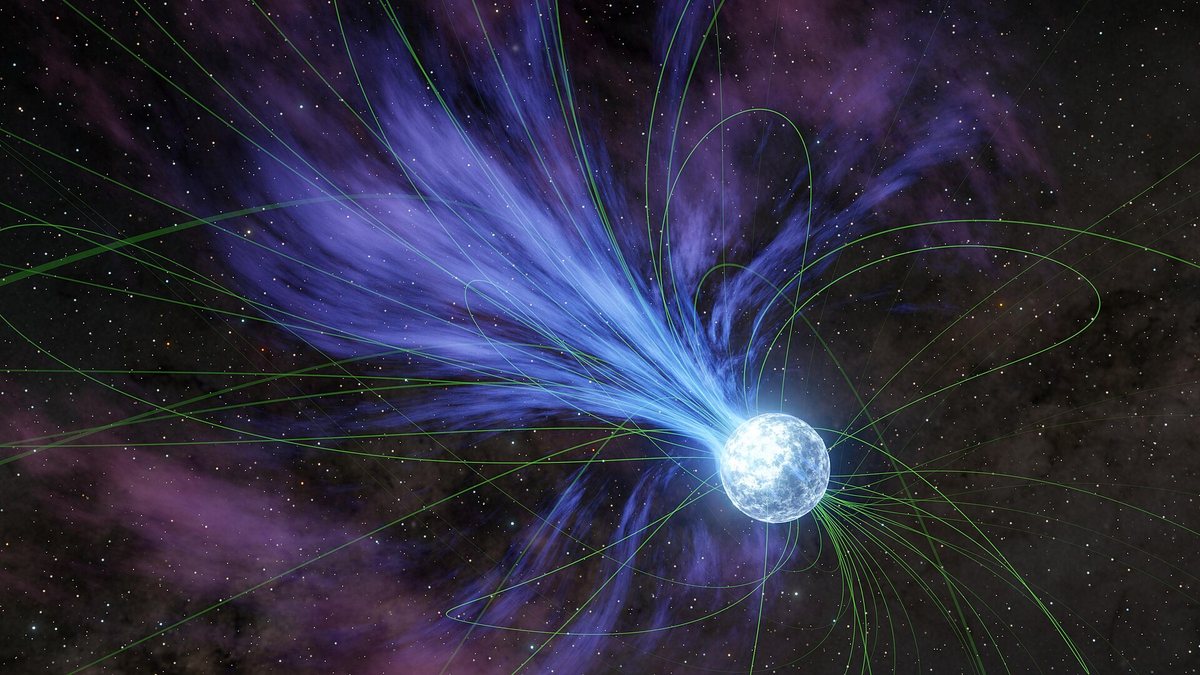
The other is that they come from magnetars: young, very strongly magnetized neutron stars left behind when massive stars explode. A magnetar could start producing bursts soon after it forms, so young, busy galaxies should host them.
This galaxy fits the second idea. “Our work suggests that it’s very unlikely that this FRB was produced by a merger,” Caleb said. The team is careful not to go further than that. In The Conversation, Caleb and co-author Themiya Nanayakkara note that fast radio bursts come in different shapes and sizes, and that not all of them necessarily have the same kind of origin.
A flashlight through the dark
“A fast radio burst is almost like a cosmic flashlight. It lights up everything along the path,” Prochaska said. “It carries an imprint of everything that it travels through, so you can use it to trace the ‘cosmic web’ – the otherwise invisible matter and structures that it encounters along the way.”
This burst picked up the marks of two structures: a galaxy cluster nobody knew about, at a redshift of 0.3 (about 3.5 billion light-years away), and the nearby Virgo Cluster, about 54 million light-years away. The paper says the burst lets astronomers probe thin, electrically charged gas across about 80% of cosmic history. Bursts like this have already been used to measure ordinary matter that was missing from the cosmic count.
Magnetic fields along the way also twisted the burst’s radio waves slightly. The paper concludes those fields are either weaker than expected or, more likely, tangled, with directions that reverse and cancel out.
What comes next
The team estimates MeerKAT could pinpoint several bursts a year from beyond redshift 1, more than halfway back to the start of the universe, with Webb needed to study their faint galaxies.
“The next step is to push this frontier further and see how close we can get to the first generations of stars,” Stappers said.
A flash shorter than a blink, from a galaxy too faint for any telescope on Earth, has just lit up most of cosmic history.
No Ground. Stay curious.