The light curve looked wrong. Not faint, not noisy — wrong. Stars brighten and fade in smooth waves, or flare and settle. This one rose to a sharp point, dropped, and did it again. And again. Every 87 minutes.
“I remember first looking at this and thinking: Stars don’t make triangular waveforms like this,” MIT astrophysicist Kevin Burdge recalled.
Years later, his team has an answer. The triangle is a fireball. A small red star is eating its companion, a brown dwarf, one steady stream at a time. And unlike the usual cosmic story, where the bigger object simply swallows the smaller one, this meal could last for billions of years.
The system is called ZTF J0440+2325. It sits in our own Milky Way, roughly 300 light-years from Earth, according to MIT. The result was published October 5, 2026, in Nature Astronomy, in a paper led by MIT graduate student Aaron Householder. The authors call it the first direct observation of stable mass transfer from a substellar object onto an ordinary, hydrogen-burning star.
Two small things, far too close
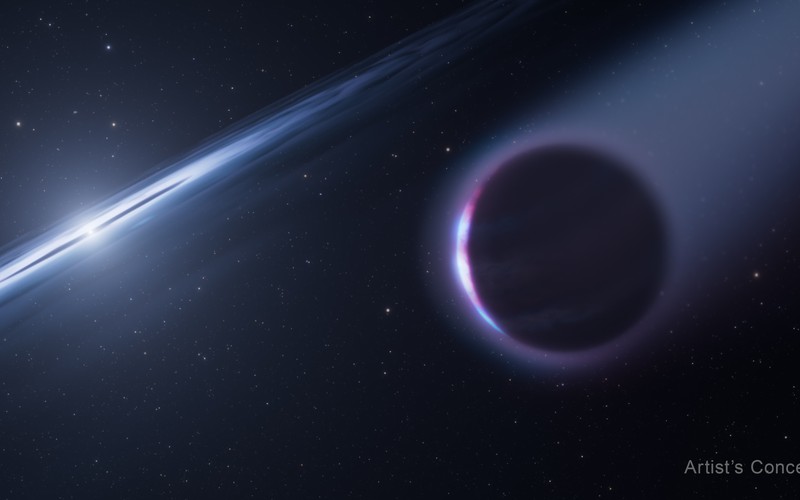
Start with the cast. The star is an M dwarf, the smallest and most common kind of star in the galaxy — a dim red ember. MIT puts it at around 85 times the mass of Jupiter. Its companion is a brown dwarf of about 25 Jupiter masses: heavier than any planet, but not massive enough to run on hydrogen fusion the way a true star does.
Now the strange part. The two orbit each other every 87 minutes. A full “year” in this system is shorter than a feature film. Their orbit is so tight, MIT says, that it could fit inside the diameter of our Sun.
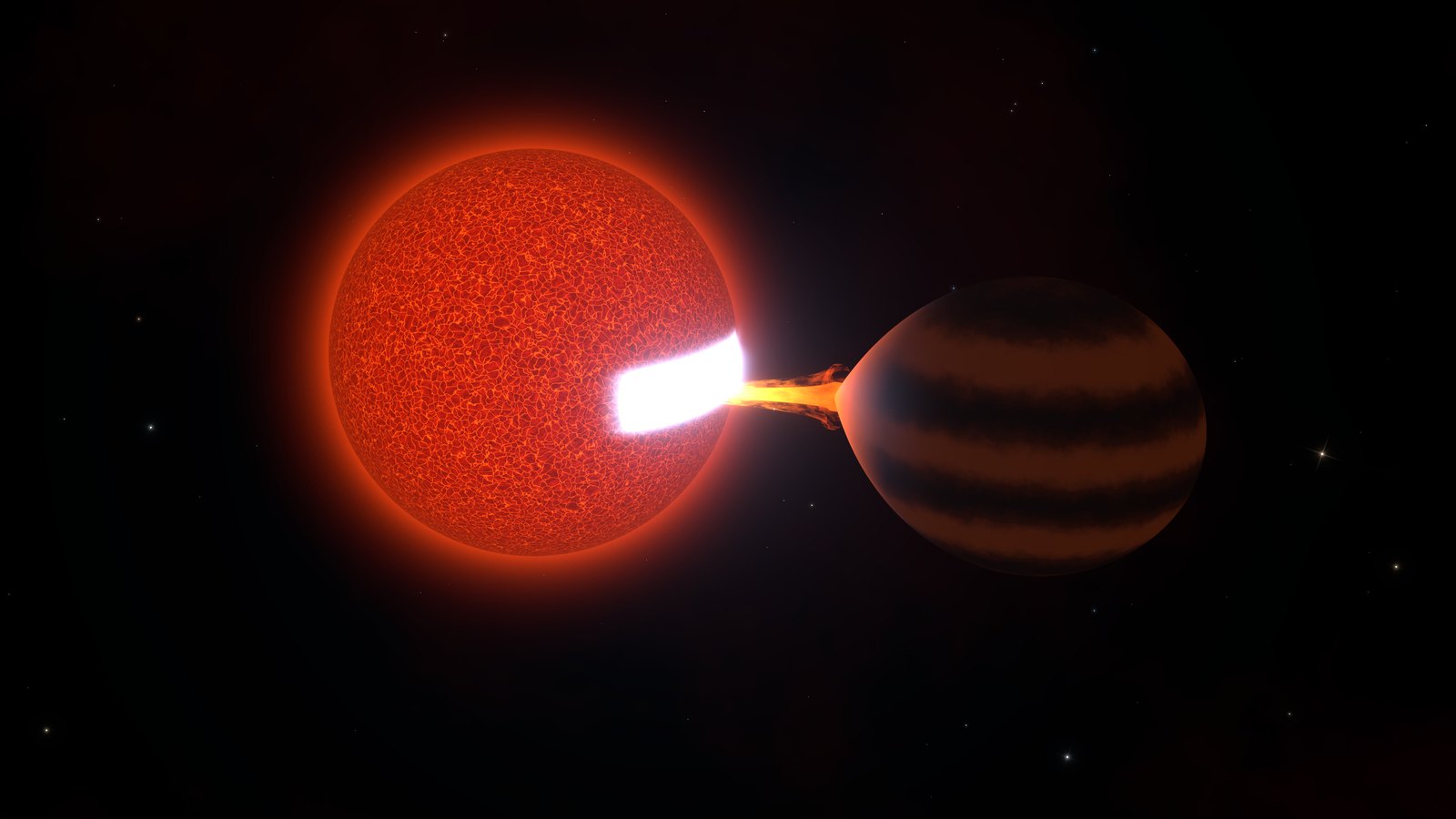
At that distance, the brown dwarf cannot hold itself together completely. The red dwarf’s gravity pulls on the near side of it, drawing material off and across the gap. The stream does not swirl gently into a disk. It slams straight into the star.
“The difference here is: The thing absorbing matter is not a tiny black hole but a star, which is relatively big in size,” Burdge explained in MIT’s announcement. “So matter just pummels directly onto the surface, at very high speeds, like an asteroid hitting the moon.”
Why the light makes a triangle
Where the stream hits, it heats a large hot spot on the red dwarf’s surface. As the pair spins around each other, that glowing patch swings toward Earth, then away.
“It’s like you’ve got this continuous fireball onto one of the objects, and as one orbits the other, that hotspot comes in and out of view, and the peak of the triangle signal is when you’re looking right at the fireball,” Burdge said.
So the shape that looked impossible was a kind of lighthouse. The sharp peak is the moment the impact site faces us. The fall is the fireball turning away.
The suspect that didn’t fit
The signal first turned up in data from the Zwicky Transient Facility, a camera on a telescope at Palomar Observatory in California that scans the sky for things that change. That is the ZTF in the system’s name.
At first, the team wondered whether it was a “black widow” — a system where a dense, spinning neutron star slowly destroys a small companion. Those can produce similar light curves. But black widows have a tell. A tiny companion whipping around a heavy neutron star swings back and forth fast.
When the researchers measured the wobble of ZTF J0440+2325 using spectra from the Keck telescopes in Hawaii, it was much smaller than that. “When we measured that wobble, we found we were not seeing a black widow,” Householder said. “This was a low-mass star that’s orbited by a brown dwarf. The wobble was too small in amplitude to be anything else.” The team also looked with NASA’s Swift observatory and found no X-ray signal, another strike against a neutron star. High-speed brightness measurements came from HiPERCAM on the Gran Telescopio Canarias in Spain’s Canary Islands.
The signal had sat unexplained for years. It took a fresh look, multiple observatories, and computer simulations of particles leaving the brown dwarf to close the case. In those simulations, Householder said, the material “indeed fall[s] right onto the surface of the star.”
A meal measured in billions of years
How much is the star eating? The team estimates the brown dwarf feeds it about one hundred-thousandth of an Earth mass every year. Do the arithmetic and that comes to roughly two billion metric tons of material every second.
It sounds catastrophic. It isn’t. Compared with the brown dwarf’s total mass, that rate is tiny. The researchers say the feeding is slow and steady enough that it could continue for hundreds of thousands of years — or billions.
Theory has long allowed for this kind of balance. When the lighter object is the one giving up material, the system can settle into a stable transfer instead of a runaway collapse. But until now, no one had actually caught it happening between a star and a substellar companion. The paper puts it plainly: the fate of some substellar objects is not rapid engulfment and destruction, but gradual consumption.
The team also reports a second system, ZTF J1444+4820, with an even shorter orbit of about 67 minutes. They describe it as a strong candidate for the same kind of slow feeding, likely sitting inside a three-star arrangement. It is not yet confirmed to the same degree as ZTF J0440+2325.
Not swallowed — sipped
Part of what makes this system fascinating is the contrast with our own future. In roughly five billion years, the Sun will swell into a red giant, and Earth is expected to be engulfed or nearly so.
“When we think of stars interacting with planets or brown dwarfs, the picture is always that the star eventually swallows the other thing,” Burdge said. “This is what will happen to the Earth when the sun becomes a red giant. But here, we’ve found an alternative: Instead of swallowing the thing up, the star can gradually eat it, for billions of years.”
That alternative does not apply to Earth. Our planet is far from the Sun and nowhere near massive enough to play the brown dwarf’s role. But it adds a new chapter to how stars and their companions can end their relationships. Some get swallowed whole. Some, it turns out, get sipped for an age of the universe.
The study’s authors dedicated the paper to their late co-author Tom Marsh of the University of Warwick, who helped develop the idea that systems like this could exist. Collaborators came from MIT, Caltech, the University of Hawai‘i, the Instituto de Astrofísica de Canarias and the Universidad de La Laguna, and the Center for Astrophysics | Harvard & Smithsonian.
Now that astronomers know what the triangle means, they can go looking for more. “It’s inspiring a lot of new searches on our part,” Householder said. “I think we’re going to learn a lot about a different kind of way that planets and brown dwarfs interact with their host stars.”
Somewhere out there, there are probably other small stars quietly feeding, their light rising to a point and falling again, waiting for someone to notice the shape.
No Ground. Stay curious.