 No Ground
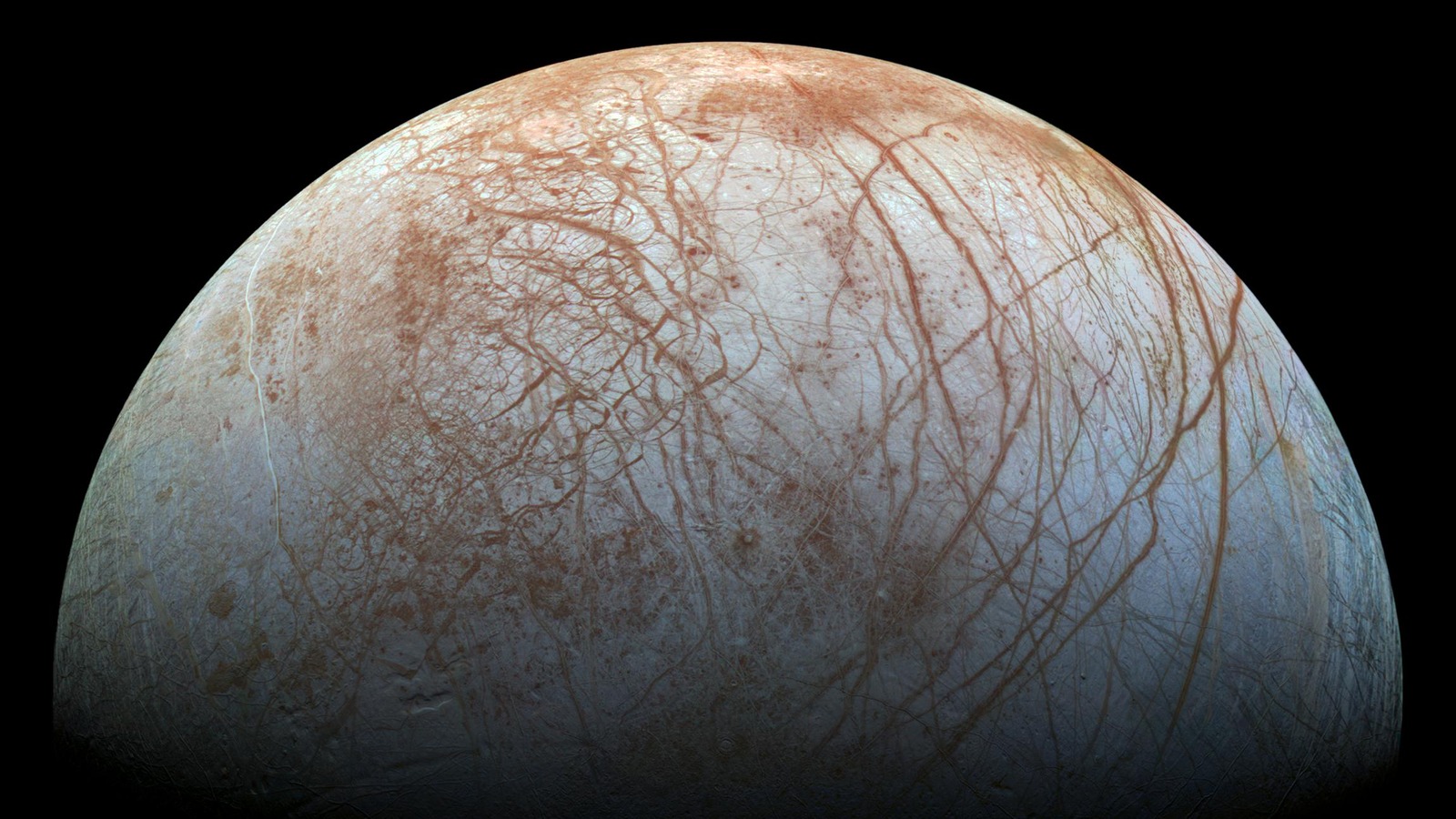
Jupiter’s moon Europa is wrapped in a huge, faint cloud of sodium atoms. For years, scientists have wondered where that sodium comes from. A new study built on more than 20 years of telescope data now points to a surprising answer: it most likely comes from Europa itself, and from the salty water hidden under its ice, not from its volcanic neighbor Io.
The work was led by Boston University and published in the Journal of Geophysical Research: Space Physics, using observations from the W. M. Keck Observatory on Maunakea, Hawaii. Keck announced the result on Nov. 20, 2026.
Here is what the team found, how they pulled it off, and why a cloud of salt atoms matters for one of the best places in the solar system to look for life.
A cloud that refuses to change
Sodium is one half of sodium chloride, better known as table salt. When sodium atoms around Europa get hit by electrons from the surrounding space environment, they give off a faint glow. That glow is what the team measured with Keck’s High Resolution Echelle Spectrometer, an instrument called HIRES that can pick out sodium’s unique fingerprint in light while also showing where around Europa the light is coming from.
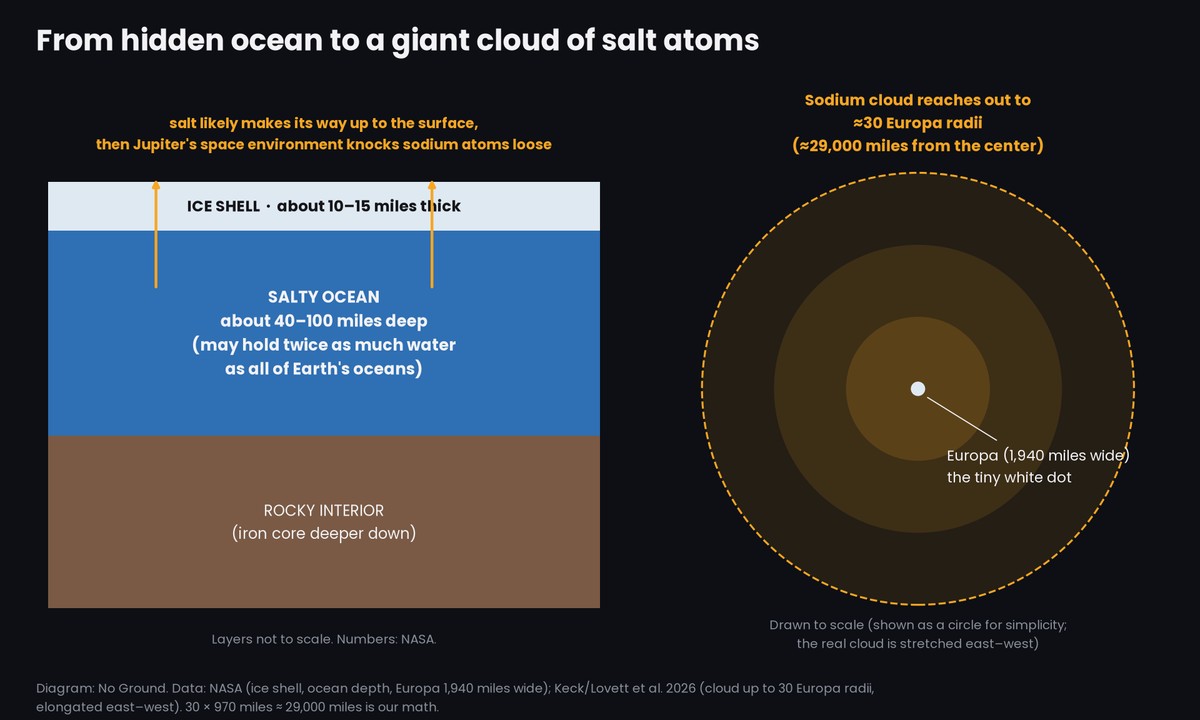
The cloud is enormous. It reaches as far as 30 times Europa’s radius. Europa is about 1,940 miles wide, so by our math that puts the edge of the cloud roughly 29,000 miles from the moon’s center. It is also lopsided, stretched out in the east–west direction.
The big surprise was how steady it is. The team combined new observations with archival Keck data going back to 1999. Over that whole stretch, the amount of sodium stayed remarkably stable, even though the space around Jupiter is anything but calm. The plasma around Jupiter, a thin soup of electrically charged particles, keeps changing, and Io keeps adding material to it.
Why Io was the obvious suspect
Io, Jupiter’s innermost large moon, is the most volcanically active body in the solar system. It sprays sodium and other material into the space around Jupiter. Since Io and Europa share the same neighborhood, a reasonable guess was that some of Europa’s sodium was really Io’s, dusted onto Europa’s surface and then kicked back off.
If that were true, Europa’s sodium cloud should rise and fall as Io’s volcanoes got more or less active. It did not.
“The neighboring volcanic moon Io sprays sodium around the Jupiter system and we’ve often wondered if Io paints Europa’s surface,” said co-author Carl Schmidt of Queen’s University Belfast and Boston University. “The stable sodium abundance in these Keck data shows that Europa is indifferent to Io’s volcanic activity. What we observe originates in Europa’s saltwater and not in Io’s volcanoes.”
Find Jupiter in your sky tonightEuropa circles Jupiter. The live map shows where it is now and when it rises.The shadow trick
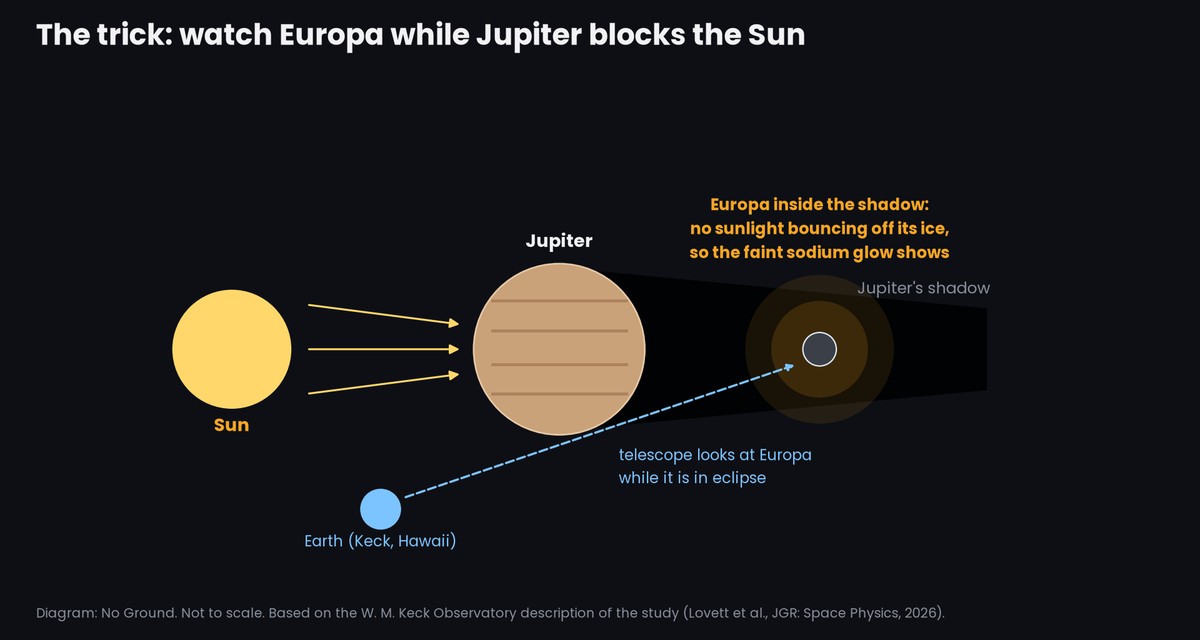
Measuring sodium right next to Europa is harder than it sounds. Europa’s icy surface is extremely bright. NASA says it reflects about 5.5 times as much sunlight as our own Moon. All that glare drowns out the faint glow of gas close to the surface.
So the team waited for Jupiter to switch the lights off. They observed Europa while it was passing through Jupiter’s shadow. With no sunlight bouncing off the ice, the faint sodium glow near the moon finally stood out.
The researchers also rotated the HIRES slit to different angles at several spots around the moon. That let them map the shape of the cloud instead of measuring a single point. According to Keck, this is the first study to connect sodium measured high above Europa with sodium seen very close to the moon’s visible disk, giving a fuller picture of the whole sodium environment.
One night stood out. On Sept. 29, 2022, the team watched Europa with Keck while NASA’s Juno spacecraft passed behind the moon from Earth’s point of view. That gave them a rare chance to compare the sodium with measurements of the charged particles around Europa at the same time.
What it says about the ocean, and what it doesn’t
Europa is about 90% the size of our Moon. NASA says scientists think its outer ice shell is about 10 to 15 miles thick, floating on an ocean 40 to 100 miles deep. That ocean may hold about twice as much water as Earth’s global ocean. The best evidence for it so far came from NASA’s Galileo spacecraft, which found that Europa disturbs Jupiter’s magnetic field in a way best explained by a deep layer of salty, electrically conducting water.
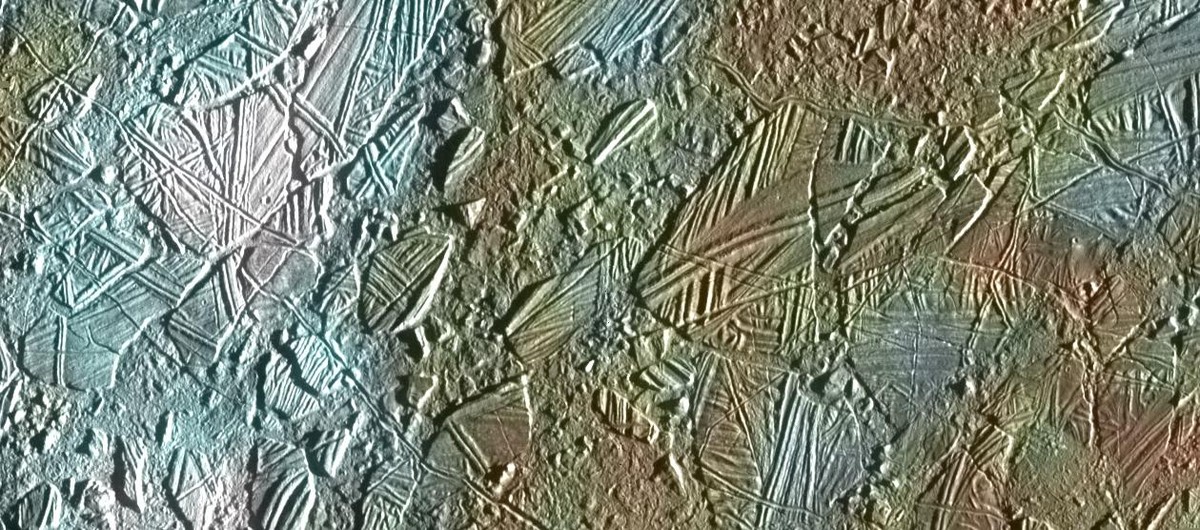
Europa’s surface also looks young, only about 40 to 90 million years old based on how few craters it has. Its cracks and blotches are stained with a reddish-brown material that NASA says likely contains salts and sulfur compounds. If salt from the ocean is working its way up through the ice, Jupiter’s harsh space environment could be knocking sodium atoms loose from the surface and feeding the cloud. Keck’s artist’s concept for the study shows exactly that idea.
It is important to be clear about the limits. The release itself says the sodium cloud is not a direct measurement of Europa’s hidden ocean. What the study shows is that the sodium behaves like it comes from Europa, not from Io. That points to salt from Europa’s own interior, but nobody has sampled that ocean yet.
“We don’t know a lot about Europa’s hidden ocean and icy surface, but its atmosphere offers a window into this potentially habitable world,” said lead author Emma Lovett, a graduate student at Boston University.
What comes next
The team is not done with salt. Keck says the researchers are using the Hubble Space Telescope in November to search for magnesium in Europa’s thin atmosphere. Magnesium has been tentatively detected on Europa’s surface but never in its atmosphere. Finding it would be another clue to what kind of salts are dissolved in the ocean.
The bigger answers will come from up close. NASA’s Europa Clipper launched on Oct. 14, 2024, and is traveling 1.8 billion miles to reach Jupiter in April 2030. It will make 49 close flybys of Europa with nine science instruments, plus a gravity experiment, all working on every pass. On the way, it swings past Earth on Dec. 3, 2026, for a gravity assist. Its main goal is to find out whether there are places below Europa’s surface that could support life.
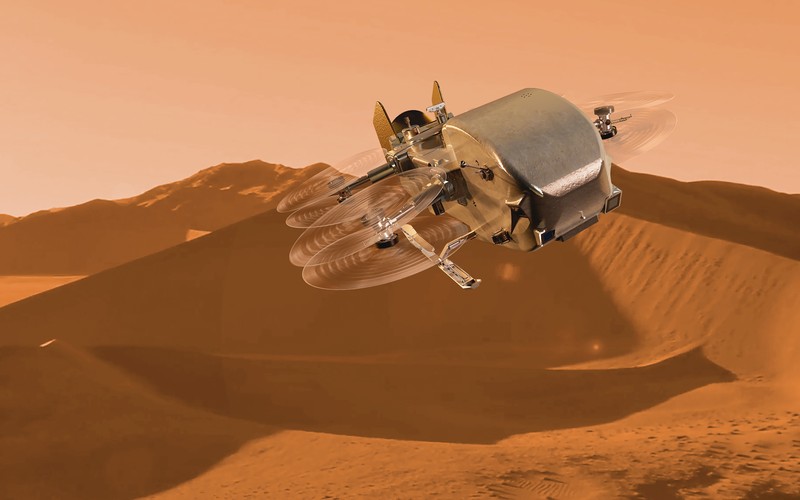
Europa is not the only ocean world out there. Saturn’s moon Titan is also thought to hide an internal ocean, and NASA’s Dragonfly rotorcraft is headed there next. Out along Jupiter’s orbit, NASA’s Lucy spacecraft has reached the Trojan asteroids that share Jupiter’s path around the Sun. And for a sense of just how frigid it gets out there, see our explainer on how cold space really is.
Bottom line: More than 20 years of Keck observations show Europa’s giant sodium cloud stays steady no matter what Io’s volcanoes are doing. That points to salt coming from Europa itself, most likely from the ocean beneath its ice. It is not proof of what is in that ocean, but it is one more sign that Europa’s hidden sea is reaching the surface, right where Europa Clipper will be looking.