 No Ground
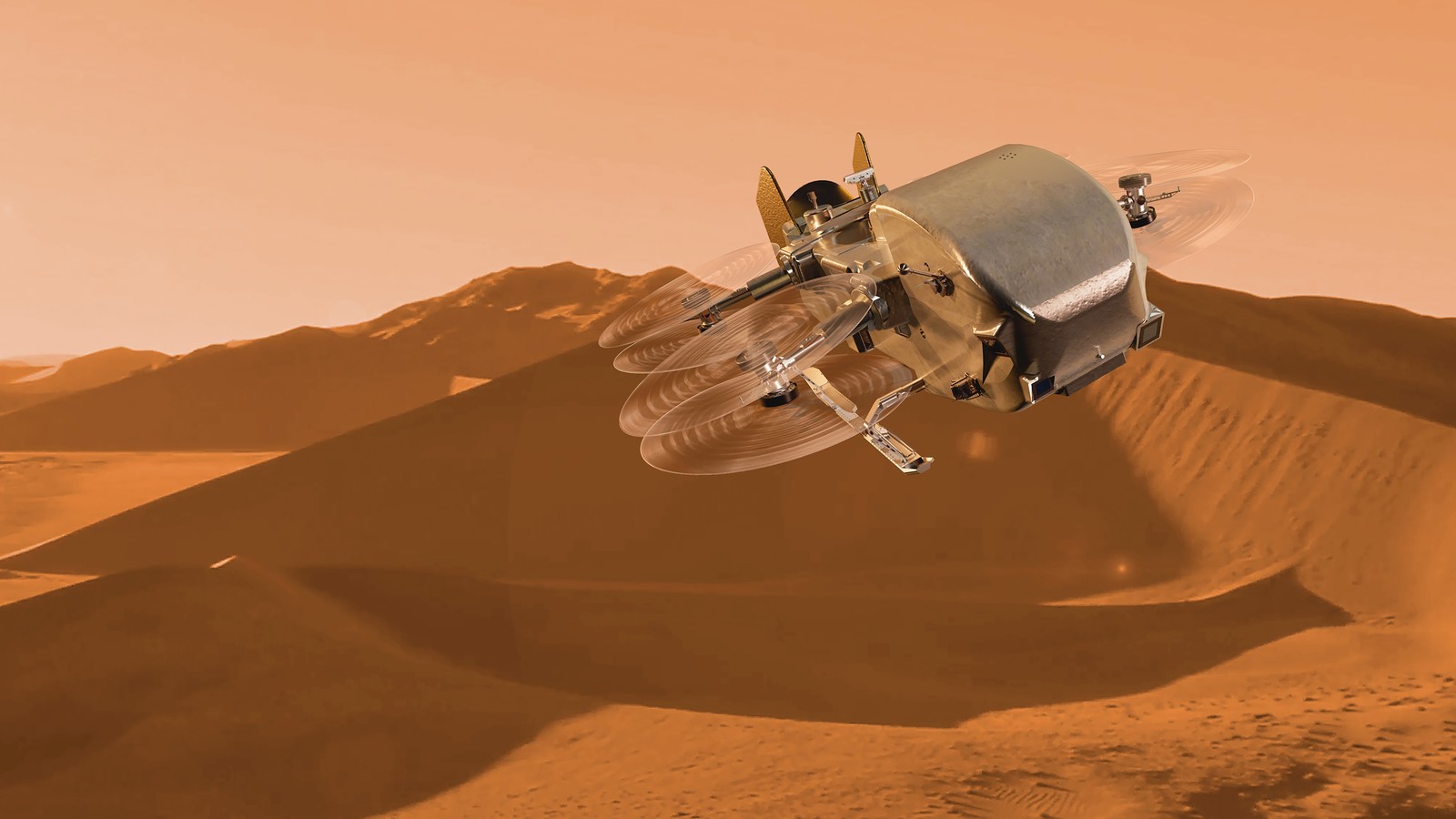
You may never stand on Saturn’s moon Titan, but your name can get there. NASA has opened a public campaign, called “Journey to Titan,” that will put names on a microchip flying aboard Dragonfly, the rotorcraft the agency is building to explore Titan by air.
Anyone can sign up. Everyone who does gets a personalized digital boarding pass to mark their place on the mission. NASA announced the campaign on Oct. 29, 2026, and says the passenger list stays open until 11:59 p.m. EST on Jan. 15, 2027.

How to send your name
Go to NASA’s official sign-up page at go.nasa.gov/dragonfly-names, fill in the short form and submit it to get your boarding pass. NASA’s Dragonfly page notes that the boarding passes are also available in Spanish. The announcement does not mention any fee.
Use only the official NASA link. If a site asks you to pay to “send your name to Titan,” it is not the NASA campaign.
What Dragonfly is
Dragonfly is a SUV-sized, nuclear-powered rotorcraft, a flying machine that lifts off with spinning rotors like a drone. NASA calls it the first science mission designed to fly and explore the surface of another world. It is being assembled at the Johns Hopkins Applied Physics Laboratory (APL) in Laurel, Maryland.
NASA’s mission page lists the launch as no earlier than July 2028 and the arrival at Titan as late 2034. That is a trip of about six years across roughly a billion miles.
Explore your sky tonightLive sky map for where you are: planets, the ISS and bright stars above your horizon.
Why Titan
Titan is Saturn’s largest moon and one of the strangest places in the solar system. It has a thick, nitrogen-rich atmosphere, rivers and lakes of liquid methane, seasons, sweeping dunes and a surface rich in organic material. NASA describes it as the distant world most similar to our own, though it is far colder.
NASA is clear that Dragonfly is not a mission to detect life. Instead it will study prebiotic chemistry, the chemistry that came before biology, to help scientists understand the ingredients and conditions that life needs.

How it will explore
Most landers stay where they touch down. Dragonfly will fly. Over a planned mission of about 3.3 years, its rotors will carry it for miles across Titan, stopping at different geological sites, including dunes and a young impact crater called Selk. NASA expects one flight every one to two Titan days. A Titan day, called a Tsol, lasts about 16 Earth days.
At each stop, Dragonfly will collect samples of surface material and analyze them with instruments inside the rotorcraft. The goal is to measure how far prebiotic chemistry has gone on Titan, identify compounds of interest to astrobiology and look for chemical signs of water-based or hydrocarbon-based life.
Dragonfly follows NASA’s Cassini spacecraft, which flew past Titan more than 100 times before its mission ended in 2017. Cassini studied the moon from above. Dragonfly is meant to see it up close, from the ground and the air.
Bottom line: Sign up at go.nasa.gov/dragonfly-names before 11:59 p.m. EST on Jan. 15, 2027, and your name will travel to Titan on Dragonfly, which is scheduled to arrive in 2034.
No Ground. Stay curious.