A solar panel is useless if the Sun is gone. On much of the Moon, the Sun is gone for about two weeks at a time.
That is the practical problem behind a political headline. The United States says it wants a nuclear reactor on the lunar surface by 2030. Russia and China have talked about power for a joint research station in the mid-2030s. None of those machines is sitting in the dust. The night is not hypothetical.
NASA’s own numbers make the case without the slogans. In full sunlight, the lunar surface reaches about 260 degrees Fahrenheit (127 degrees Celsius). In darkness it falls to about minus 280 degrees Fahrenheit (minus 173 degrees Celsius). Near the equator, NASA’s Glenn Research Center says a lunar night lasts 14 and a half Earth days. A base that only has solar power has to store enough energy to live through that — or it has to shut down.
The south pole, where NASA plans a long-term presence, is stranger than the Apollo sites. The Sun stays low. Some high ground can stay lit for long stretches. Some crater floors never see the Sun at all. NASA says some of those permanently shadowed regions can reach about minus 334 degrees Fahrenheit (minus 203 degrees Celsius), cold enough to hold water ice — and a bad place to count on a solar array. With almost no air to move heat around, temperature follows the light.
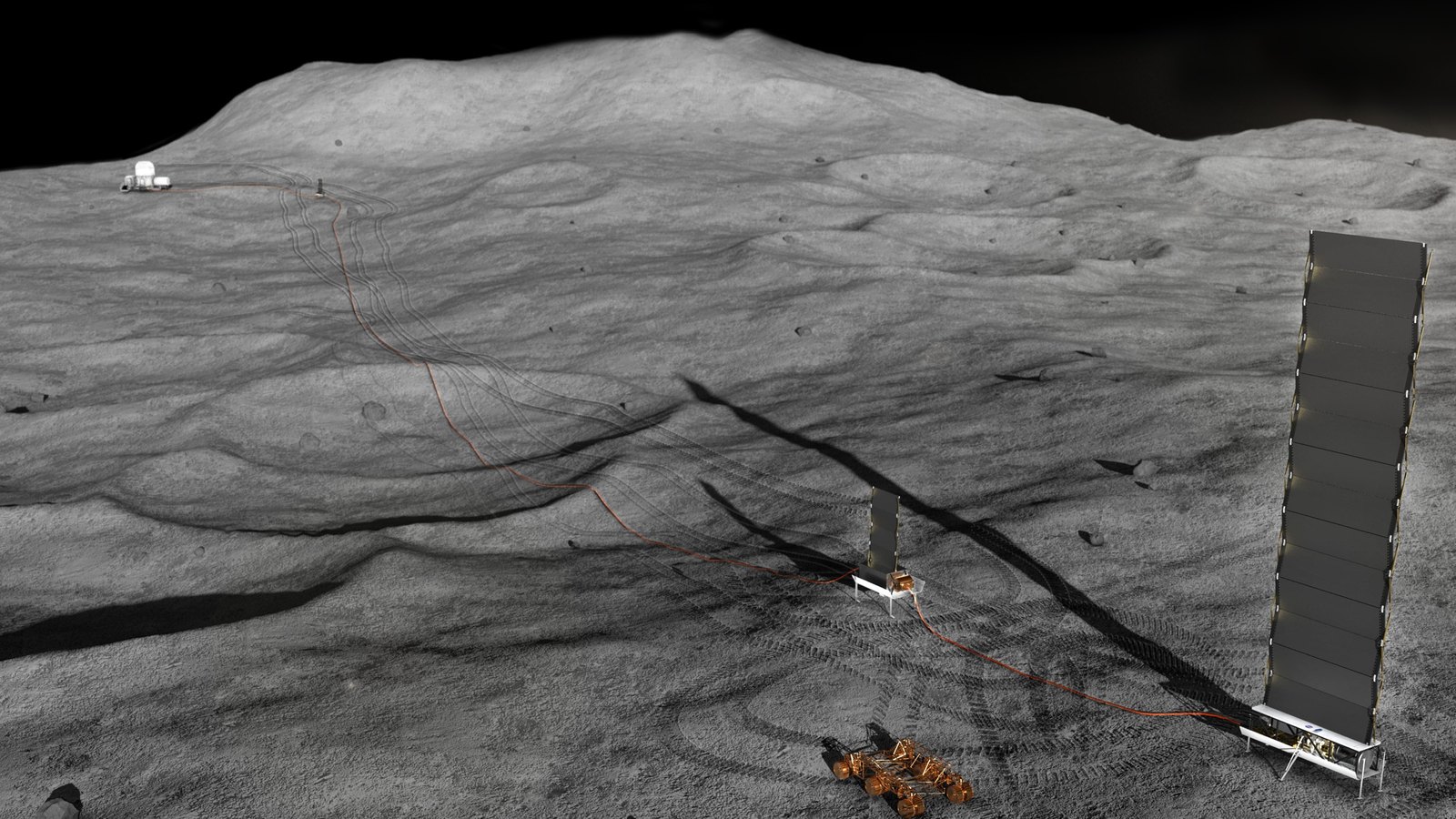
A fission reactor does not care whether the sky is bright. Heat from splitting atoms is turned into electricity, in sun or in shadow. NASA and the Department of Energy have said they want that kind of power for sustained missions on the Moon, and later on Mars: continuous, and able to run for years without refueling.
The public target date is 2030. On January 13, 2026, NASA and DOE announced a renewed memorandum of understanding. The release says the partnership includes development of a lunar surface reactor by 2030, for Artemis and for later Mars missions. Administrator Jared Isaacman said the future NASA is aiming at “requires harnessing nuclear power.” The release does not say a reactor has been built, fueled, or booked onto a rocket.
The power level people quote is easy to mix up, because NASA has used more than one number.
In June 2022 the agencies selected three industry teams to sketch a demonstration system in the 40-kilowatt class, planned to last at least 10 years. Each study contract, awarded through the Department of Energy’s Idaho National Laboratory, was worth about $5 million. Lockheed Martin of Bethesda, Maryland, partnered with BWXT and Creare. Westinghouse of Cranberry Township, Pennsylvania, partnered with Aerojet Rocketdyne. IX of Houston, a joint venture of Intuitive Machines and X-energy, partnered with Maxar and Boeing.
By January 31, 2024, NASA’s Glenn Research Center said it was wrapping up that first phase. The design ask was 40 kilowatts — on average, NASA said, about what 33 U.S. households use — and a mass under six metric tons, able to run for a decade without someone standing next to it. The plan then was a one-year lunar demonstration plus nine operational years, with a reactor at the launch pad in the early 2030s. A second-phase solicitation was planned for 2025. It was still concept work. Trudy Kortes, director of Technology Demonstration Missions, said a demonstration was needed to show nuclear power could be “a safe, clean, reliable option,” because it runs independent of the Sun.
In August 2025 the bar moved. Then-Acting Administrator Sean Duffy signed a fission-surface-power directive dated August 4. It told NASA to seek a system with at least 100 kilowatts of electrical output, a closed Brayton-cycle converter, and a mass that could fit a heavy lander of up to 15 metric tons. The date in that document is not “operating on the Moon in 2030.” It is readiness to launch by the first quarter of fiscal year 2030 — October through December 2029. Industry, the directive said, had told NASA that long-term crews and on-site resource work need at least 100 kilowatts. It also said NASA had spent more than $200 million on these technologies since 2000 “with no significant advancement towards flight system readiness.” The last completed step it cited was those 2023 Phase 1 studies.
Then the schedule got less certain in public. On March 26, 2026, NASA posted on the federal contracting site SAM.gov that it had “decided to reassess the FSP development approach” and that the technical library for potential offerors would be made inactive. Readers were told to keep watching for updates. The 2030 language is still a stated goal. It is not a reactor on the surface, and it is not a flight contract NASA has closed out in public view.
Russia and China are on a later calendar, and the paperwork is thinner than the headlines.
On March 5, 2024, Roscosmos chief Yury Borisov said at the World Youth Festival that Russia and China were “seriously considering” a project to deliver and mount a power reactor on the Moon with Chinese partners sometime between 2033 and 2035. TASS reported that he said such a mission would have to be automated, and that the necessary technology was almost ready. That is a consideration, said by the head of Russia’s space agency. It is not a launched mission.
In May 2025, Interfax reported that Roscosmos said it and the China National Space Administration had signed a memorandum on a lunar power plant, among documents from a meeting of Presidents Vladimir Putin and Xi Jinping. Roscosmos called a Russian plant an important contribution to the International Lunar Research Station and said that station should be completed by 2036. The station’s framework is older: TASS has described a March 2021 Roscosmos–CNSA memorandum on creating the ILRS.
On December 24, 2025, Roscosmos said it had signed a state contract with NPO Lavochkin for work through 2036 on a Russian lunar power plant. Interfax and Reuters both reported it. The stated job is long-term power for Russian rovers and an observatory, and for ILRS infrastructure, including foreign partners’ facilities. Roscosmos named Rosatom and the Kurchatov Institute as participants. Reuters noted a limit: the December statement did not explicitly call the plant nuclear. That label rests on who is involved, and on Borisov’s 2024 remarks — not on a published design with a verified power rating.
NASA’s August 2025 directive treated the foreign announcements as a reason to hurry. It said that since March 2024, China and Russia had on at least three occasions described a joint effort to place a reactor on the Moon by the mid-2030s, and that the first to do so might declare a keep-out zone. That is NASA’s reading. It is not a finished reactor.
Solar power is not written out of the plan. NASA still expects sunlit south-pole ground to help. A reactor is the piece that does not go dark when the Sun does, and that can sit near the cold traps where ice may be. The United States has a 2030 goal, concept studies, and a procurement it said in March 2026 it was reassessing. Russia and China have a mid-2030s conversation and a contract running to 2036. The night will last two weeks either way.
No Ground. Stay curious.
Tags: Moon, fission surface power, NASA, Department of Energy, Artemis, ILRS, Roscosmos