 No Ground
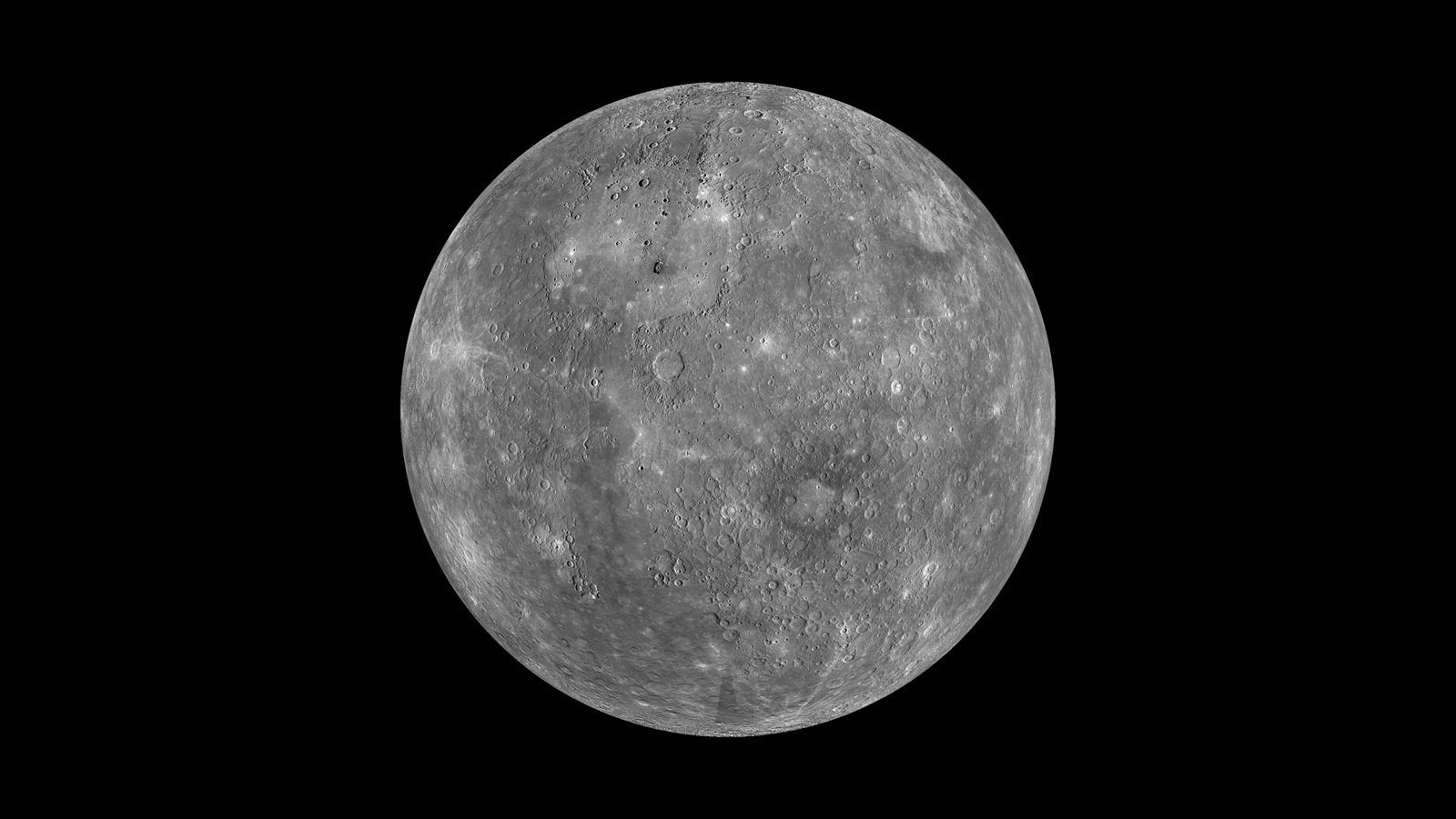
BepiColombo is safely in orbit around Mercury. That much is settled. What ESA only described in full a couple of days later is how close the arrival came to a mess: a software glitch cut the braking burn short, the spacecraft dropped into safe mode, and the team had to wait through a planned radio blackout to find out whether the smallest planet had actually caught it.
It had. On Monday, Nov. 23, 2026, the European Space Agency said the joint ESA–Japan Aerospace Exploration Agency (JAXA) mission is in a stable orbit, already adjusted for the surprise, and still on track for the next big step: the two science orbiters are scheduled to separate on Dec. 9 in Germany (Dec. 10 in Japan).
We wrote about the arrival itself on Sunday, when ESA announced that the stacked spacecraft had slipped into orbit after an eight-year trip. This is the update on what went wrong during the burn, and why the mission is still in good shape.
A burn that stopped early
The key firing began at 18:24 UTC on Nov. 21 — 1:24 p.m. EST — as BepiColombo passed just 635 kilometres (about 395 miles) above Mercury’s surface. Four of ESA’s Mercury Planetary Orbiter (MPO) thrusters were supposed to fire for 37 minutes, slowing the stack enough for Mercury’s weak gravity to hold it.
The commands had been sent in advance. At 16:51 UTC (11:51 a.m. EST), the spacecraft turned to the right orientation, and that turn produced a scheduled loss of contact with Earth. The Mission Control Team at the European Space Operations Centre (ESOC) in Darmstadt, Germany, had to wait it out.
When the signal came back through ESA’s New Norcia deep-space antenna in Australia, the burn was already over, and the spacecraft was in safe mode — a protective state that shuts down non-essential activity when something unexpected happens. Analysis showed the manoeuvre had stopped early, after delivering around 77% of the planned change in speed.
“Upon finding Bepi in safe mode, it was like flipping a switch. Everybody was focused in understanding what had happened,” said Ignacio Tanco, ESA’s BepiColombo Flight Operations Director.
ESA later traced the problem to a software issue involving attitude guidance and thruster control. Teams at ESOC and Airbus, the lead spacecraft manufacturer, are still investigating, working with colleagues across the ESA–JAXA mission. The agency has not said, in the Nov. 23 update, exactly how many minutes the thrusters actually fired — only that the burn ended earlier than planned and delivered about 77% of the intended speed change.
Then the words everyone wanted to hear
Being in radio contact again confirmed the spacecraft was there. It did not, by itself, tell the team which orbit they had. That took more work. Around 1 a.m. local time in Darmstadt, the answer came over the voice loop from Flight Dynamics.
“We confirm Mercury orbit capture!” announced Frank Budnik, ESA’s BepiColombo Flight Dynamics Manager.
ESA also highlighted a technical first: BepiColombo entered orbit around another planet using “weak stability capture.” In that approach, a spacecraft arrives more slowly than is typical for a planetary mission, so the planet’s gravity can hold it for a while even before the big braking burn. The technique has been used by some spacecraft going to Earth’s Moon, ESA said, but not, until now, at another planet.
That weak capture is only temporary. “With this weak gravity capture, BepiColombo would remain captured for several orbits, but only temporarily,” Budnik said. “This is why Mercury orbit insertion (MOI) is essential.” The chemical-thruster burn is what turns a brief hold into a lasting orbit and, eventually, into the lower paths the two orbiters need for science.
Find Mercury in your skyIt never strays far from the Sun. The live sky map shows whether it’s up from where you are.Mercury is a hard target to see from a backyard, and a harder one to orbit. It never strays far from the Sun in our sky, and a spacecraft falling toward the Sun picks up so much speed that the little planet cannot catch it without a long campaign of braking. If you have read our explainer on how long it takes to get to Mars, it is the same orbital math run in reverse: instead of climbing away from the Sun, BepiColombo had to keep slowing down. That is why the Nov. 21 burn mattered so much, even after eight years and nine planetary flybys had already bled off speed.
A 75-hour orbit, not a 58-hour one
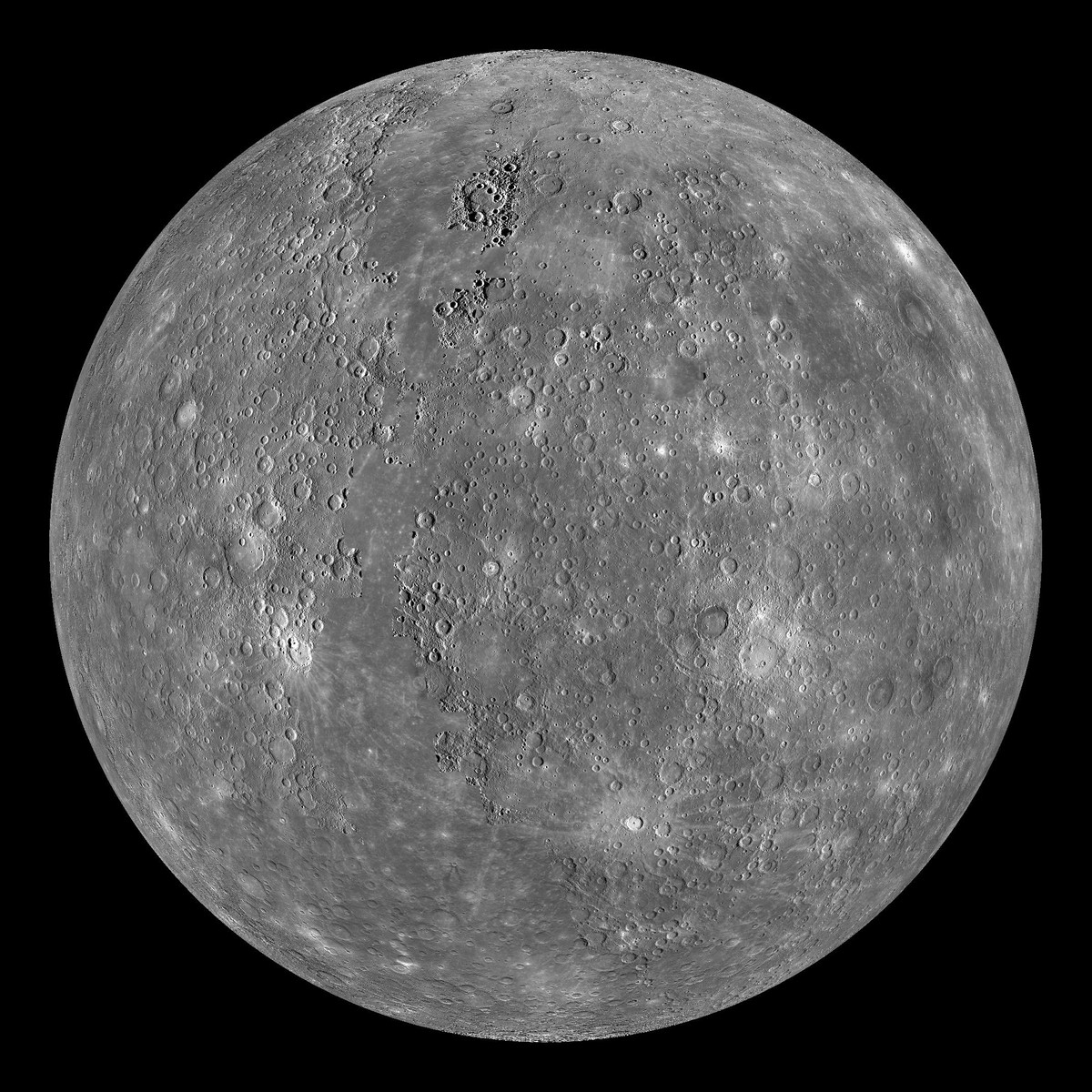
Because the burn stopped early, BepiColombo did not end up on the orbit the team had drawn as the first step. ESA says the spacecraft entered a 75-hour orbit, rather than the 58-hour orbit originally planned. The agency has not, in that same update, published a new closest-and-farthest distance for the actual path, so we are not repeating the planned figures as if they were the ones now being flown.
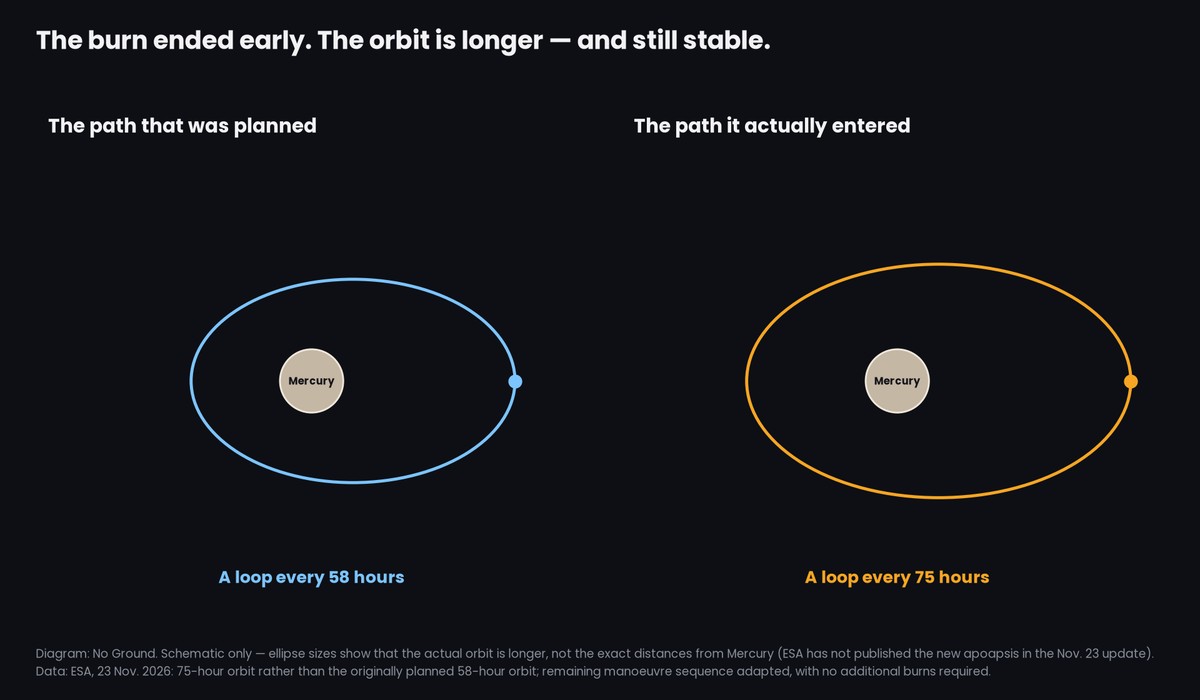
The important part, ESA says, is that the rest of the plan was built to flex. Mercury orbit insertion is not a single burn. It is a sequence of firings, each one done when the spacecraft is closest to the planet — the “sweet spot” — so the team does not waste fuel fighting what they call gravity loss. After each burn, Flight Dynamics measures the orbit it actually got and designs the next one.
“It's a dynamic sequence! Each new manoeuvre is based on the previous ones,” Budnik said.
That is why a short burn did not require a scramble of extra firings. ESA says the remaining sequence has already been adapted to the new 75-hour trajectory, with no additional thruster burns required. The changes, the agency says, do not affect the December separation or MPO’s ability to reach its planned science orbit.
What this does not change
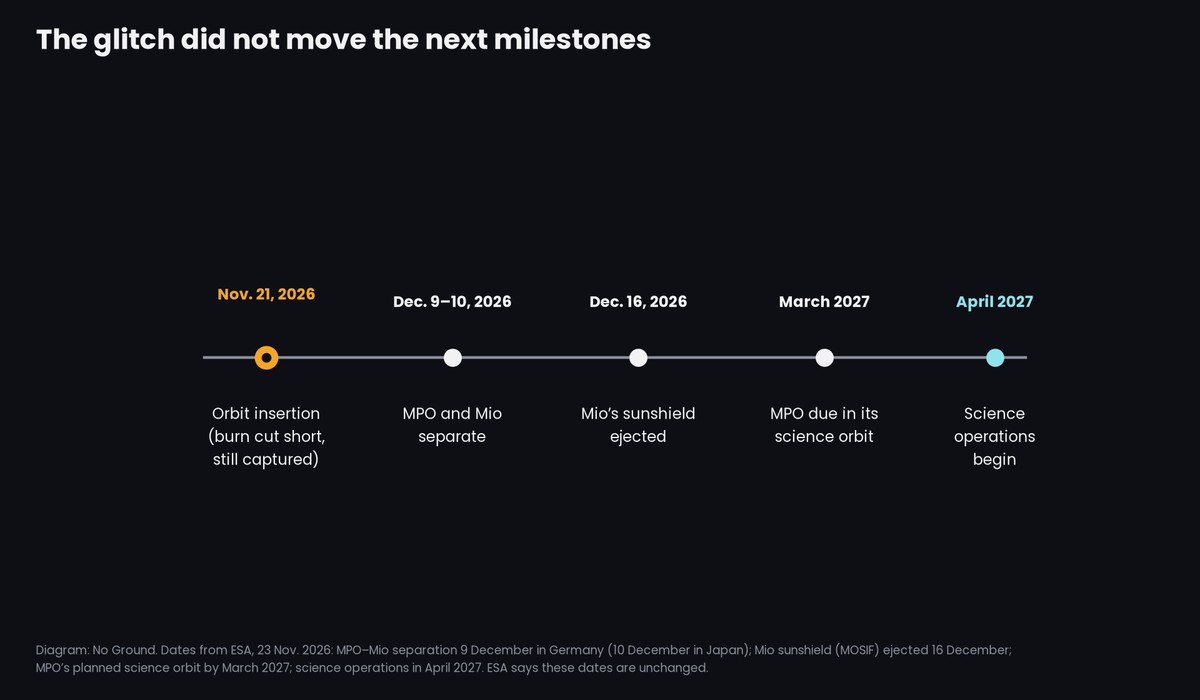
For the JAXA team, orbit insertion is the step that makes the next one real. ESA’s Mercury Planetary Orbiter and JAXA’s Mercury Magnetospheric Orbiter, called Mio, are still joined. They are scheduled to separate on Dec. 9–10. Mio’s protective sunshield, MOSIF, stays attached to MPO until it is ejected on Dec. 16. Further burns are then supposed to take MPO to its science orbit by March 2027, with science operations beginning in April 2027.
“Our almost 600-strong science team will be delighted to see BepiColombo pass this key milestone and begin revealing more about Mercury, from its interior and surface to the space around it,” said Geraint Jones, ESA’s BepiColombo Lead Project Scientist.
None of those dates, ESA says, has slipped because of the glitch. That is the quiet victory inside a stressful night: the spacecraft is in a slightly different first orbit, and the path from here to science still holds.
A follow-up, not a do-over
When we first wrote about this arrival, ESA had not yet published the safe-mode story or the 75-hour orbit. The public announcement on Nov. 21 was that the spacecraft had made it. The Nov. 23 operations report is the one that explains how. The two accounts fit together: the braking burn happened on time, it did not run to completion, and it was still enough.
That is worth sitting with. Mercury is unforgiving, and arrival software is unforgiving too. A glitch in attitude guidance and thruster control could, in a less carefully designed sequence, have left a mission stranded or off-course. In this case, the team had already assumed something might go wrong. They built a plan that could absorb a short burn, then used the quiet hours after safe mode to prove the planet had taken the spacecraft anyway.
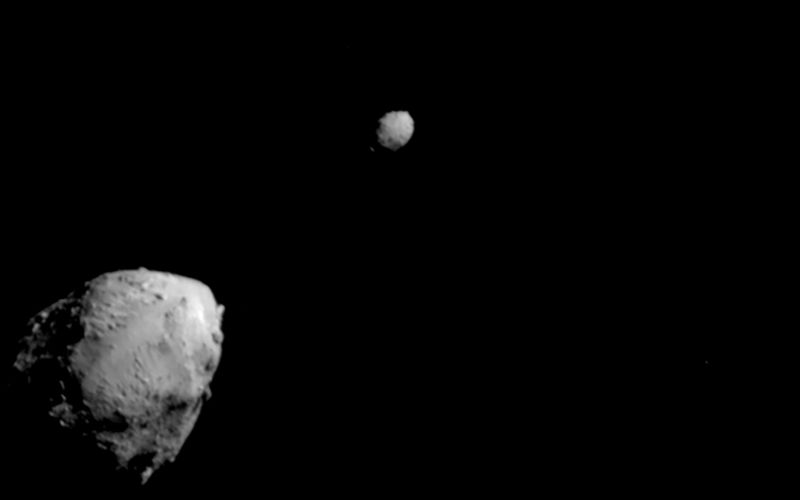
The work now is ordinary, in the best sense: keep measuring the orbit, keep designing the next burn, and get the two orbiters ready to part company in December. After eight years, and after a night that began with silence, BepiColombo is where it is supposed to be — just on a slightly longer first loop around the little world it came to study. Elsewhere this month, ESA’s Hera spacecraft is flying a very different kind of arrival at two small asteroids, a place where it cannot simply park in orbit.