 No Ground
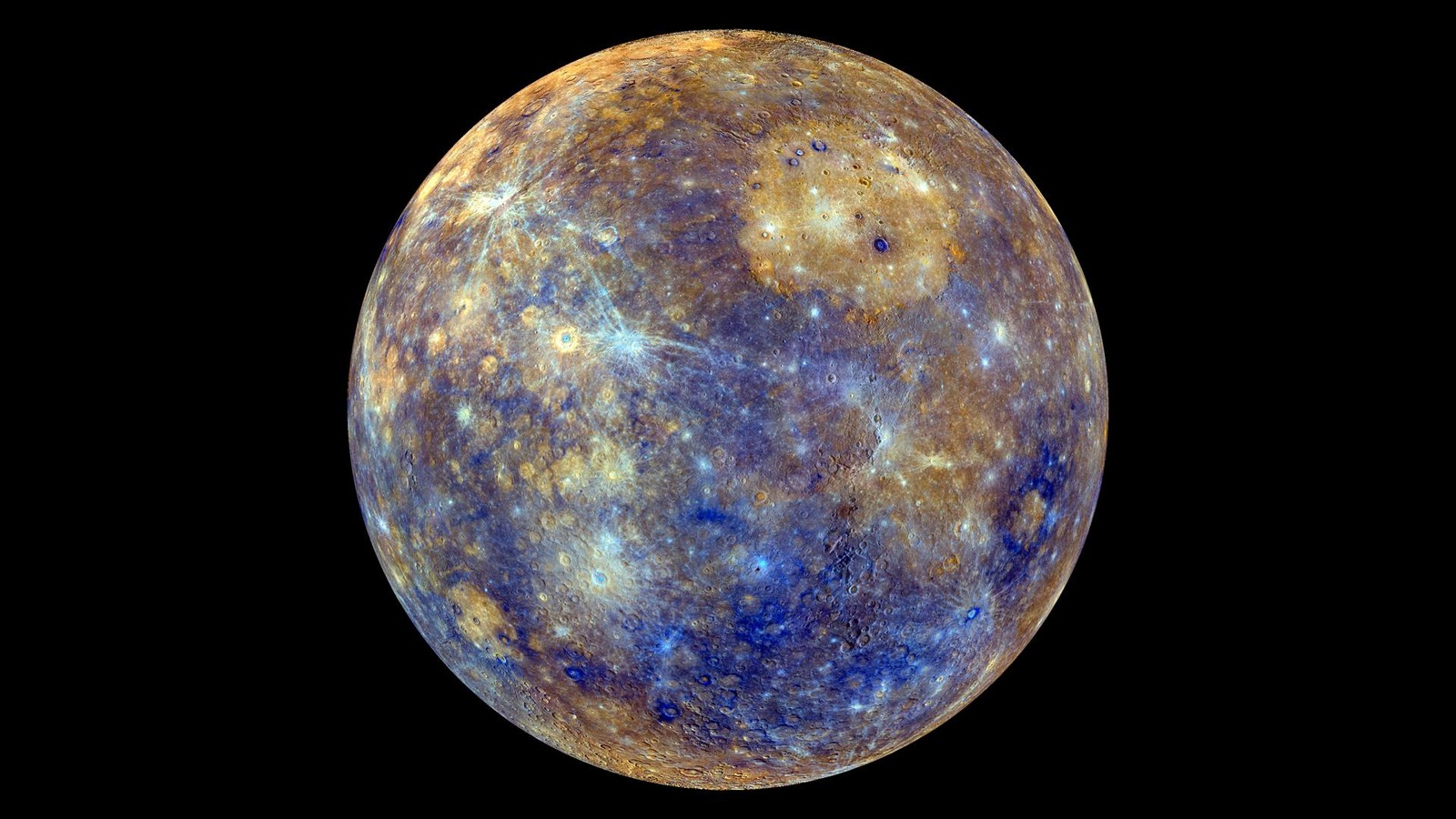
After an eight-year trip through the inner solar system, a pair of spacecraft is finally circling Mercury. The joint European-Japanese mission BepiColombo slipped into orbit around the smallest planet on Saturday, Nov. 21, 2026, the European Space Agency (ESA) announced.
BepiColombo is really two spacecraft riding as one: ESA’s Mercury Planetary Orbiter, called MPO, and the Japan Aerospace Exploration Agency’s Mercury Magnetospheric Orbiter, called Mio. The roughly $2 billion mission is only the third ever to visit Mercury, after NASA’s Mariner 10 flybys in the 1970s and NASA’s MESSENGER orbiter, which circled the planet from 2011 to 2015. It is the first to bring two orbiters at once.
Here is what happened, why the trip took so long, and what the two spacecraft will try to learn.
What happened on Nov. 21
The key moment was a braking burn. Four of MPO’s thrusters were scheduled to start firing at 1:24 p.m. EST and keep going for about 37 minutes. The stacked spacecraft came in over Mercury’s night side, near the south pole, and the burn slowed it just enough for the planet’s weak gravity to grab it.
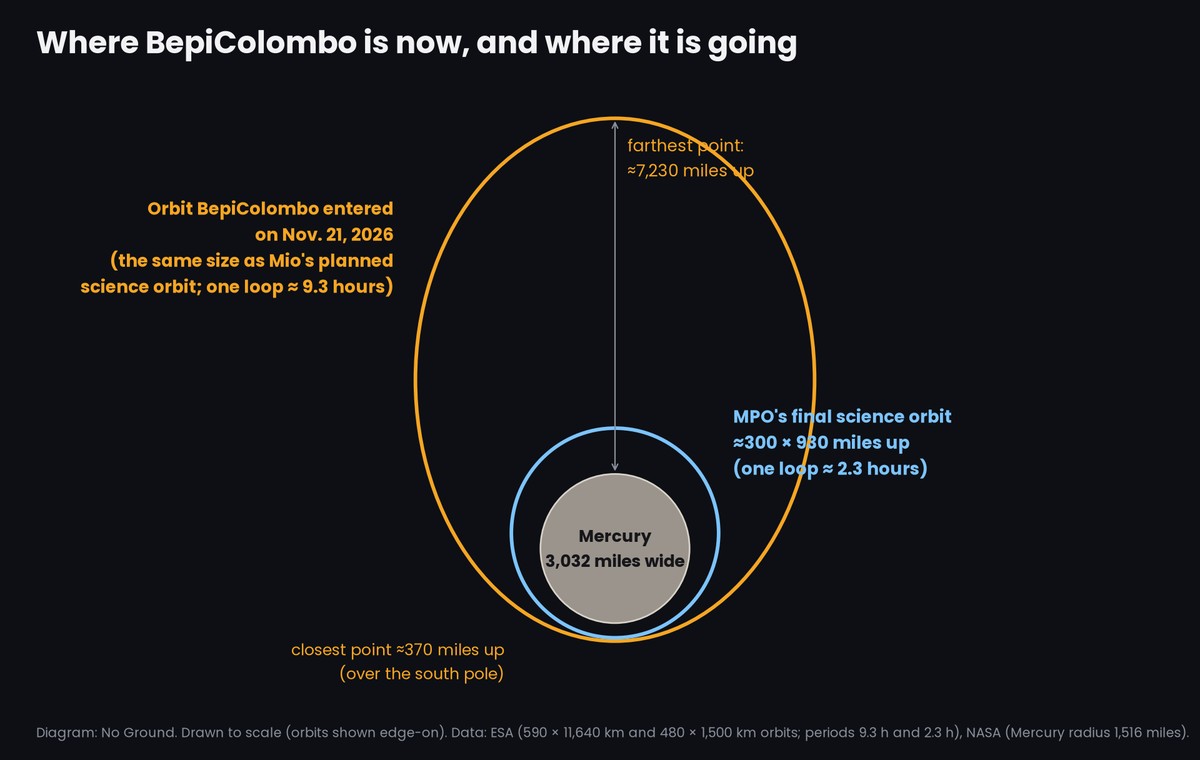
The starting orbit is a long, stretched loop. At its closest the spacecraft dips to about 370 miles above the surface, and at its farthest it swings out to about 7,230 miles. That loop matches the size ESA lists for Mio’s planned science orbit, which is one reason the arrival sequence works the way it does.
Arrival is not a single event for this mission. It is a six-month sequence. The big solar-powered engine module that pushed the pair across the solar system, the Mercury Transfer Module, was cut loose on Sept. 3, 2026. The orbit insertion on Nov. 21 was the next step. The two orbiters are still joined together, and they are scheduled to separate on Dec. 9–10, 2026.
Why Mercury is so hard to reach
Mercury is the closest planet to the Sun, about 36 million miles away on average. You might think that makes it easy to get to. It is the opposite. ESA says putting a spacecraft into orbit around Mercury takes even more energy than sending a mission to Pluto.
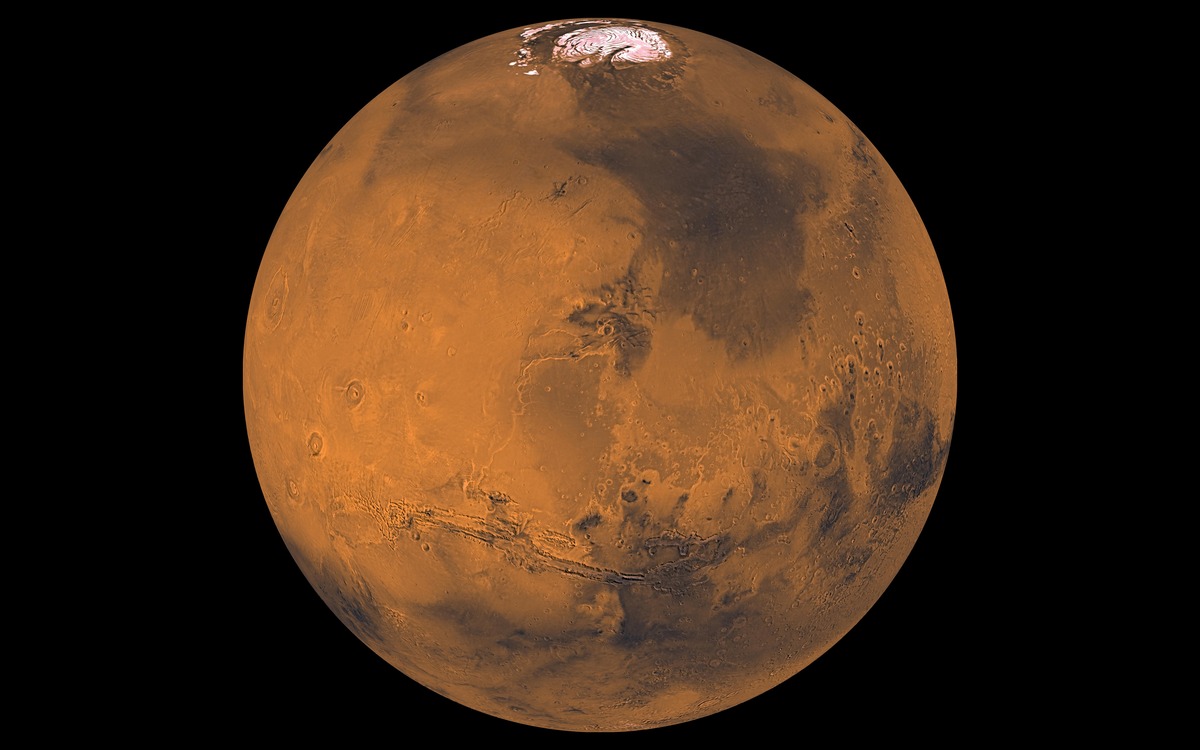
The problem is speed. Anything falling toward the Sun picks up speed, the same way a ball speeds up as it rolls downhill. By the time a spacecraft reaches Mercury’s distance, it is moving far too fast for the little planet’s gravity to catch it. The spacecraft has to shed a huge amount of energy first. If you have read our explainer on how long it takes to get to Mars, it is the same orbital math, just run in reverse: instead of climbing away from the Sun, BepiColombo had to keep braking against it.
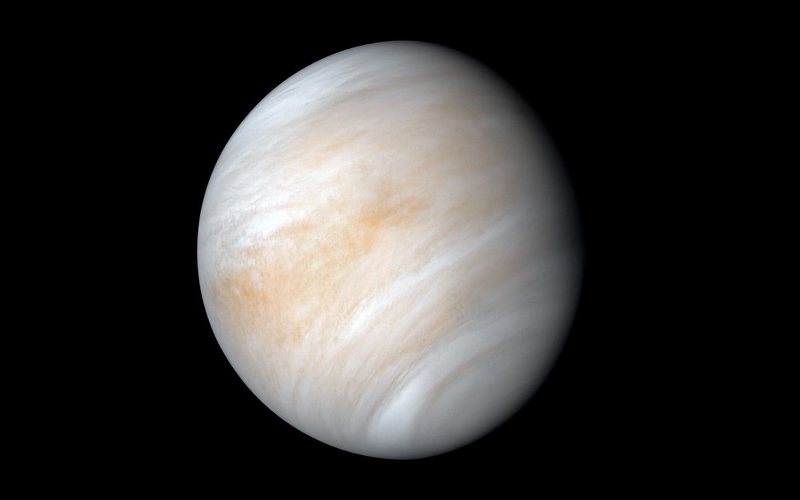
BepiColombo did that braking in two ways. First, it used planets as brakes. It flew past Earth once, Venus twice and Mercury itself six times, and every close pass bent its path and changed its speed. Second, it used ion engines. The transfer module carried solar wings about 49 feet long that powered thrusters turning xenon gas into a fast stream of plasma. That push is gentle, but it can run for weeks or months on very little fuel.
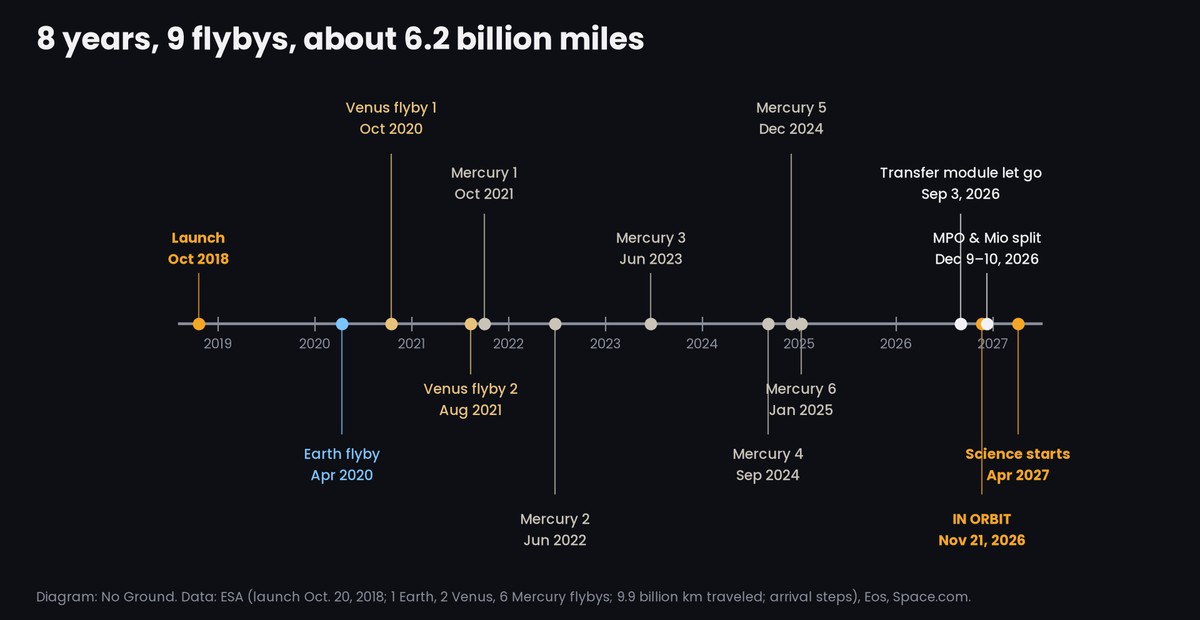
Altogether, ESA says the spacecraft traveled about 9.9 billion kilometers, or about 6.2 billion miles, and made nine planetary flybys. It was supposed to arrive in December 2025. In 2024, a problem cut the power reaching the thrusters, so the team redesigned the route, and that pushed arrival back to November 2026.
Two spacecraft, two different jobs
The two orbiters were built to work together from different heights.
Explore your sky tonightLive sky map for where you are: planets, the ISS and bright stars above your horizon.- MPO (Europe) will fly a tight orbit, about 300 by 930 miles above the surface, going around the planet roughly every 2.3 hours. It will map the surface, measure what the rocks are made of and how hot they get, chart the planet’s gravity, and use radio signals to help pin down the size of the core.
- Mio (Japan) will stay in the long, looping orbit, which takes about 9.3 hours per lap. From there it can study Mercury’s magnetic field, the charged particles around the planet, and how the planet interacts with the solar wind blowing off the Sun.
Watching the same planet from two places at once is the whole point. One spacecraft can see what the solar wind is doing out in space at the same moment the other sees what is happening close to the surface.
The mysteries waiting at Mercury
Mercury looks a lot like our Moon at first glance, gray and covered in craters. But it is a strange world, and NASA’s MESSENGER mission left scientists with plenty of open questions.
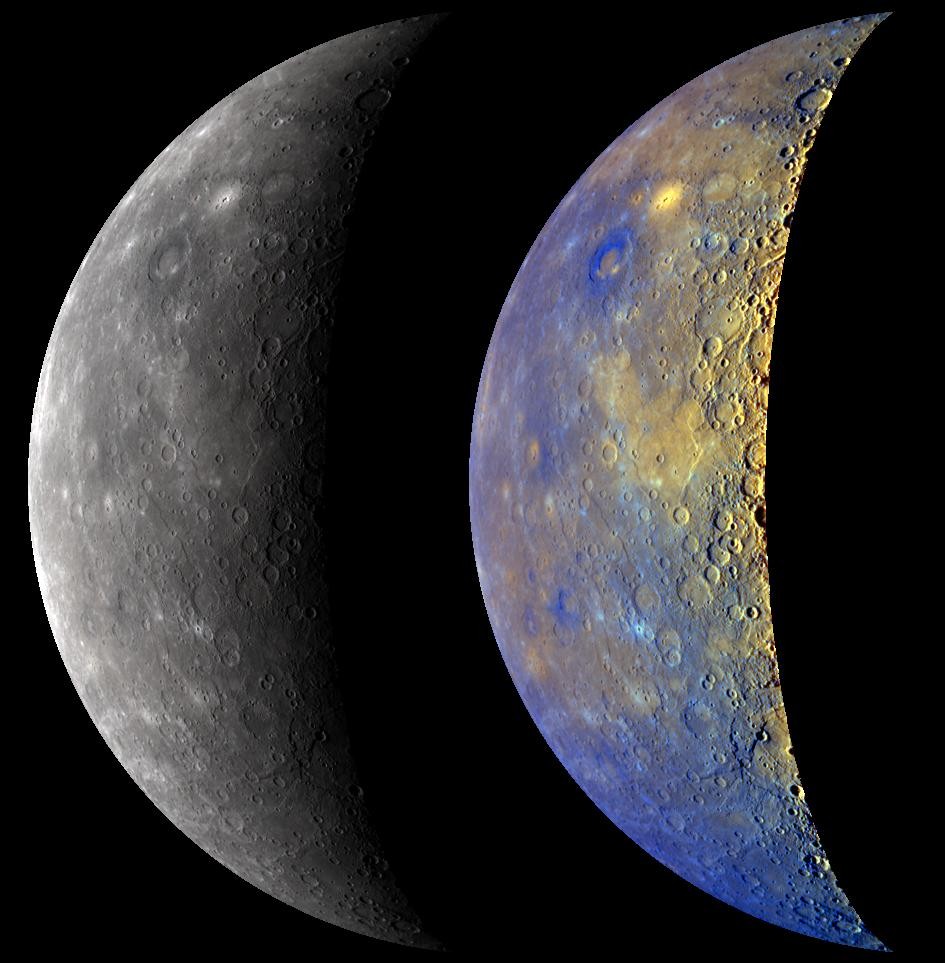
A giant metal heart. Mercury is only about 3,030 miles wide, a little more than a third the width of Earth. Yet its metal core stretches out to about 85% of the planet’s radius. Nobody is sure how a planet ends up so heavy on metal. BepiColombo’s measurements of the planet’s gravity and interior should help test the ideas.
A lopsided magnetic field. Mercury has a global magnetic field, which is surprising for such a small planet. It is only about 1% as strong as Earth’s at the surface, and it is offset from the planet’s center. Scientists don’t yet understand what keeps it running. That is Mio’s main target.
Ice next to the Sun. Daytime ground on Mercury can reach about 800°F, and nights can fall to about −290°F because there is no real atmosphere to hold heat. You can read more about those extremes in our explainer on how cold space really is. Even so, deep craters near the poles never see sunlight, and they may hold water ice.
A shrinking planet. Mercury has cliffs hundreds of miles long and up to about a mile high. NASA says they formed as the planet’s interior cooled and contracted over billions of years. In other words, the whole planet has been slowly shrinking.
What happens next
The next big step is the separation on Dec. 9–10, 2026. After that, Mio stays in its long orbit, and MPO fires its own engines over the following months to work its way down. Space.com reports MPO should reach its final orbit around March 10, 2027. Science operations for both spacecraft are set to start in April 2027.
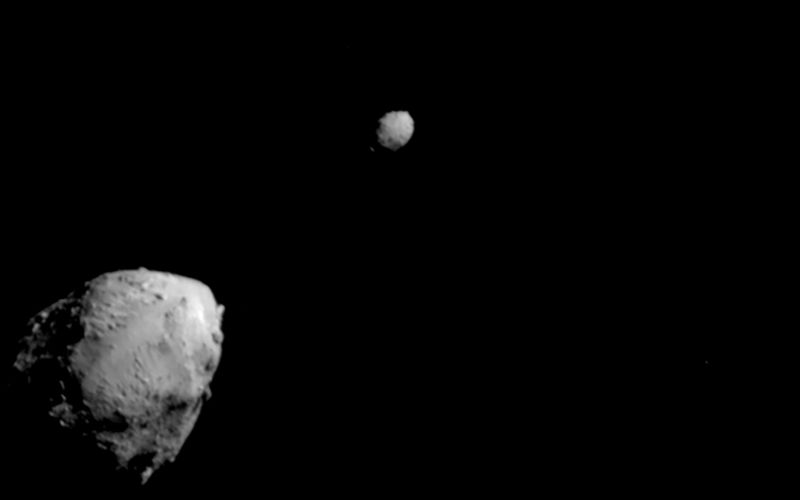
The planned mission lasts one year, with a possible extension through 2029. Like ESA’s Hera mission to the Didymos asteroids, BepiColombo will spend its first months making careful moves before the real science begins.
The spacecraft has already sent back useful data from its flybys, but this is the first time both orbiters will be able to use all their instruments from orbit around the planet.
Bottom line: BepiColombo entered orbit around Mercury on Nov. 21, 2026, after an eight-year trip of about 6.2 billion miles and nine flybys. The European and Japanese orbiters split up in December and start full science in April 2027, aiming to explain Mercury’s oversized metal core, its odd magnetic field and the ice hiding in its polar craters.