 No Ground
Every few weeks a new NASA picture goes viral, and the comments fill up with the same two reactions. Some people see a face, a hand or even a god in the glowing clouds. Others ask a sharper question: is that even real, or did someone just paint it?
The short answer: the pictures are real data, collected by real telescopes. But the colors are often chosen by people, because many telescopes record light our eyes cannot see at all. And the faces? Those are mostly coming from your own brain.
Here is how a space photo is actually made, what the colors mean, and how to tell a real image from an illustration.
Every space photo starts in black and white
A phone camera hands you a color picture instantly. Big science telescopes don’t work that way. NASA’s James Webb Space Telescope, about 1 million miles from Earth, takes black-and-white exposures. Each one simply records how much light landed on each pixel.
To learn what kind of light that was, the telescope puts a filter in front of the camera for each exposure. A filter lets through only a narrow slice of wavelengths. Webb’s main near-infrared camera, NIRCam, has 29 filters, and some are tuned to pick up specific things like hydrogen, iron, water or methane.
When those raw frames first arrive, they look almost completely black. That is not because they are empty. Space is dim, and Webb’s detectors capture an enormous range of brightness: each pixel can be one of more than 65,000 shades of gray, far more than a screen can show. Image processors “stretch” the data so the faint parts become visible without blowing out the bright stars.
Then they clean the frames. Cosmic rays hit the detectors and leave bright specks. Very bright stars can leave ghost dots in the next exposure. Those defects are removed so they aren’t mistaken for real objects.
How the colors get added
Color comes from combining several of those filtered black-and-white frames. Each frame gets assigned a color, usually red, green or blue, and the frames are stacked on top of each other. Your screen builds every color it shows out of red, green and blue light, so three frames are enough to make a full-color picture. It is basically the same trick used to make some of the very first color photographs more than a century ago.
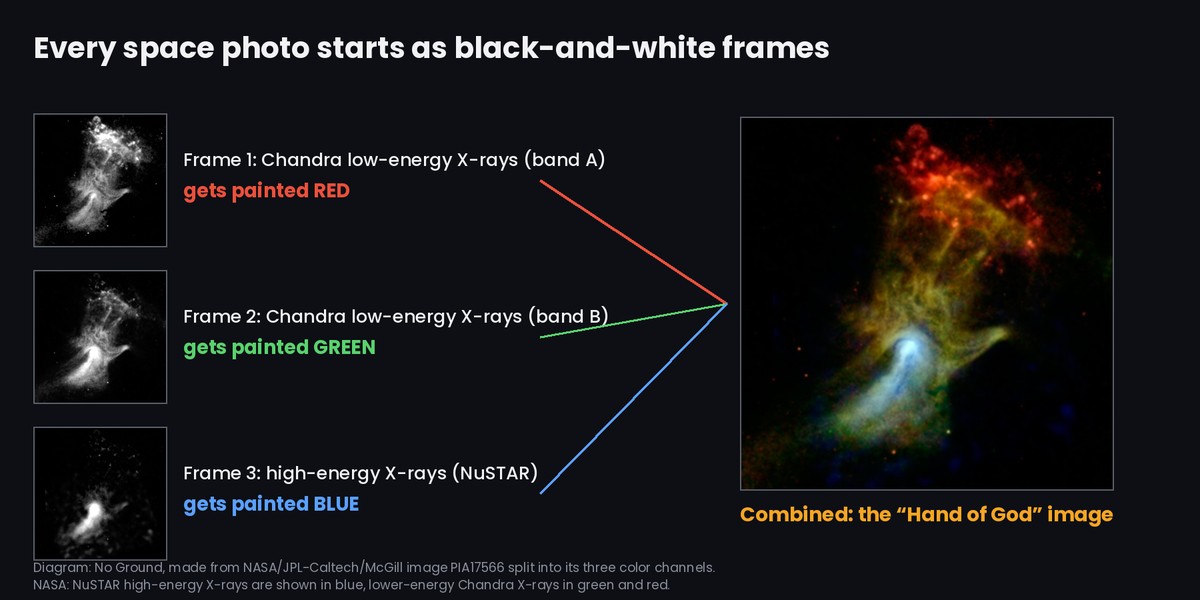
Here is the important part. Webb sees almost entirely infrared light, which is invisible to human eyes. So there is no “true” color to show. Instead, the image team follows a rule called chromatic order: the shortest wavelengths are shown as blue, the middle ones as green, and the longest as red. That keeps the same order a rainbow has, even though every wavelength in the picture is invisible to us.
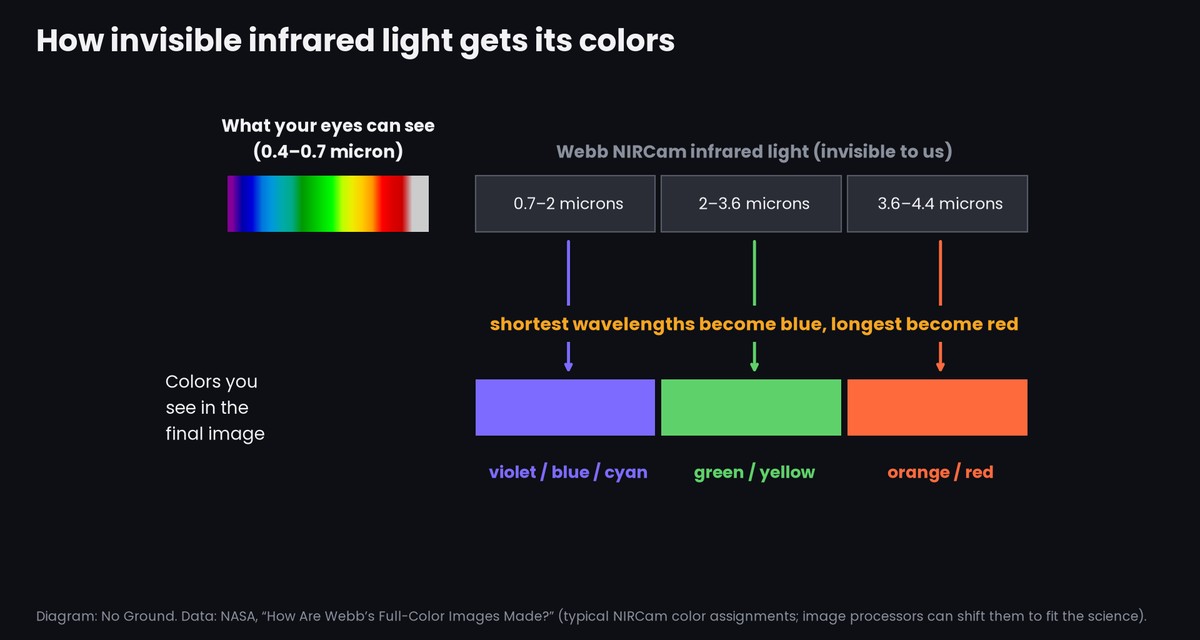
ESA, Webb’s European partner, calls these “representative color” images. The colors stand in for light you could never see, but the structure is real. ESA notes that the dark areas really are dark dust or empty space, and the bright areas really are glowing gas and stars, just as Webb recorded them.
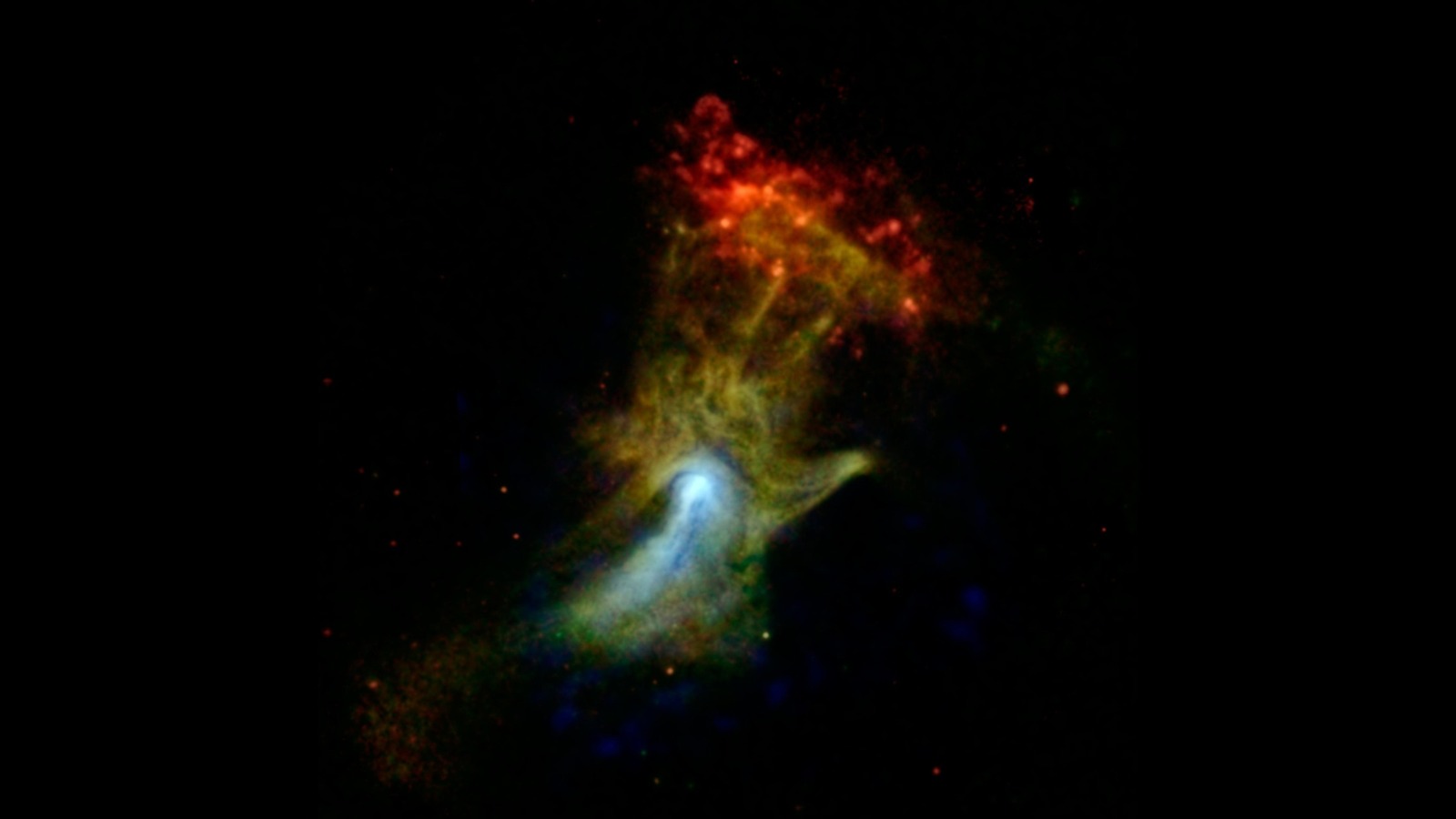
The same idea works for other kinds of light. NASA’s famous “Hand of God” picture shows X-rays, which our eyes can’t see either. In that image, high-energy X-rays from NASA’s NuSTAR telescope are shown in blue, and lower-energy X-rays from NASA’s Chandra observatory are shown in green and red.
Hubble is a bit different. It sees mostly visible light, plus some ultraviolet and infrared, from about 300 miles above Earth. Some Hubble images are close to natural color, while others use representative colors to show infrared light or the glow of specific chemical elements. If you have read our explainer on why the sky is blue, you already know color is just our brain’s label for different wavelengths of light. Telescopes simply measure many more wavelengths than our eyes do.
Explore your sky tonightLive sky map for where you are: planets, the ISS and bright stars above your horizon.Would you see those colors with your own eyes?
Usually not, and there are two reasons.
The first is the light itself. If an image shows infrared or X-rays, you could float right next to that nebula and still not see what the picture shows, because your eyes can’t detect those wavelengths.
The second is brightness. Even for visible light, most nebulas and galaxies are too faint for the color-sensing cells in your eyes. Sky & Telescope explains that the human eye has an effective “exposure time” of about one-tenth of a second. A color photo of a galaxy or nebula collects light for minutes or even hours. That is why amateur astronomers often see a gray smudge through the eyepiece, then capture rich reds and blues with a camera on the same telescope.
So when someone asks “is it real,” a better question is: real in what kind of light? The shapes, positions and brightness come from real measurements. The colors are a translation.
Why people see faces, hands and gods in space
Now for the viral part. Why do so many people see faces in nebulas?
Scientists call it face pareidolia. Researchers at the University of Sydney explain that the brain’s face detector plays “fast and loose.” It uses a rough template, two eyes over a nose and a mouth, and fires within a few hundred milliseconds when something fits. From an evolutionary point of view, missing a real face was riskier than mistaking a rock for one. That is the same kind of brain shortcut behind our explainer on why the Moon looks bigger on the horizon: your brain makes a fast guess, and you feel the guess as if it were reality.
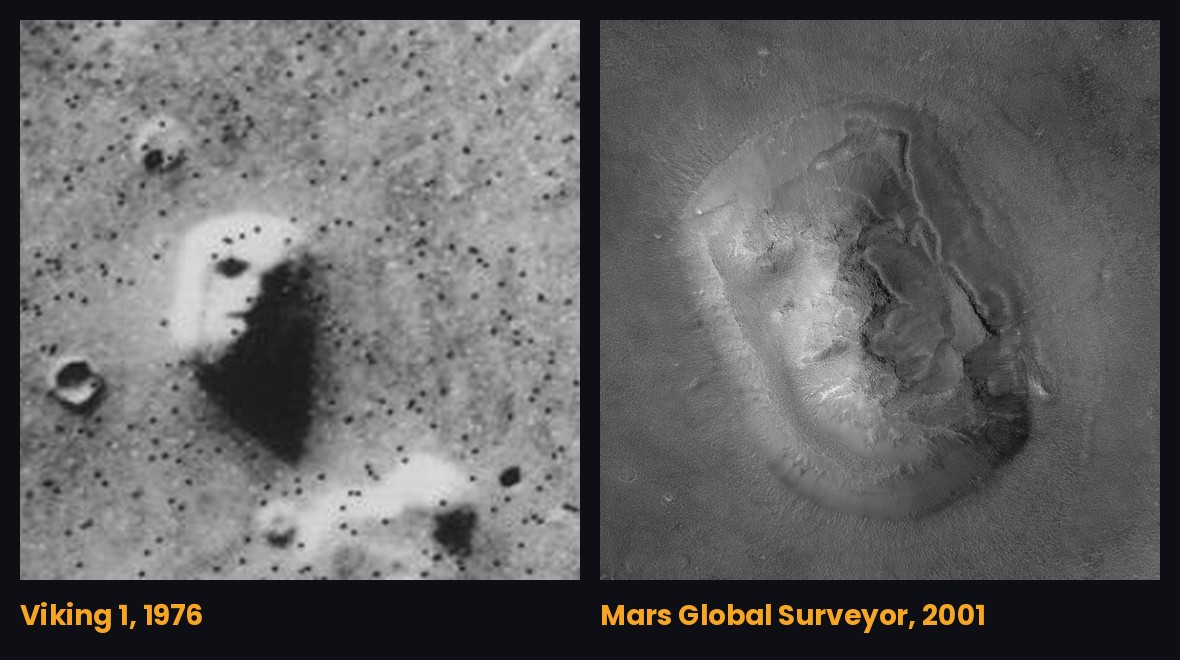
The most famous space example is the “Face on Mars.” In 1976, NASA’s Viking 1 orbiter photographed a mesa that looked like a human face, with shadows making the eyes and mouth. It became a pop-culture legend. On April 8, 2001, NASA’s Mars Global Surveyor turned its camera to the same spot and took a far sharper picture, at about 6.6 feet per pixel. The “face” turned out to be an ordinary eroded hill about 2.2 miles across.
The “Hand of God” is another good one. It is a cloud of particles energized by a pulsar called PSR B1509-58, the collapsed core of an exploded star. NASA says the pulsar is only about 12 miles wide but spins nearly seven times every second, about 17,000 light-years from Earth. Even the scientists who study it are careful: “We don’t know if the hand shape is an optical illusion,” one of them told NASA. In NuSTAR’s higher-energy view, the hand looks more like a fist.
How to tell if a space image is real
A few quick checks will sort out most viral pictures:
- Look for the credit line. Real telescope images name the mission or team, such as NASA, ESA, CSA, STScI or JPL. No credit at all is a warning sign.
- Read the caption. Official captions say which filters or wavelengths were used, and words like “representative color” or “enhanced color” tell you the colors were assigned.
- Watch for “illustration” or “artist’s concept.” Those are drawings, not photos, even when they look very real. Close-up views of planets around other stars are almost always illustrations.
- Find the original. NASA’s image library at images.nasa.gov and Webb’s public archive keep the originals. Anyone can download Webb’s raw data and make their own color version.
Next time you see a striking image, like the ice Webb found in our story on ice that may be older than its star, check the caption. You’ll often find a short note saying exactly which colors stand for which wavelengths.
Bottom line: Space photos are real measurements, but many show light our eyes can’t see, so the colors are assigned in rainbow order to make invisible wavelengths visible. Nebulas also look much grayer to the eye because they are faint. The faces and hands people spot are mostly pareidolia, our brain’s face detector firing on random shapes, as the 2001 close-up of the “Face on Mars” proved.