 No Ground
Most spacecraft have to keep racing around a planet to stay up. But a handful of the most important machines we have ever launched sit somewhere stranger: in places where the pull of the Sun and the pull of Earth balance so neatly that a spacecraft can ride along with Earth around the Sun with almost no effort.
These places are called Lagrange points. There are five of them for every pair of big objects in space, and they are the closest thing the solar system has to parking spots. The James Webb Space Telescope lives near one. Spacecraft that warn us about solar storms live near another. And at two of them, nature was quietly collecting asteroids long before we arrived.
What is a Lagrange point, in plain words?
NASA’s short definition is that Lagrange points are “positions in space where objects sent there tend to stay put.” At these spots, the gravitational pull of two large bodies — say, the Sun and Earth — works out to exactly the pull a small object needs to move along with them.
Here is why that is surprising. Normally, the farther an object is from the Sun, the slower it goes around it. Earth takes a year. Mars, farther out, takes almost two. So a spacecraft sent a little beyond Earth’s orbit should fall behind Earth and drift away. A spacecraft placed a little inside Earth’s orbit should run ahead.
Except at a few special points. Just outside Earth’s orbit, Earth’s own gravity adds a little extra pull toward the Sun, and that extra tug is enough to make a spacecraft there keep pace with Earth exactly. Just inside Earth’s orbit, Earth’s pull works the other way, partly cancelling the Sun’s, so a spacecraft there slows down to match Earth as well. The result: two spots on the Sun–Earth line where an object goes around the Sun once a year, in lockstep with us.
The points are named after Joseph-Louis Lagrange, a mathematician born in Turin in 1736. In a prize-winning 1772 paper on the three-body problem, he worked out where a small object could keep the same position relative to two larger ones. He found five answers, today labelled L1 through L5.
The five points, one by one
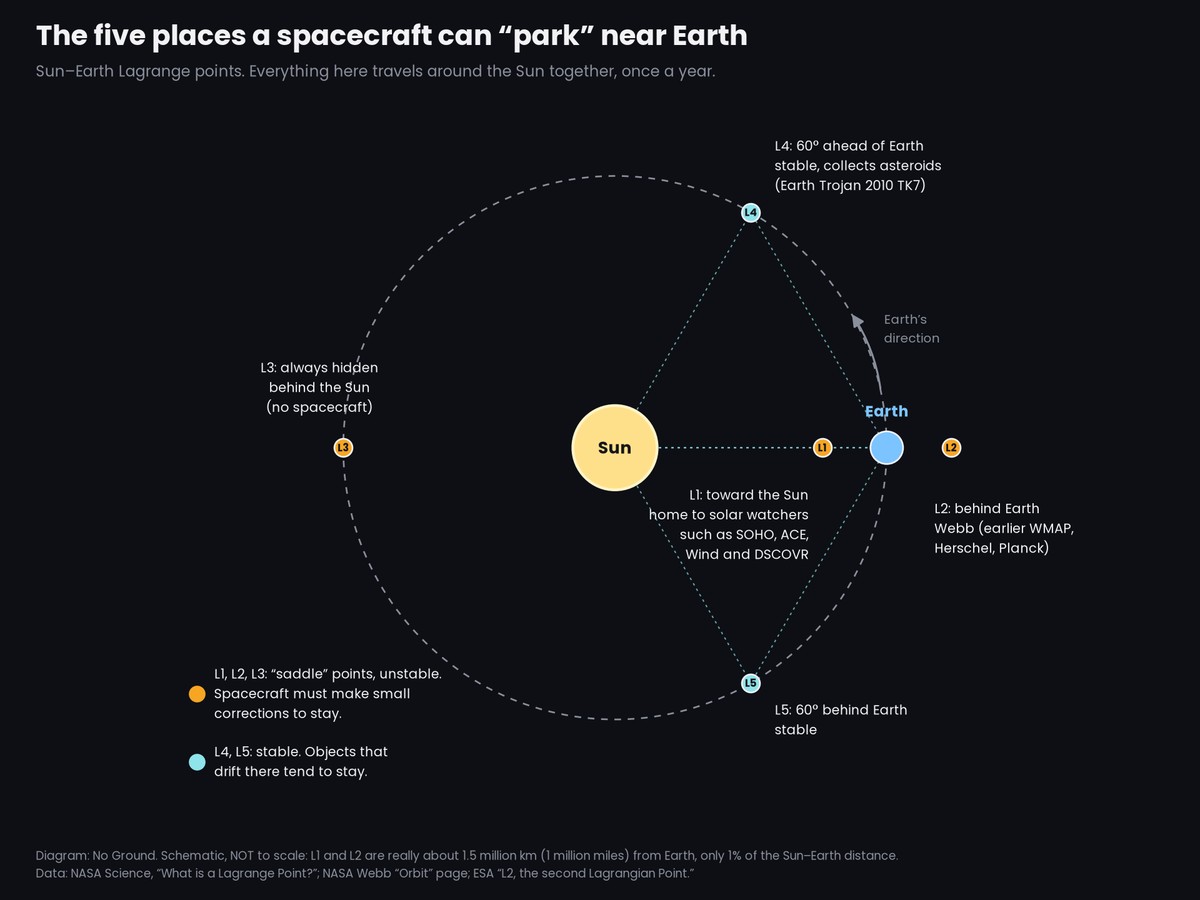
L1 sits between Earth and the Sun, about 1.5 million kilometres (roughly 1 million miles) from Earth. NASA calls it a spot with “an uninterrupted view of the sun.” That has made it home to solar observatories such as SOHO, ACE, Wind and DSCOVR. It is also where space weather forecasting starts. NOAA’s Space Weather Prediction Center says its real-time solar wind data comes from spacecraft “typically orbiting the L1 Lagrange point,” upwind of Earth, so forecasters can spot disturbances heading our way before they arrive. When you read a storm alert — and our guide to how to read space weather alerts explains what the codes mean — the measurement behind it very likely came from L1.
L2 is on the other side of Earth, the same distance away, directly behind our planet as seen from the Sun. ESA points out that it is about four times farther from Earth than the Moon ever gets. From L2, the Sun, Earth and Moon are always in roughly the same direction, so a single shield can block all three at once. That is exactly what astronomers want.
L3 is on the far side of the Sun, just outside Earth’s orbit, permanently hidden behind the Sun from our point of view. NASA says it is unlikely to find any use for it. Science fiction writers have long imagined a hidden “counter-Earth” there. There is no such planet.
L4 and L5 sit on Earth’s orbit itself, one 60 degrees ahead of Earth and one 60 degrees behind. Each one forms an equilateral triangle with the Sun and Earth, which is the neat geometry Lagrange found. NASA notes that L4 leads Earth and L5 follows it.
Why “parking” is the right word, and also not quite
Here is the twist that most people miss: L1, L2 and L3 are unstable. NASA compares them to saddles, or to balancing a marble on top of a watermelon. If a spacecraft drifts a little, it keeps drifting. NASA says the L1 and L2 points are unstable on a time scale of about 23 days, which is why the spacecraft there make regular small course corrections with their thrusters.
That is also why no spacecraft actually sits exactly on L1 or L2. They fly big, slow loops around the point instead. NASA says Webb’s orbit around L2 is similar in size to the Moon’s orbit around Earth, and that Webb takes about six months to go around it once. That loop keeps it out of the shadows of Earth and the Moon.
L4 and L5 are different. They behave like hilltops, which sounds even less stable, but here motion helps. When an object starts to roll away, it speeds up, and the Coriolis effect — the same effect that makes hurricanes spin — bends its path into a loop around the point instead of off into space. NASA says these orbits stay stable as long as the bigger of the two main bodies is at least 24.96 times as massive as the smaller one. The Sun outweighs Earth by far more than that, and Earth outweighs the Moon by enough too, so both pairs have stable L4 and L5 points.
Why Webb lives at L2
The James Webb Space Telescope does not orbit Earth at all. NASA says it orbits the Sun, about 1.5 million kilometres (1 million miles) from Earth, near L2, and keeps in line with Earth all year. That matters because Webb sees mostly infrared light — essentially heat — and its mirrors and instruments must stay extremely cold. NASA says the telescope operates at about minus 225 degrees Celsius (minus 370 degrees Fahrenheit).
To stay that cold, Webb hides behind a huge sunshield that NASA likens to sunscreen with an SPF of one million. A shield only works if every hot thing is on the same side of it. In a low orbit around Earth, Hubble goes in and out of Earth’s shadow every 90 minutes. At L2, Sun, Earth and Moon all stay behind the shield, so Webb can work around the clock. Results like the ones in our story Webb found ice that may be older than its star depend on that cold, steady view.
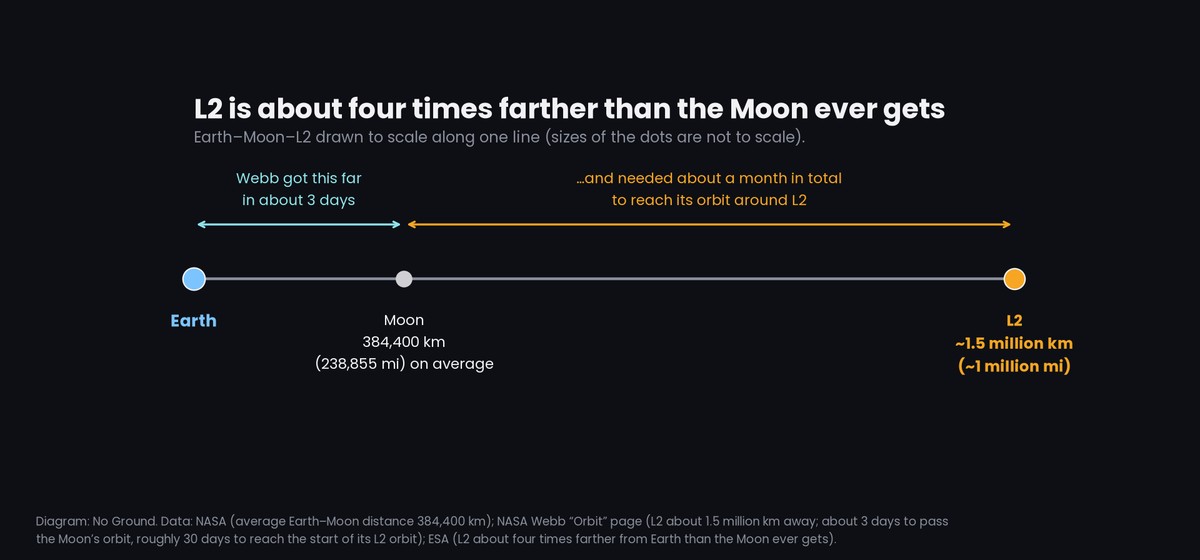
Getting there took patience. NASA says Webb needed about 30 days to reach the start of its orbit around L2, even though it passed the distance of the Moon’s orbit in just 3 days. Before Webb, L2 was home to other observatories, including NASA’s WMAP and ESA’s Herschel and Planck.
The points nature filled first: Trojan asteroids
Long before any spacecraft, the stable L4 and L5 points were already collecting things. Asteroids that wander into them can stay for very long times. Astronomers call them Trojans, after asteroids at Jupiter’s L4 and L5 points named for heroes of the Trojan War, such as Agamemnon, Achilles and Hector.
Find Jupiter in your sky tonightIts Trojan asteroids travel 60 degrees ahead of and behind it. The live map shows where Jupiter is now.Jupiter, the heaviest planet, has the biggest collection. Its Trojans travel in two swarms, one ahead of the planet and one behind. NASA’s Lucy spacecraft, launched in 2021, is the first mission sent to explore them; we covered Lucy’s arrival in the Jupiter Trojan region. NASA says Mars has Trojans too, and several of Saturn’s moons have Trojan companions.
Earth has them too. In 2010, NASA’s WISE telescope confirmed the first known Earth Trojan asteroid, 2010 TK7, at Earth’s leading L4 point. And in 1956 the Polish astronomer Kazimierz Kordylewski reported faint concentrations of dust at the Trojan points of the Earth–Moon system, a hint that even the Moon’s Lagrange points gather material.
The view from L1: Earth’s full face
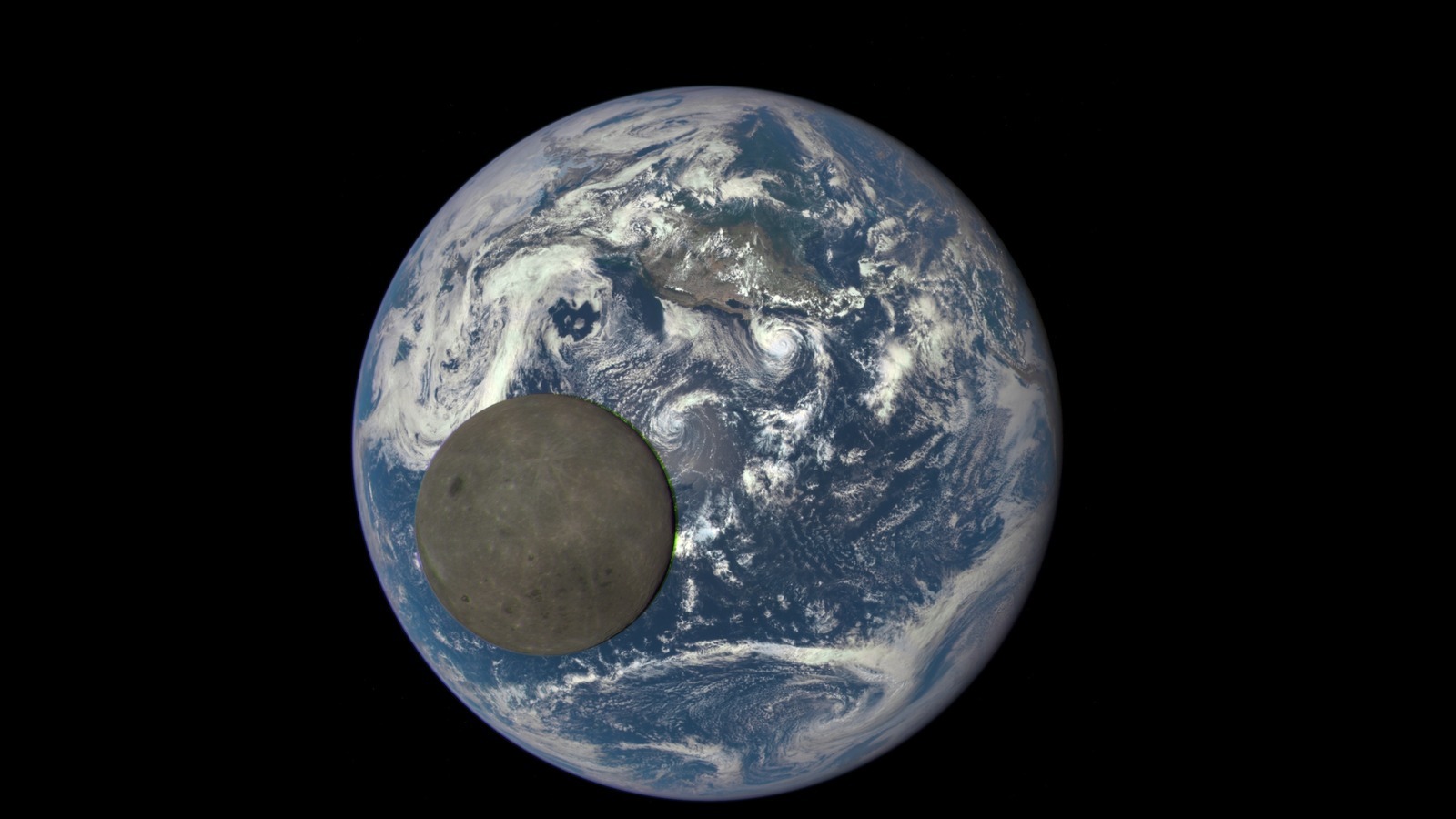
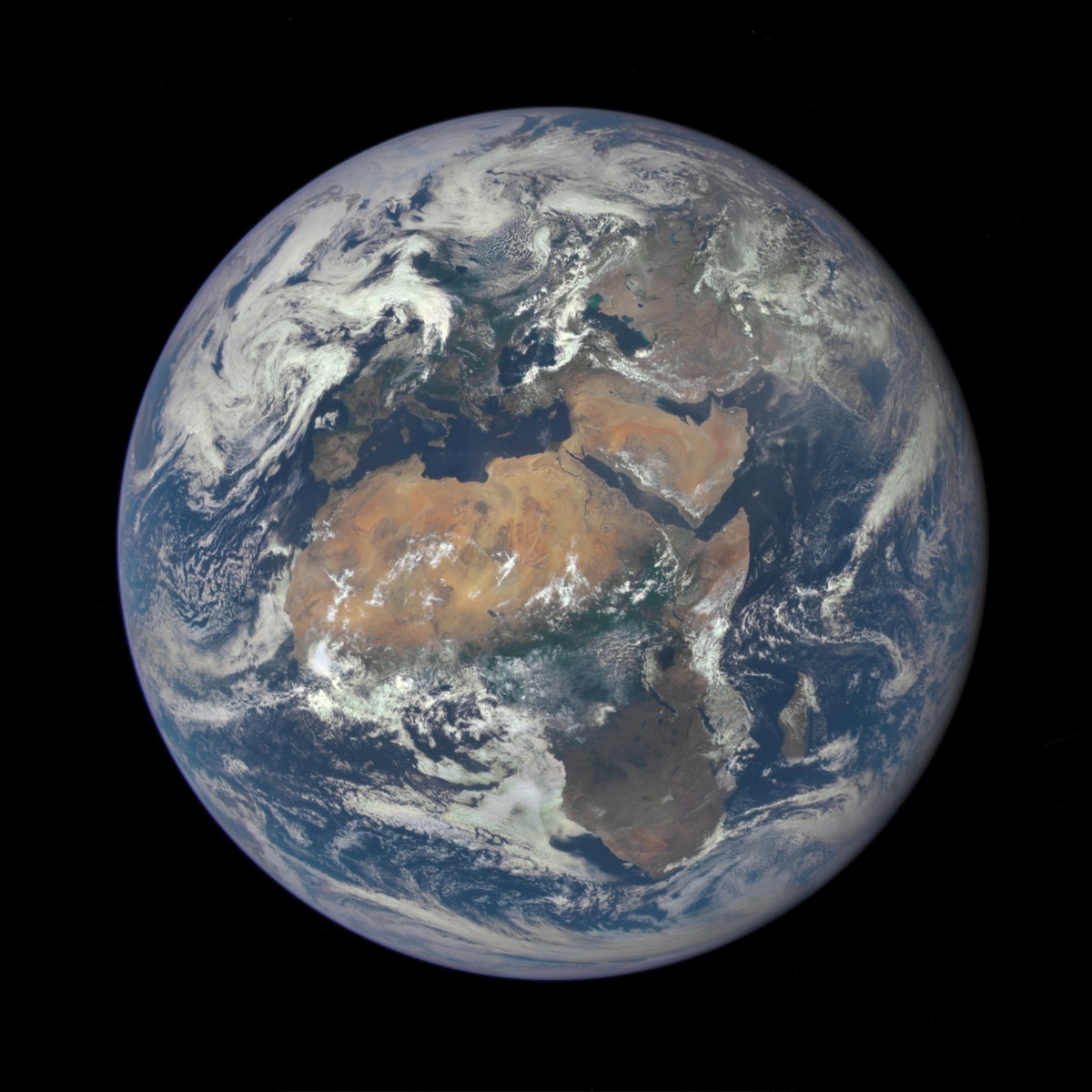
Lagrange points also gave us one of the most unusual everyday views of our own planet. NASA’s Earth Polychromatic Imaging Camera (EPIC) rides on the Deep Space Climate Observatory, DSCOVR, a NASA–NOAA–U.S. Air Force mission launched in 2015 to L1. From there, about 1 million miles away toward the Sun, it sees the whole sunlit side of Earth at once. That is the camera that took the photo at the top of this page: in July 2015 it caught the Moon crossing in front of Earth, showing the Moon’s far side fully lit — the side that is never visible from Earth.
ESA notes that a spacecraft with a giant solar sail could, in principle, use sunlight to create its own “artificial” Lagrange point. For now, the five natural ones keep us busy: a lookout for solar storms, a cold corner for telescopes, and two quiet zones where asteroids gather.