The Sun and all its planets are racing through space. NASA says our solar system orbits the center of the Milky Way at about 515,000 miles per hour (828,000 kph), and that one lap takes about 230 million years. Yet one star, Polaris, seems to hang in the same spot in the northern sky, night after night, year after year. Why?
It is very far away
Polaris is about 430 light-years away, according to NASA’s Hubble team. Astronomers at the Center for Astrophysics | Harvard & Smithsonian put it at about 445.5 light-years, using a distance based on data from ESA’s Gaia mission. Gaia cannot measure Polaris itself because the star is too bright, so the measurement was made on its faint companion, Polaris B. For years, estimates ranged from about 326 to 522 light-years. The exact number has been argued over, but every version is hundreds of light-years.
That distance keeps the star’s apparent shifts tiny. Parallax is the small shift in a star’s position as Earth travels around the Sun. ESA’s Hipparcos satellite measured Polaris’s parallax at 7.54 milliarcseconds, give or take 0.11. That is about 0.0075 arcseconds. The full Moon is about half a degree, or roughly 1,800 arcseconds, across, so by our arithmetic Polaris’s parallax is about 240,000 times smaller than the Moon’s width.
The stars are moving too, just very slowly from here
Polaris is not standing still. The Hipparcos catalogue lists its motion across the sky as about 44.5 milliarcseconds per year in one direction and about 11.9 in the other. Combined, that is roughly 46 milliarcseconds a year, or under 5 arcseconds in a century (our arithmetic). A study of Polaris B’s distance notes that the Hipparcos figure is affected by the orbit of Polaris’s close companion, so treat it as approximate. Either way, it is far too small to see by eye.
The light you see tonight left Polaris roughly 430 to 445 years ago (our arithmetic from the distances above). It is a reminder of how far away it is.
The real reason: Earth’s axis points almost straight at it
The biggest reason is not about Polaris at all. NASA explains that Polaris sits more or less directly above Earth’s north pole, along the line our planet spins around. As Earth turns through the night, the stars near that point appear to circle it. The farther a star is from the pole, the bigger its circle. Polaris is so close to the pole that it traces a very small circle over 24 hours, so it stays in roughly the same place in the sky.
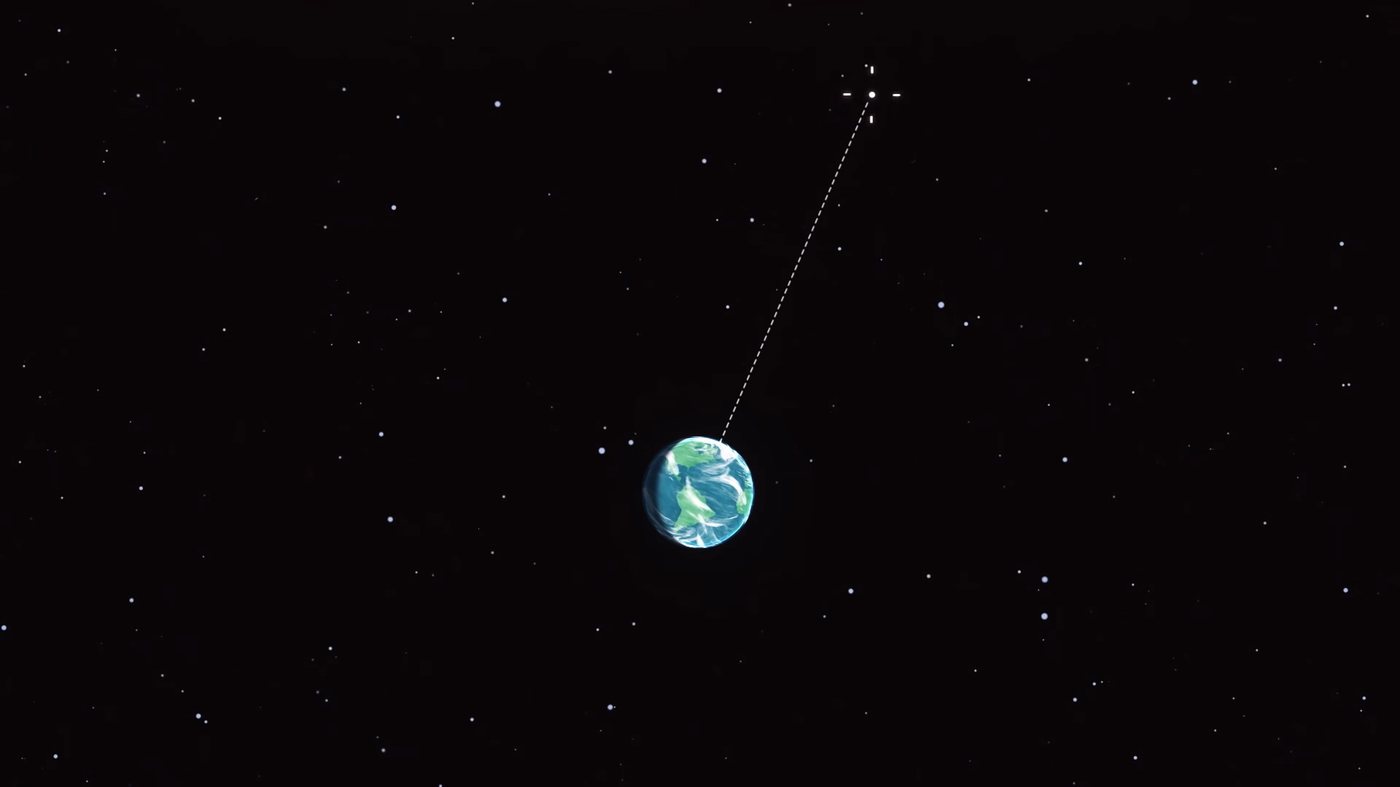
It is close, not exact. Polaris’s catalogued position, at declination +89° 15′ 50.8″, puts it a little under one degree from the pole (about 0.74°, our arithmetic from 90° minus that value). So even Polaris makes a small circle. To find it, NASA says, locate the Big Dipper and follow the two stars at the end of its “cup.” They point the way to Polaris, the tip of the Little Dipper’s handle.
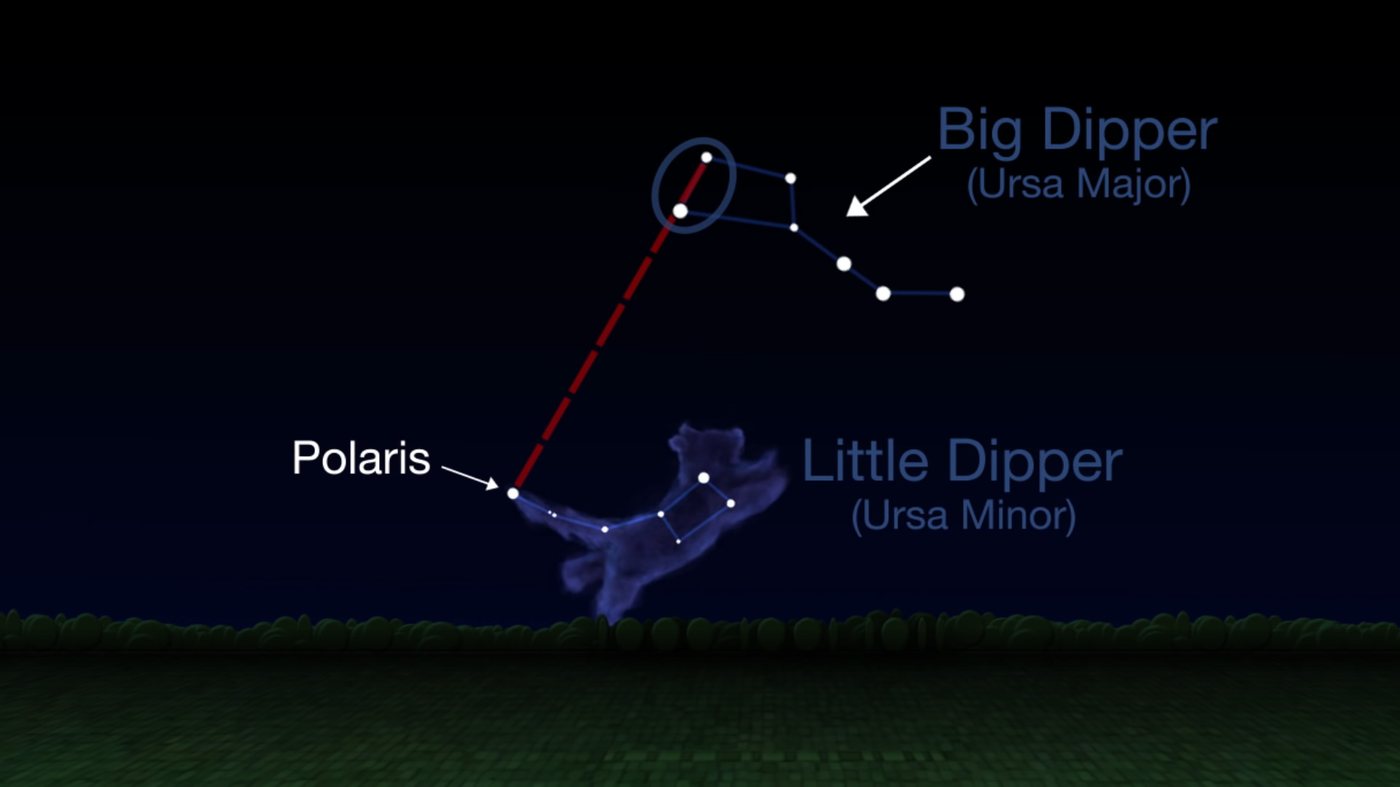
It will not stay the North Star
Earth’s axis wobbles like a spinning top, a motion called precession. NASA says the wobble takes about 26,000 years, and it makes the celestial pole wander in a slow circle among the stars. NASA’s StarChild site says the pull of the Moon and Sun on Earth’s equatorial bulge causes it, and that the Greek astronomer Hipparchus first estimated it around 130 B.C.
About 14,000 years ago, NASA says, the pole pointed toward the bright star Vega, and it will point near Vega again in roughly 12,000 years. (StarChild says about 13,000 years, so the exact date depends on who is counting.) In 3000 B.C. the North Star was a different star, Thuban, in the constellation Draco. Don’t feel bad for Polaris: StarChild says that in another 26,000 years it will be the pole star again.
And Polaris itself is not a calm, single star
Polaris is a triple star system, NASA’s Hubble team reported in 2006, when astronomers photographed its close companion for the first time. The star we see by eye, Polaris Aa, is a supergiant more than 2,000 times brighter than the Sun. It is also the nearest Cepheid variable, a kind of pulsating star whose brightness changes are used to measure distances to other galaxies.
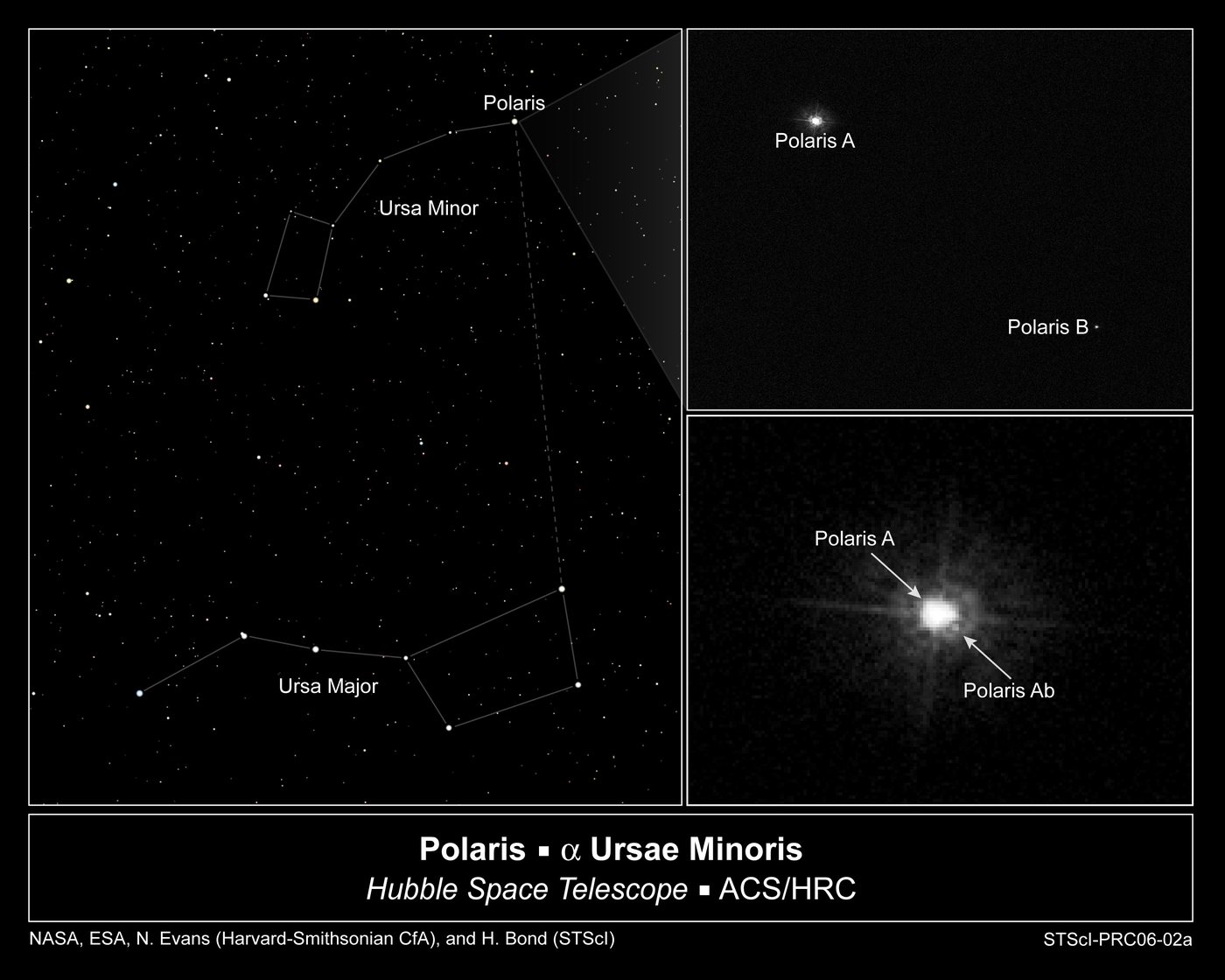
The close companion, Polaris Ab, orbits Polaris Aa once every 29.59 years, according to the Harvard & Smithsonian CfA. NASA gives the average separation as 18.5 astronomical units (about 2 billion miles), where one astronomical unit is the distance from Earth to the Sun. The wider companion, Polaris B, is on average about 2,400 astronomical units away.
Bottom line: Polaris is not magic, and it is not standing still. It looks fixed because it is far away, because stars move slowly from our point of view, and because Earth’s axis happens to point almost straight at it for now.
Watch the reel on the NO GROUND Facebook page.
No Ground. Stay curious.