 No Ground
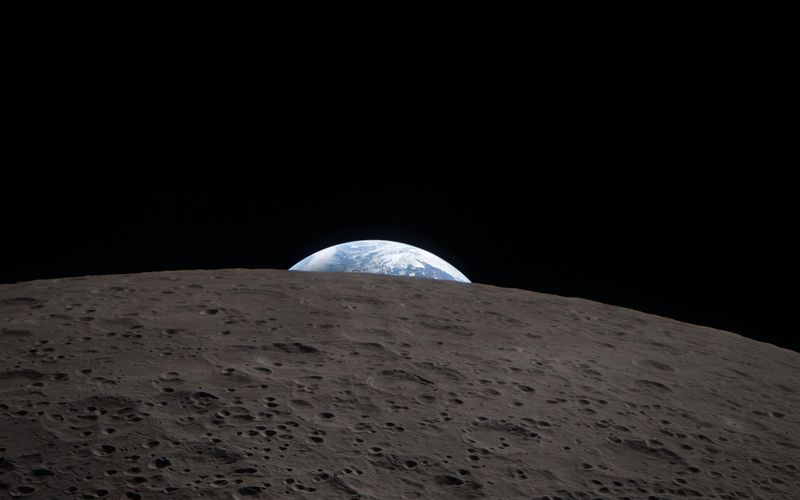
Look at the Moon tonight, next month or in ten years, and you will see the same dark patches in the same places. People have been looking at that same face for as long as there have been people. The other half of the Moon stayed a total mystery until 1959, when a spacecraft finally flew around behind it.
So why does the Moon always show us the same side? The answer is not that the Moon stays still. It is that the Moon spins at exactly the right speed, and Earth’s gravity is the reason why.
The short answer: the Moon does spin
It is a common mix-up. If we always see the same side, it seems like the Moon must not be turning at all. In fact, the opposite is true.
The Moon goes around Earth about once every 27.3 days. In that same time, it also turns once on its own axis. NASA compares it to a dancer circling a partner while always facing them. Because one spin takes exactly as long as one orbit, the same side always ends up pointed at Earth. This is called synchronous rotation, and the Moon is said to be “tidally locked.”
Try it in a room: walk in a circle around a chair while keeping your face toward it. By the time you get back to where you started, you have also turned all the way around, facing every wall of the room once. The chair, though, only ever saw your face.
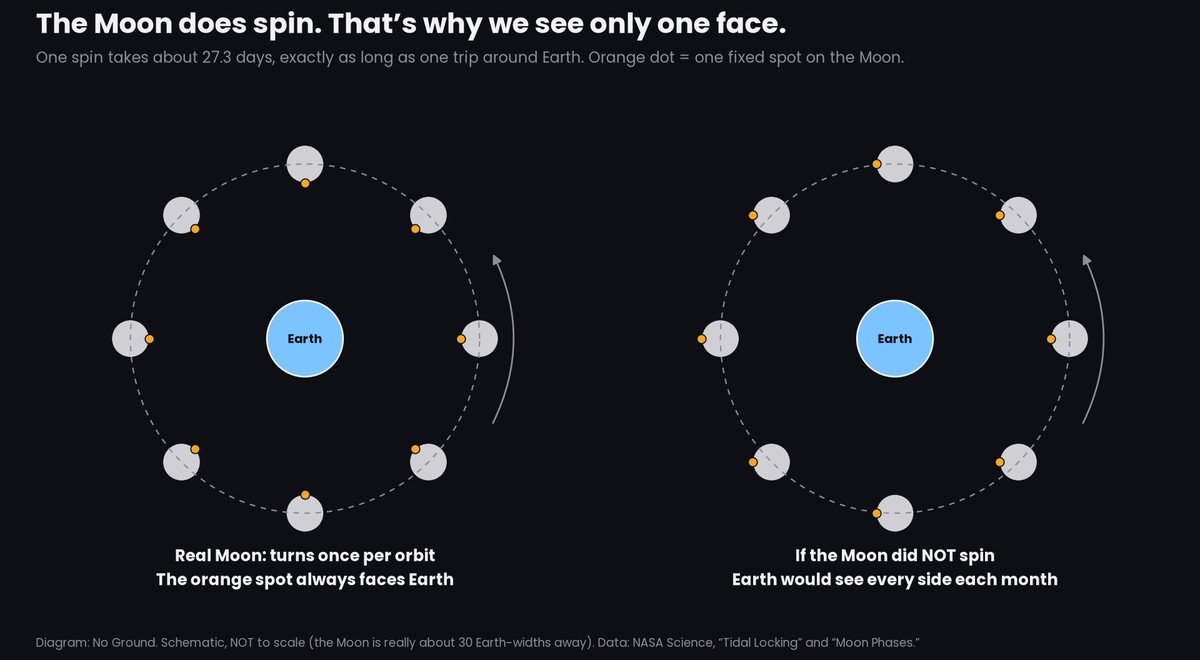
If the Moon did not spin at all, the diagram above shows what would happen: as it went around us, it would show Earth every side over the course of a month. We would know the far side as well as the near side.
How Earth’s gravity locked the Moon
This perfect match is not a coincidence. According to NASA, it goes back to the Moon’s birth. The Moon is thought to have formed after a huge object collided with the early Earth and threw material into space. That material pulled together into a hot, molten Moon that was spinning much faster than it does today.
Earth’s gravity stretched the young Moon into a slight football shape, with a bulge pointing toward Earth. Even today, the Moon is still a little stretched in this way. But back then the Moon was closer and softer, so the bulge was much bigger. As the Moon spun, the bulge kept trying to stay lined up with Earth, but it always lagged a little behind, because it takes time for so much rock to rise and fall.
That constant tug-of-war flexed the Moon and turned some of its spinning energy into heat. Bit by bit, the spin slowed down. It stopped changing only when one spin took exactly as long as one orbit. At that point the bulge stayed pointed at Earth, there was no more flexing, and the Moon was locked. NASA says the big moons in our solar system lock this way early in their lives, within hundreds of thousands of orbits.
The same tides are still at work today, just in a different way. Earth’s oceans bulge toward the Moon, and that pull slowly pushes the Moon outward by about 1.5 inches (4 centimeters) a year, while very slightly slowing Earth’s own spin. We covered that slow escape in The Moon Is Slowly Leaving Us.
We actually see a bit more than half
Here is a twist: over time, people on Earth can see more than 50% of the Moon. NASA’s Moon viewing guide says experienced observers can see about 59% of the lunar surface.
That is thanks to an effect called libration. The Moon’s orbit is not a perfect circle, so it speeds up when it is closer to Earth and slows down when it is farther away, while its spin stays steady. That lets us peek a little way around its eastern and western edges at different times of the month. The Moon’s orbit is also tilted, so sometimes we see a bit past its north pole and sometimes a bit past its south pole. Over a month, the Moon seems to rock and nod.
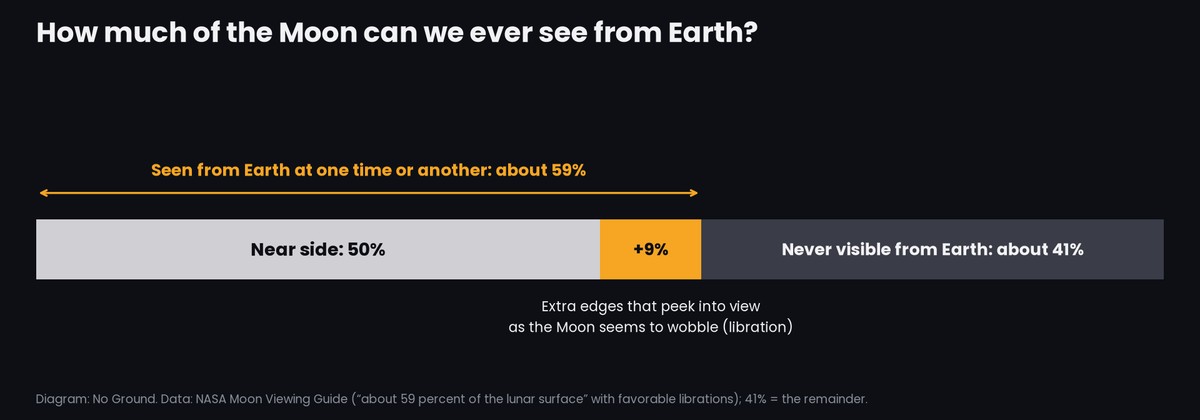
That still leaves about 41% of the Moon that nobody standing on Earth can ever see.
Is there a “dark side of the Moon”?
Not really. The hidden half is often called the dark side, but NASA calls that name misleading. The far side gets just as much sunlight as the near side, just at different times.
The Moon has phases on both halves. When we see a full Moon, the side facing us is in full sunlight and the far side is having its night. At new Moon, it is the other way around: the far side is fully lit, and the side facing us is dark. A better name is simply the far side. It is hidden from us, not dark.
The Moon also never looks bigger or smaller because it turns, by the way. It does look bigger near the horizon, but that is a trick of the brain, which we explained in Why Does the Moon Look Bigger Near the Horizon?
What is on the far side?
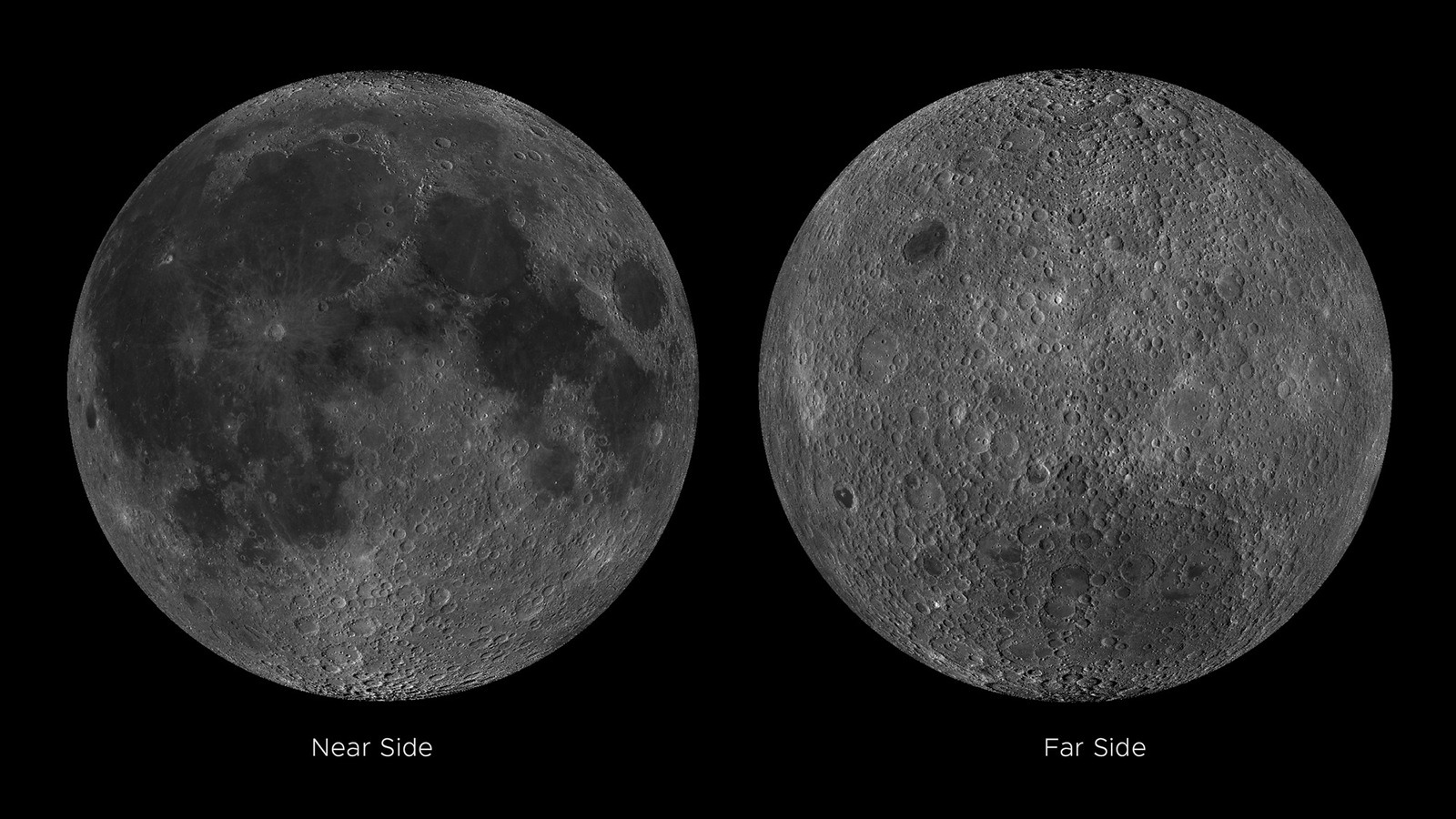
The first look came in October 1959, when the Soviet spacecraft Luna 3 swung around the Moon and sent back grainy pictures. Even those blurry images showed something surprising: the far side is very different from the face we know.
The near side is covered with large dark patches, called maria or “seas.” They are old lava flows that filled huge impact basins. The far side has very few of them. Instead it is crowded with craters of every size and age. It is also home to the South Pole–Aitken basin, one of the largest and oldest impact features in the solar system.
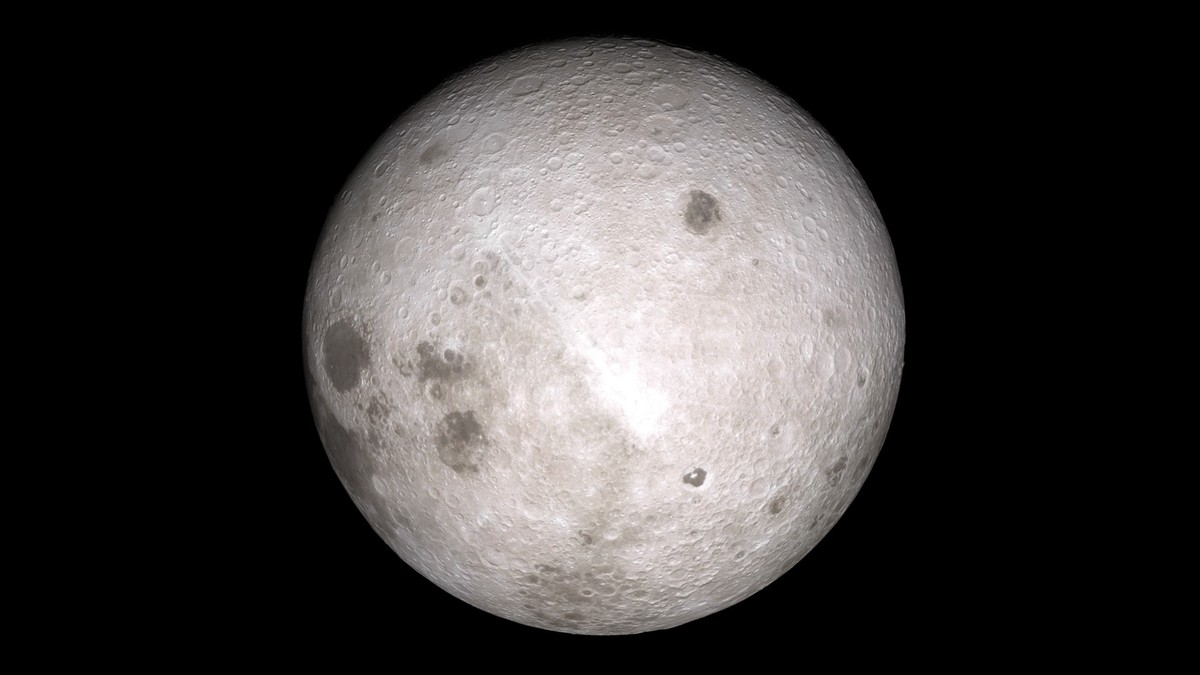
Why the difference? One clue is the crust. NASA says the crust on the Earth-facing side is only about two-thirds as thick as on the far side, which may have made it easier for lava to reach the surface on our side. Scientists are still working out why the Moon ended up lopsided in the first place.
The first people to see the far side with their own eyes were the Apollo 8 crew, Frank Borman, Jim Lovell and Bill Anders, who became the first humans to orbit the Moon in December 1968. Since 2009, NASA’s Lunar Reconnaissance Orbiter has mapped the far side in detail. And in July 2015, NASA’s DSCOVR spacecraft, about a million miles away, caught the fully lit far side crossing in front of Earth, a view we showed in our guide to Lagrange points. And on January 3, 2019, China’s Chang’e 4 became the first spacecraft to land there, on the floor of Von Kármán crater. Landing on the far side is harder than it sounds, because the Moon itself blocks direct radio contact with Earth.
It is not just our Moon
Tidal locking sounds strange, but NASA says it is common. All of the large moons in the solar system are tidally locked to their planets. Pluto and its big moon Charon have gone one step further: they are locked to each other, so each always shows the other the same face.
In theory, Earth could end up locked to the Moon too. NASA estimates that in about 50 billion years, if Earth and the Moon could somehow survive the Sun’s eventual death, the Moon would be so far away that Earth would always turn the same side toward it. Only people on one half of the planet would ever see the Moon.
That will never happen in practice, so for us the deal is fixed. The face of the Moon you see tonight is the same one every human before you saw, and the other side is reserved for spacecraft and the few astronauts who have flown around it.