The storm the forecasts kept promising finally showed up on Saturday. It just showed up at lunchtime.
A cloud of magnetized solar material reached Earth late Saturday morning, and within about three hours NOAA’s Space Weather Prediction Center logged a G3 (Strong) geomagnetic storm. That's the strongest level this week’s run of solar activity has produced, and one step above the G2 watch NOAA had out for the weekend. The catch: the peak hit in broad daylight across the United States. Here’s what happened, what’s left for tonight, and what the Sun is doing next.
How Saturday unfolded
NOAA says the solar wind “became strongly enhanced following the arrival of a CME from 08 Oct” at about 10:34 a.m. ET. Its forecasters flagged the shock in data from a spacecraft about a million miles upstream at 10:43 a.m. ET. At 11:16 a.m. ET, magnetometers on the ground felt the jolt: NOAA recorded a sudden impulse of 56 nanotesla at a station in Germany.
(NOAA’s post doesn’t say which of Thursday’s clouds it was. NASA’s DONKI database, which logs the same shock at 10:33 a.m. ET, links it to CMEs from Oct. 6 and 7. Several clouds were in flight at once, so the exact mix may take time to sort out.)
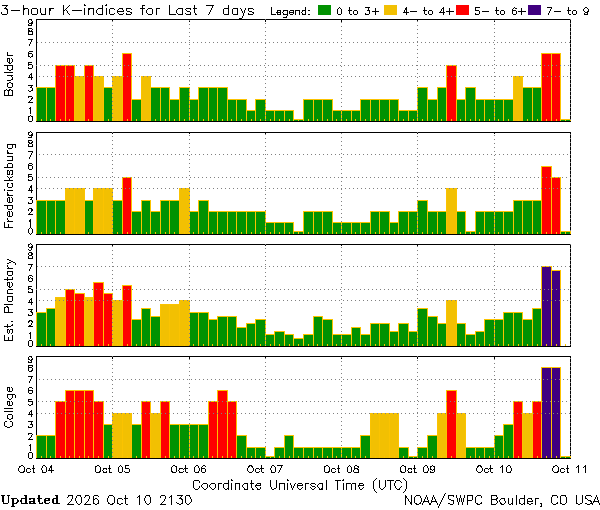
Things moved quickly after that. NOAA issued G1 alerts at 11:35 a.m. ET and G2 at 1:17 p.m. ET. At 1:58 p.m. ET, the planetary index hit Kp 7, a G3 storm. It hit Kp 7 again at 3:27 p.m. ET. NOAA’s three-hour readings put the 11 a.m.–2 p.m. ET block at Kp 7.00 and the 2–5 p.m. block at 6.67.
The solar wind behind it was fierce. NOAA and the U.S. Air Force reported a peak speed of 904 km/s (about 2 million mph) at 1:53 p.m. ET, more than double Friday’s pace. The interplanetary magnetic field reached 46 nT, and its north-south component swung as far as −29 nT at 12:24 p.m. ET. A strongly southward field like that is what lets a CME pour energy into Earth’s magnetic field.
By early evening, it was easing. NOAA’s last G1 alert came at 5:45 p.m. ET. Shortly after 6 p.m., the wind was still fast, around 760 km/s, but the field had turned roughly neutral, which is less helpful for aurora. NOAA’s warning for Kp 7 or higher runs through 7:59 p.m. ET.
What to watch tonight
NOAA’s geomagnetic forecast, issued at 6:05 p.m. ET, still sees storm levels after dark:
- 8 to 11 p.m. ET Saturday: Kp 5.67, which is G2 (Moderate).
- 11 p.m. to 2 a.m. ET: Kp 4.67, which NOAA counts as G1 (Minor).
- After 2 a.m. ET Sunday: Kp 3.67 to 4, active but below storm level.
Out West, that G2 block runs from 5 to 8 p.m. PT, partly before dark. The G1 block, 8–11 p.m. PT, falls after sunset. NOAA puts the odds of a moderate storm at 35% for Oct. 11 (UTC) and a strong-to-extreme storm at 15%.
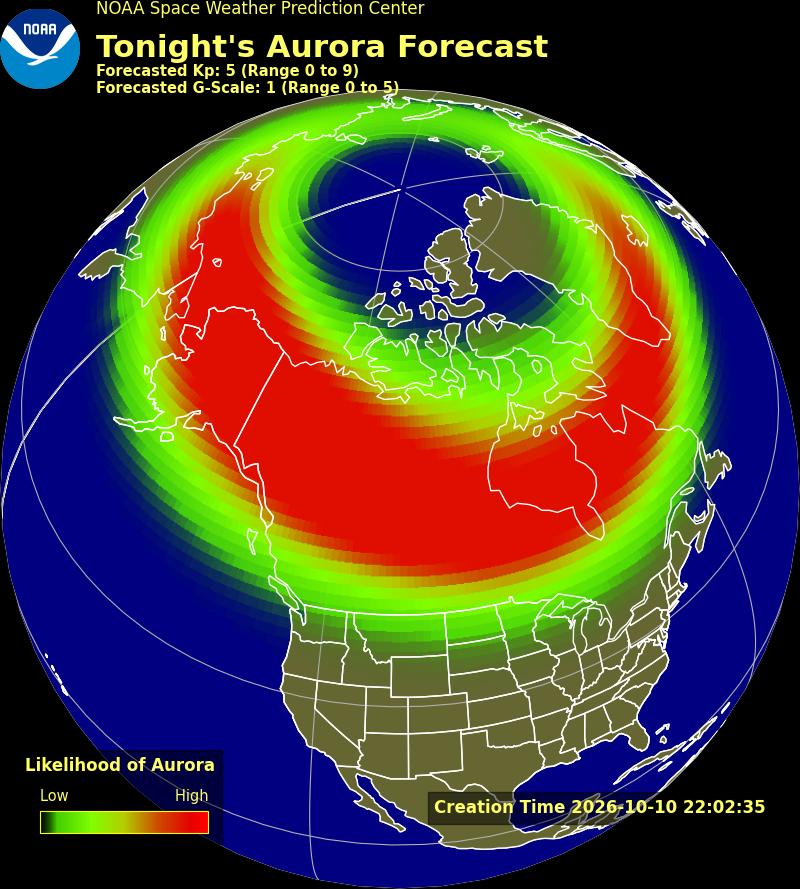
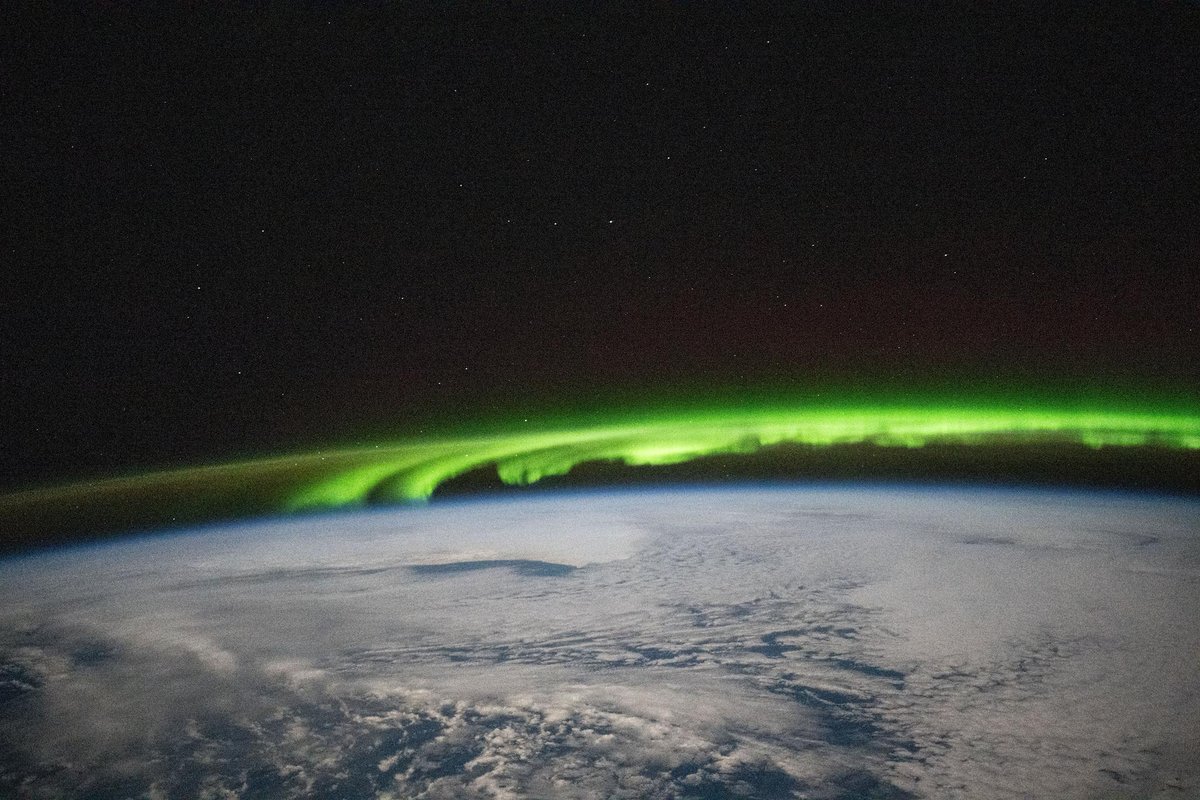
At G2, NOAA says aurora “has been seen as low as New York and Idaho.” At G1, it’s more often limited to places like northern Michigan and Maine. Neither is a promise for your backyard. Tonight is about checking in real time:
- Watch the live map. NOAA’s 30-minute aurora forecast shows where the oval is right now. The Aurora Dashboard puts it next to real-time solar wind.
- Watch Bz. If the solar wind’s magnetic field turns south (negative) again, conditions can pick back up quickly.
- Go dark and look north. Leave city lights, find a low northern horizon, and give your eyes 15–20 minutes.
- Use your phone. Night mode often picks up color your eyes miss. Check your cloud forecast, too.
Sunday: quieter, for now
This morning, NOAA expected the bigger storm on Sunday night. Its 6:05 p.m. update no longer does. It now forecasts Kp 3.67 to 4.00 for Sunday evening and night, active but below storm level. A joint NOAA/Air Force report issued at 6 p.m. ET expects “active to major storm levels” on Oct. 11 overall, then unsettled to active on Oct. 12–13.
The Sun fired again
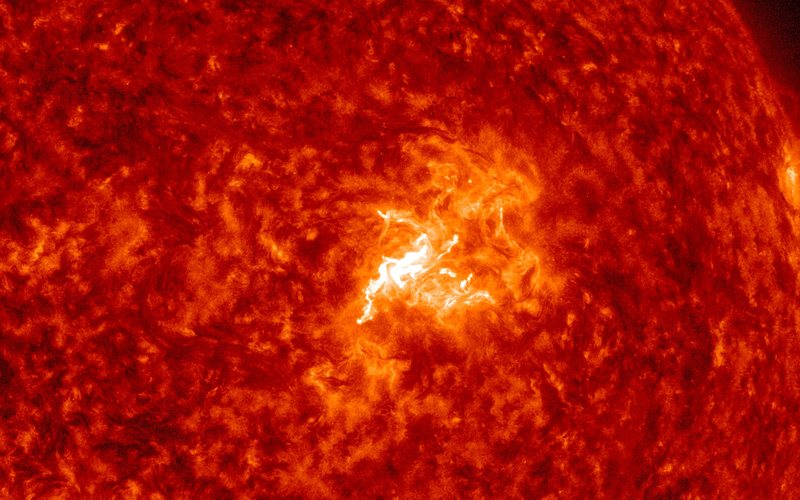
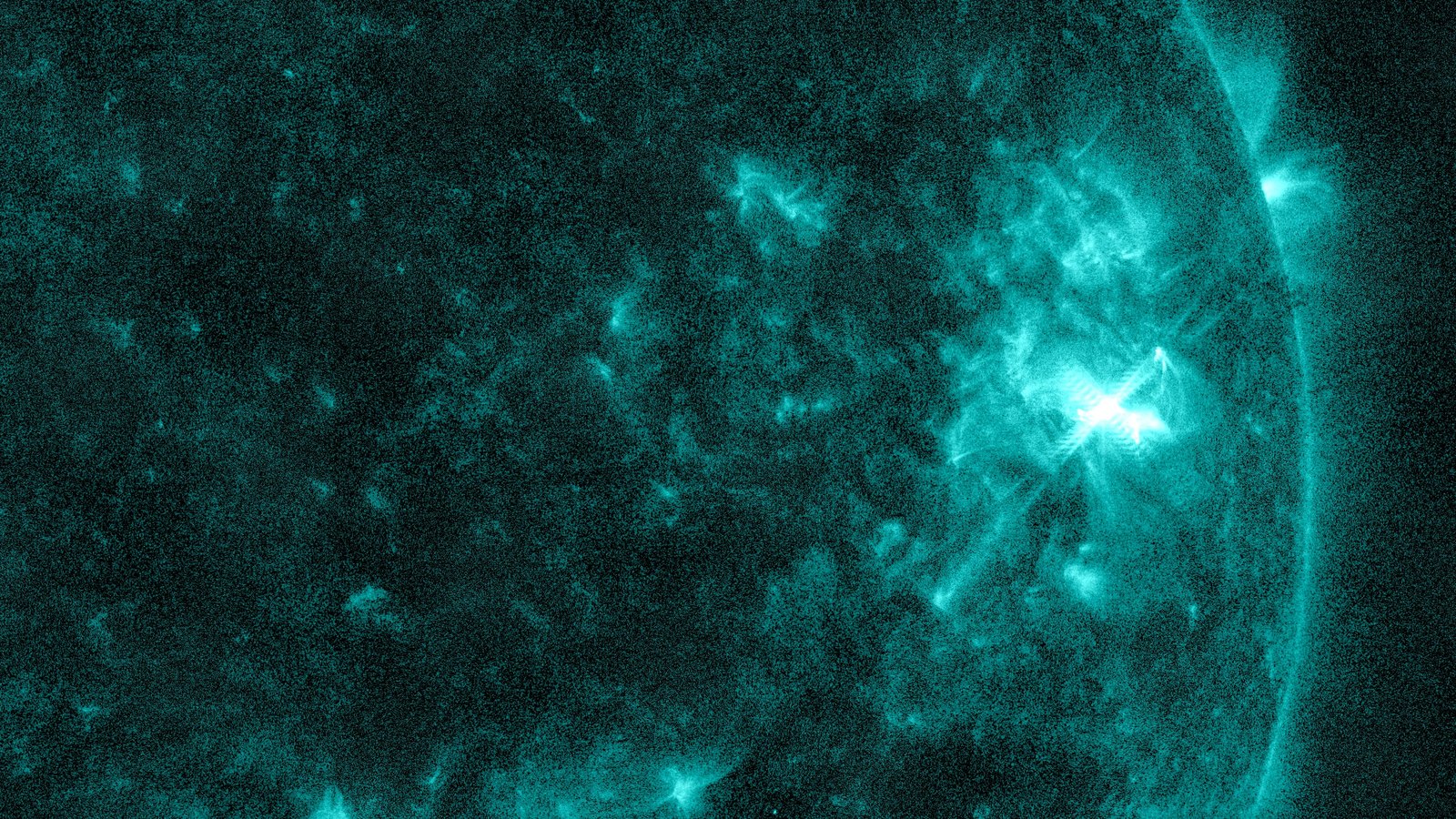
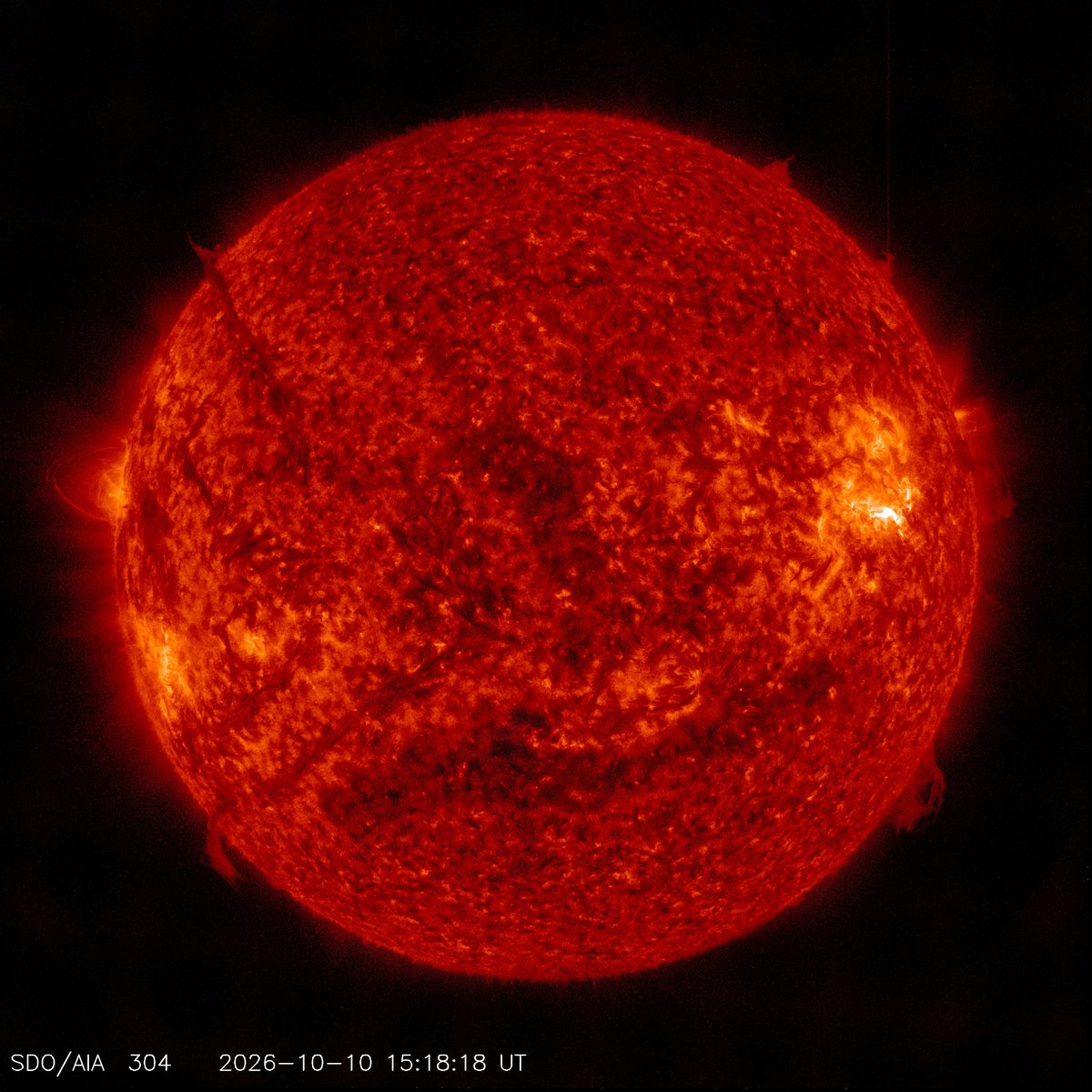
While Earth was absorbing one storm, sunspot Region 4549 produced another strong flare. It was an M6.4 that peaked at 11:10 a.m. ET Saturday, NOAA reports, causing an R2 (Moderate) radio blackout on the sunlit side of Earth. It's the same region behind Thursday’s M6.7.
A cloud followed. NASA’s DONKI database describes a CME seen in SOHO and NOAA coronagraphs “with a full halo shock,” meaning material appeared to spread all the way around the Sun as seen from Earth. That's often a sign some of it is headed our way. NOAA also reported a radio burst that suggested a shock moving about 929 km/s.
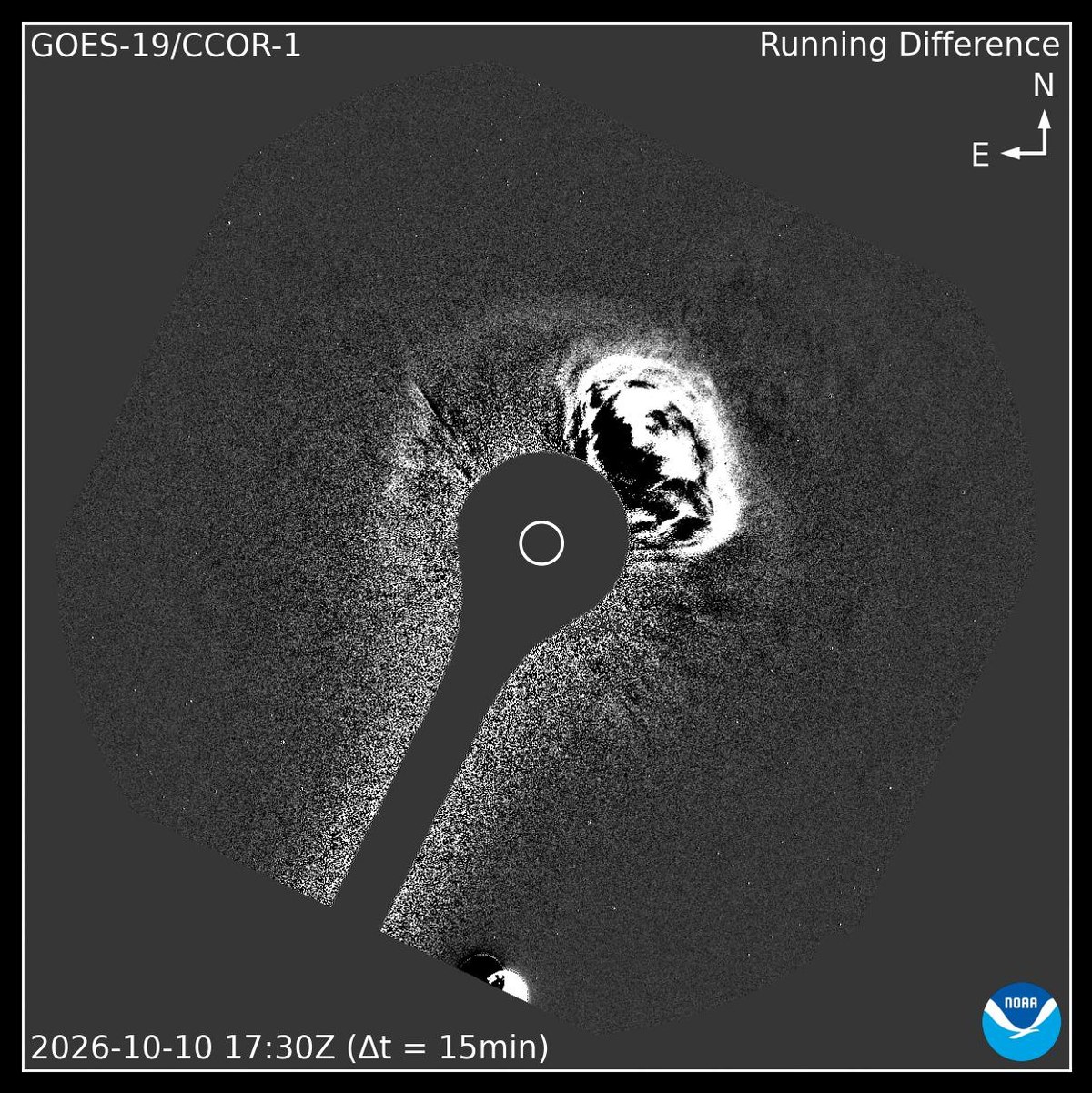
When, or whether, it arrives is still preliminary. NOAA hasn’t published an arrival forecast for it yet; after tonight, its 6:05 p.m. Kp forecast shows no further storm levels through Oct. 13. NASA’s early model runs disagree with each other. We’ll update when NOAA weighs in.
NOAA and the Air Force give a 15% chance of an X-class flare on each of Oct. 11 and 12, and 65% for more M-class flares.
For background, our story on Thursday’s M6.7 flare and our northern lights viewing guide both carry updated notes.
After a week of near misses, Earth finally caught one. If the clouds clear and the field tips south again tonight, the best part may still be ahead.
No Ground. Stay curious.